

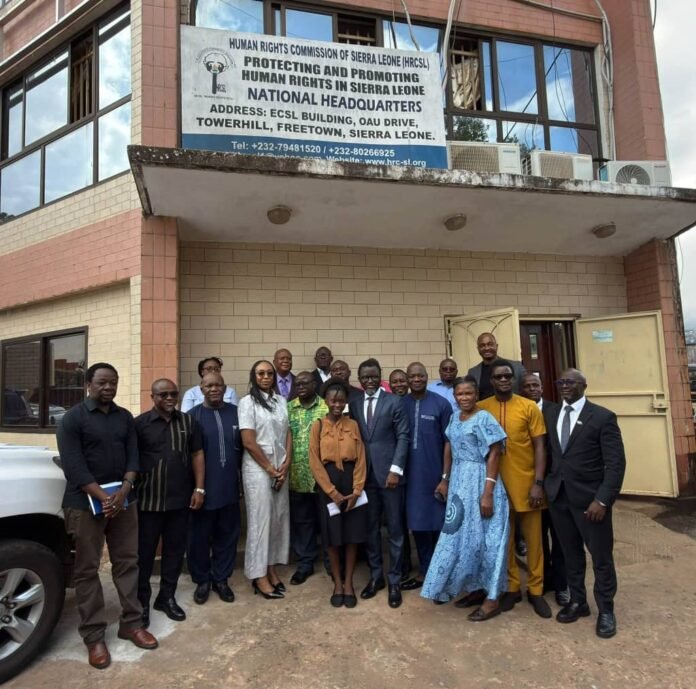
The Human Rights Commission of Sierra Leone (HRCSL) hosted a high-level follow-up engagement with the All People’s Congress Party (APC) and the Independent Commission for Peace and National Cohesion (ICPNC) at Tower Hill, focusing on the implementation of Tripartite Committee Recommendation 29, which tasks HRCSL with monitoring election-related human rights violations and intensifying civic education on electoral rights and responsibilities.
The engagement formed part of ongoing efforts by the Independent Commission for Peace and National Cohesion (ICPNC) to monitor the implementation of recommendations arising from the Agreement for National Unity and the Tripartite Committee on Electoral Systems and Management Bodies.
The engagement, which focused principally on Recommendation 29 of the Tripartite Committee Report, provided an opportunity for stakeholders to review progress made, discuss institutional challenges, and identify practical measures to strengthen collaboration ahead of future electoral processes.
HRCSL’S Commissioner of Oversight for Complaints, Investigations and Legal Services, Hassan Samba Yarjah, welcomed the delegations, describing the engagement as an important platform for constructive dialogue aimed at strengthening Sierra Leone’s democracy.
He expressed gratitude to ICPNC for facilitating continuous stakeholder engagement, and reaffirmed the Commission’s commitment to impartiality, independence, and professionalism. He highlighted the Commission’s newly developed position paper on the Constitution (Amended) Act, 2025, as a contribution toward electoral justice and inclusivity.
Vice Chairperson for the Human Rights Commission (HRCSL), Victor Idrissa Lansana, provided a historical overview, tracing the Commission’s evolution from constitutional recommendations in the late 1970s through the 1999 Lomé Peace Agreement and the 2004 TRC report, culminating in its establishment in 2004. He clarified that HRCSL has consistently monitored elections before, during, and after polling, contrary to concerns raised and has produced comprehensive reports covering violence, voter participation, security conduct, and post-election developments. He also stressed that institutional effectiveness depends on adequate investment, security of tenure, professional capacity, and operational independence.
He further highlighted several initiatives already undertaken by the Commission to promote peaceful elections, including capacity-building programmes for election monitors, nationwide deployment of observers during elections, civic education campaigns, public hearings on election-related human rights complaints, youth engagement programmes and continuous human rights training for security sector institutions.
“Sustained investment in democratic institutions remains essential if they are to effectively discharge their constitutional responsibilities. Public institutions are often criticized for underperformance despite receiving limited support, but institutional effectiveness depends largely on adequate investment, security of tenure, professional capacity and operational independence” he concluded.
ICPNC Executive Secretary Madam Hawa Samai emphasized that the meeting fulfilled ICPNC’s mandate to monitor progress on the Agreement for National Unity and the Tripartite recommendations, to review HRCSL’s progress, identify challenges, and strengthening institutional cooperation for peace and democracy.
The APC delegation led by Dr Kelfala Marrahawareness welcomed the Commission’s work but raised concerns about the visibility of election monitoring reports and called for stronger public awareness of electoral rights. He noted that elections often see allegations of abuses involving political actors and security agencies, urging HRCSL to intensify engagement with police, political parties, and the public to prevent violence and build confidence. He framed the engagement as a bipartisan effort to strengthen institutions and not assign blame.
APC’s Boniface Ndiki Kamara called for greater national unity, urging political leaders and citizens to place Sierra Leone’s national interest above political, ethnic, and regional considerations, stressing that sustainable peace depends on collective commitment to constitutional governance and accountability.
HRCSL acknowledged that while its mandate has expanded significantly, financial, logistical, and human resources remain inadequate, citing limited budgets, insufficient staffing, and lack of specialized election monitors as major constraints affecting mandate delivery.
The engagement climaxed with the following action points:
· HRCSL to develop a comprehensive position paper outlining resource requirements for implementing Recommendation 29, to be used for advocacy and fundraising.
· APC to support HRCSL’s resource mobilization efforts through parliamentary channels and engagement with international development partners.
· APC to continue discussions with the Commonwealth Secretariat and UNDP regarding technical support for electoral reforms, and facilitate similar support for HRCSL where needed.
· HRCSL to continue engagement with the Sierra Leone Police, political parties, and the wider public to prevent electoral violence and build confidence in democratic processes.
Government and development partners to continue providing stronger financial and technical support to public institutions to enable effective discharge of constitutional responsibilities.
The discussion further reflected on broader governance challenges, including persistent political polarization and limited civic participation, with all parties agreeing that sustained investment in democratic institutions is essential for Sierra Leone’s democratic future.