
By Alpha Amadu Jalloh
For many Africans, Senegal was supposed to become proof that politics could still produce honest leadership. Not recycled politicians. Not military strongmen disguised as democrats. Not businessmen purchasing power through influence and foreign alliances. But ordinary men who understood the state, understood corruption, understood manipulation and promised to expose the lies that buried generations beneath debt, poverty and hopelessness.
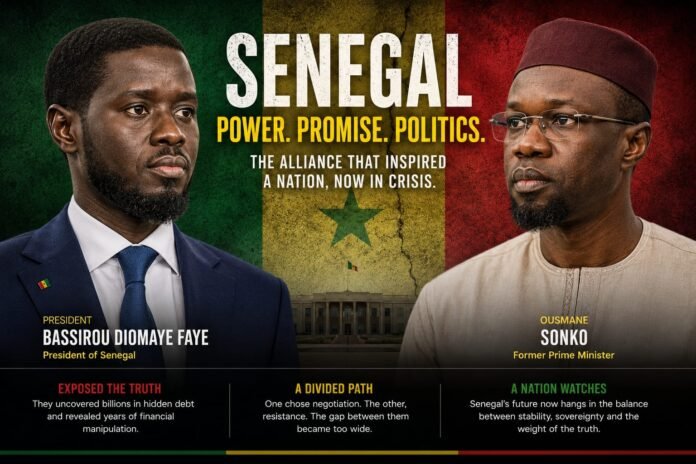
Bassirou Diomaye Faye and Ousmane Sonko became symbols of resistance across Africa. Two former tax inspectors who understood numbers, state systems and the dangerous gap between what governments announce publicly and what is actually happening behind closed doors. When they emerged from prison and defeated the political establishment in Senegal, millions across Africa celebrated. Young people especially saw themselves in that victory. It was no longer only about Senegal. It became a continental emotional moment. It gave Africans something dangerous and beautiful again called hope.
Hope that the system could still be challenged. Hope that ordinary citizens could defeat entrenched political machines. Hope that honesty could survive modern African politics.
Today, that alliance lies broken.
President Bassirou Diomaye Faye has dissolved the government and removed Prime Minister Ousmane Sonko from office. To outsiders, it may appear like an ordinary political disagreement between two ambitious men. But beneath this political separation lies something far deeper and far more dangerous. What happened in Senegal is not merely about personalities. It is about the brutal collision between revolutionary politics, economic survival and the unforgiving realities of global finance.
Perhaps this is the tragedy Africa continues repeating.
We produce leaders capable of fighting for power, but governing after victory becomes an entirely different battlefield.
When Faye and Sonko entered office, they reportedly did what experienced auditors naturally do. They opened the books. What they allegedly discovered shocked both Senegal and the international financial community. Public debt figures had reportedly been hidden or underreported under the previous administration of Macky Sall. Deficits were allegedly manipulated. Liabilities were concealed. Senegal’s image as a rising economic success story was carefully maintained while deeper financial problems quietly expanded beneath the surface.
This is where the Senegalese crisis becomes important for the entire African continent.
Because the problem was not merely the debt itself. The problem was the exposure of the debt.
There is something deeply ironic about modern international politics. Governments can survive comfortably while hiding economic realities, but the moment transparency appears, punishment begins immediately. Investors panic. International lenders become nervous. Financial programs freeze. Credit access tightens. Citizens begin suffering for truths they never created.
That is the trap Senegal appears to have entered.
The previous administration allegedly benefited from presenting Senegal as stable, attractive and financially disciplined. But the new government inherited the consequences after choosing transparency. Suddenly, the same truth that should have been rewarded became a national burden.
And this raises one painful question for Africa.
What should governments do?
Tell the truth and risk economic instability?
Or hide the truth and continue deceiving citizens?
This contradiction now sits at the center of modern African governance.
Faye and Sonko eventually reached different conclusions.
President Faye appears to have chosen pragmatism. Restore confidence. Reengage the IMF. Negotiate new agreements. Accept painful economic adjustments and stabilize Senegal before matters worsen further. In simple terms, he appears to believe survival must come before ideological confrontation.
Sonko represented something emotionally powerful to many Africans. Resistance. Sovereignty. Refusal to surrender African dignity before international financial institutions. His language resonated because many Africans genuinely believe institutions like the IMF often arrive with conditions that punish ordinary citizens while protecting the broader global financial system.
And to be fair, Africa remembers.
Structural adjustment programs across the continent left scars that still exist today. Fuel increases. Currency collapses. Removal of subsidies. Public suffering disguised as economic correction. Many African citizens therefore instinctively understand Sonko’s resistance because they have seen these stories before.
But revolution sounds different once governing begins.
Markets react emotionally to instability. Investors react to uncertainty. Governments still need money to function. Salaries must be paid. Hospitals must operate. Fuel must enter the country. Debt obligations must be serviced. Citizens still expect food, transport, electricity and stability regardless of political speeches.
That is where political romance collides violently with governing reality.
A revolutionary movement can unite easily against a common enemy, but governing requires agreement on painful decisions. Eventually the cracks inside the alliance became visible. The disagreement over fuel subsidies reportedly became one of the defining fault lines between both men. Senegal’s Finance Ministry allegedly pushed for fuel price increases to satisfy economic conditions linked to IMF negotiations while Sonko resisted.
Economically, Faye may have viewed compromise as unavoidable.
Politically and ideologically, Sonko may have viewed compromise as surrender.
Somewhere between those two positions, the alliance collapsed.
What happened in Senegal should concern every African nation because the continent increasingly faces the same dangerous pressures. Massive public debt. Youth unemployment. Rising anger among citizens. Dependence on external financing. Increasing costs of living. Declining trust in political elites. African governments today are trying to satisfy international lenders while simultaneously calming frustrated populations at home.
That balancing act is becoming harder every year.
One economic shock can destabilize an entire administration. One debt crisis can destroy years of political goodwill. One unpopular economic reform can transform heroes into villains overnight.
Senegal therefore becomes more than a national political crisis. It becomes a warning sign for future African reform movements.
Because revolutionary leaders often enter power united by opposition, but once governing begins, ideology and pragmatism start fighting each other internally.
Who compromises?
Who resists?
Who protects sovereignty?
Who protects economic stability?
Sometimes there is no clean answer.
That is why many Africans will likely sympathize with both men simultaneously.
Some will support President Faye because governments cannot operate emotionally. States must negotiate. Institutions must survive. Economic collapse punishes ordinary citizens first before politicians.
Others will support Sonko because Africa’s frustration with external economic control remains deeply emotional and historically rooted. Many Africans are tired of leaders campaigning with revolutionary language only to become administrators of international financial discipline once they enter office.
Perhaps both sides carry uncomfortable truths.
That is what makes this situation painful.
Senegal was viewed as one of Africa’s democratic success stories. A country respected for institutional stability and relatively peaceful political transitions. The rise of Faye and Sonko was supposed to deepen that democratic hope. Instead, their separation now exposes how difficult genuine reform becomes once leaders inherit wounded economies and international financial obligations.
It is easier to expose corruption than to repair economic damage accumulated over years.
It is easier to mobilize angry youth than to manage national debt.
It is easier to promise sovereignty than to finance a state without external dependence.
Yet Africans continue demanding leaders capable of somehow doing all three simultaneously.
This political divorce between Faye and Sonko may now reshape Senegalese politics for years. Sonko still commands enormous public loyalty. His support was never artificial. He represents the frustrations of a generation exhausted by elite politics, dependency and economic humiliation.
President Faye meanwhile now carries the heavy burden of proving that pragmatism can stabilize Senegal without destroying the ideals that brought them to power.
That may become the greatest test of his presidency.
Can he stabilize the economy without appearing captured by international institutions?
Can he negotiate externally while maintaining domestic trust?
Can Senegal avoid becoming another African country where revolutionary hope eventually dissolves into public disappointment?
Those questions now hang heavily over Dakar.
But beyond Senegal, Africa itself must reflect honestly.
We cannot continue building political movements entirely around anger without preparing seriously for governance. We cannot celebrate revolutionary victories without understanding the brutal economic realities waiting behind presidential gates.
Power changes everything.
The opposition speaks emotionally. Government speaks financially.
And sometimes the same men who once stood side by side against injustice eventually discover that governing a wounded state forces impossible choices.
Perhaps that is the real tragedy of Senegal today.
Two men who promised to tell the truth finally did.
And the truth itself may have destroyed the alliance that brought them to power.