

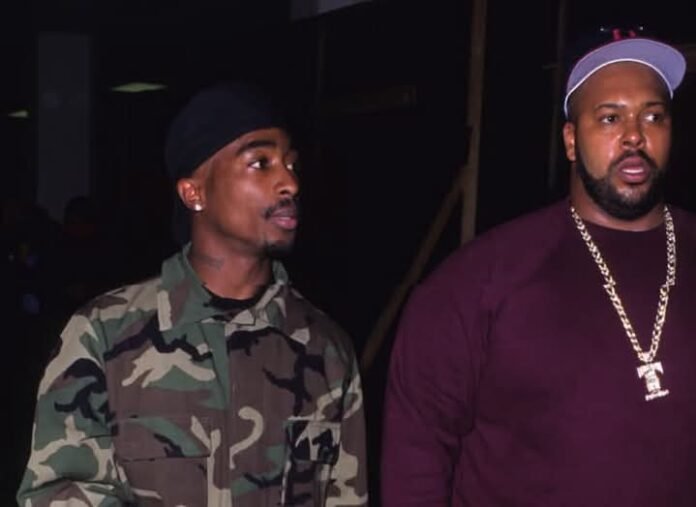
Suge Knight, a longtime friend and associate of late rapper Tupac Shakur, has claimed that the rapper’s ashes were smoked following his cremation.
According to TMZ, Knight made the revelation while discussing what happened after Tupac’s death in 1996.
Tupac was fatally wounded in a drive-by shooting in Las Vegas and died six days later after being placed on life support.
Knight said he began making arrangements for Tupac’s cremation by contacting a worker at a funeral home. He claimed the individual initially refused his request, but after several attempts, Knight said he went to the worker’s home and offered him $200,000, along with an additional $1 million in cash.
Knight said that after Tupac’s ashes were collected, the rapper’s mother invited a group of people to the hotel where she was staying in Las Vegas. According to Knight, they rolled the ashes into blunts and smoked them.
Knight added that he did not participate because he was on probation at the time and feared that smoking would violate the conditions of his release.
The revelation comes as the long-running legal case over Tupac’s killing moves forward in Las Vegas, where the trial of Duane “Keffe D” Davis has begun nearly three decades after the rapper’s death.
Davis, a former Los Angeles-area gang leader, was arrested in September 2024 and has pleaded not guilty to a murder charge involving the use of a deadly weapon in connection with gang activity.
During the trial, prosecutor Binu Palal alleged that Davis had intense anger toward Tupac following an earlier confrontation involving Orlando “Baby Lane” Anderson, Davis’ nephew.
Palal argued that Davis obtained a firearm and handed it to Anderson, who allegedly used it to shoot at Tupac’s vehicle in Las Vegas.
Palal also argued that the case remained unsolved for years because of a culture of silence within gangs, saying that “silence means survival.”
He maintained that Davis was unable to maintain that silence, pointing to interviews and a book in which Davis allegedly discussed his involvement in the events surrounding the killing.
Davis’ defence attorney, Michael Sanft, rejected the prosecution’s account, arguing that Palal had presented what he described as “fictional details as fact.”
Sanft also questioned the police investigation into Tupac’s murder and challenged the evidence being presented against his client.
Tupac, regarded as one of the most influential figures in hip-hop history, was 25 when he was killed.