
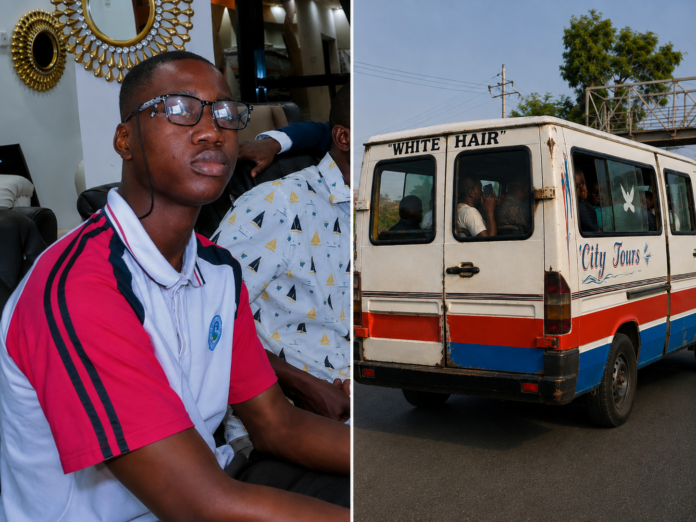
By George Ojuku Momoh
I write this piece not merely as a writer, but as an angry and concerned citizen worried about the direction in which Sierra Leone’s public transport system is heading.
Transport fares continue to rise, yet the condition of many of the vehicles carrying citizens from one place to another remains deplorable. Passengers pay more but are too often transported in vehicles that are overcrowded, poorly maintained, dirty, mechanically defective and, in some cases, potentially dangerous.
If this is the condition of public transport today, what will it look like ten years from now if nothing changes?
On 29 August 2026, at around 6 a.m., I boarded a poda-poda expecting nothing more than a safe journey to my destination. I did not know that what I was about to witness would compel me to write this article.
Shortly after the vehicle started moving, there was a heavy downpour. That was when the true condition of the minibus revealed itself.
The roof was leaking badly. Rainwater poured into the vehicle, leaving some passengers struggling to protect themselves. One male passenger became so uncomfortable that he had to stand and manoeuvre himself inside the moving vehicle simply to avoid getting soaked.
That was not all.
The boot of the vehicle was apparently defective and could not remain properly secured. As it moved unexpectedly, anxiety spread among the passengers. What should have been an ordinary morning journey became another reminder of the risks Sierra Leoneans routinely accept simply because they need to get to work, school, the market or their businesses.
That experience forced me to ask a disturbing question: Have we normalized unsafe public transportation?
Across Sierra Leone, poorly maintained vehicles operate every day carrying hundreds of thousands of people. Some drivers and vehicle owners appear more concerned with collecting passengers and fares than ensuring that the vehicles entrusted with human lives are roadworthy, clean and safe.
This should not be treated as a minor inconvenience. It is a public safety, public health and governance issue.
The institutions responsible for road safety and public transportation must therefore answer some difficult questions. How are vehicles that are visibly defective allowed to continue carrying passengers? How rigorous and transparent are roadworthiness inspections? How frequently are commercial vehicles checked? And what happens when a vehicle fails to meet the required safety standards?
The responsibility does not belong to drivers alone. Vehicle owners, transport unions, traffic enforcement agencies, regulatory authorities and government institutions all have roles to play. Where enforcement is weak, corruption or negligence can turn a mechanical defect into a death sentence.
The consequences are already visible.
Poorly maintained vehicles increase the risk of road accidents, causing injuries, disabilities and deaths that might otherwise have been prevented. Passengers endure torn or dirty seats, leaking roofs, overcrowding, offensive smells and other unhealthy conditions. Badly maintained engines and exhaust systems can produce excessive smoke, contributing to air pollution, while defective exhausts and engines add unnecessarily to noise pollution.
Overloaded vehicles can also contribute to road deterioration, while oil leaks and other mechanical problems damage the environment. Beyond these immediate consequences, the appearance and condition of public transportation contribute to the image visitors form of the country.
But there is an even bigger question.
What happens if we continue like this for another ten years?
By 2036, Sierra Leone will have a larger population, greater urban congestion and an even greater demand for mobility. If investment, regulation and enforcement do not keep pace with that growth, today’s inconvenience could become tomorrow’s transport crisis.
More defective vehicles will mean greater risks on increasingly congested roads. More pollution will affect urban health and the environment. More overcrowding will diminish the dignity of passengers. And a culture in which citizens simply accept dangerous transportation as “normal” will become even harder to reverse.
We cannot build a modern country on a public transport system held together by improvisation.
There is also the troubling issue of corruption. Allegations of corruption involving some traffic officers and enforcement personnel cannot simply be ignored. If an unroadworthy vehicle can remain on the road because regulations are not enforced—or because enforcement can somehow be negotiated—then corruption ceases to be merely an ethical problem. It becomes a threat to human life.
Every defective brake allowed onto the road is a potential accident.
Every dangerously worn tyre overlooked is a potential tragedy.
Every unsafe commercial vehicle permitted to carry passengers represents a failure of regulation.
This is why I call upon the Sierra Leone Road Safety Authority, the Ministry responsible for transport, public transport authorities, the police and traffic enforcement agencies, transport unions, the Ministry of Health, civil society organisations and all institutions concerned with public safety to treat the condition of commercial transportation with the seriousness it deserves.
There should be rigorous and regular roadworthiness inspections. Commercial vehicles that fail basic safety standards should not be permitted to carry passengers until the defects are corrected. Drivers and vehicle owners must also understand that collecting fares comes with an obligation: the lives they carry are more valuable than the money they collect.
Citizens, too, must stop accepting dangerous conditions as an unavoidable part of life. Leaving everything “in the hands of God” cannot become an excuse for human negligence. Faith does not absolve institutions of responsibility, nor does it excuse drivers from maintaining vehicles entrusted with the lives of passengers.
A nation reveals something about itself by how it moves its people.
Public transportation is not merely about vehicles and fares. It is about safety. Health. Dignity. Productivity. Regulation. Development. And ultimately, human life.
Ten years from now, Sierra Leone will either look back at this period as the moment it began transforming public transportation, or it will confront the consequences of another decade of neglect.
The choice is ours.
And the time to make it is now.
This is not merely an article. It is a call to action.
Written by: George Ojuku Momoh
@George the invisible writer
Author|Poet|Writer|Activist