

By Hassan Solokoh Bockarie
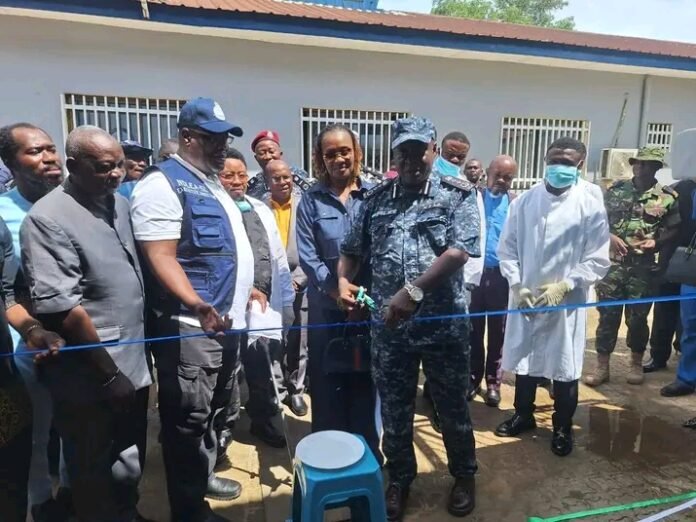
The Sierra Leone Police has strengthened the country’s fight against transnational organised crime with the commissioning of a state-of-the-art Transnational Organised Crime Unit (TOCU) Forensic Laboratory at Hastings, a development expected to significantly improve the investigation and prosecution of drug-related offences.
The facility was officially commissioned by the Inspector General of Police, William Fayia Sellu, who described the laboratory as a landmark investment in modern policing and a critical tool for securing successful convictions through scientific evidence.
Delivering the keynote address, IGP Sellu said the establishment of the forensic laboratory represents a major milestone in strengthening Sierra Leone’s criminal justice system, particularly in combating drug trafficking and other forms of transnational organised crime.
“Today we are commissioning a very important aspect of the investigation of transnational organised crime, particularly drug-related offences. For us to secure convictions in court, we must present scientific evidence that is indisputable,” the Police Chief said.
He noted that forensic evidence has become indispensable in criminal investigations, stressing that no drug-related prosecution can succeed without certified laboratory analysis confirming the nature of seized substances.
The Inspector General praised the commitment and professionalism of the Sierra Leone Police forensic experts, with special recognition for Assistant Superintendent of Police Stephen, whose technical expertise, he said, has become an integral part of the country’s criminal justice process.
Reaffirming his commitment to strengthening the forensic unit, IGP Sellu assured personnel that the Police leadership would continue to provide the logistical, infrastructural and technical support required to ensure the laboratory operates at optimum capacity.
“Whatever you need to make this laboratory more functional, let me know. I will support every project that adds value to the Sierra Leone Police,” he assured.
Highlighting the country’s growing success in tackling organised crime, the Inspector General attributed the achievements to strong teamwork and collaboration among security institutions.
“If Sierra Leone is being recognised as one of the safest countries in West Africa, it is because of what we have achieved together as a team,” he said.
The Police Chief further disclosed that the Sierra Leone Police is pursuing international partnerships aimed at enhancing forensic expertise through specialised training opportunities. He revealed ongoing engagements with the Chinese, Indian, Turkish and Egyptian diplomatic missions to facilitate advanced training for Sierra Leonean officers in forensic science and drug analysis.
He also commended the police forensic unit for training officers across all six administrative regions to conduct preliminary drug analysis, describing the initiative as a significant step towards decentralising forensic services nationwide.
Providing an update on the national anti-drug campaign, IGP Sellu disclosed that the inter-agency task force led by the National Drug Law Enforcement Agency has secured 129 convictions in drug-related cases across the country.
He said regular progress reports on the campaign are submitted to Julius Maada Bio, whom he described as unwavering in his commitment to combating narcotics trafficking and organised crime.
Also addressing the ceremony, the Director of Crime acknowledged the progress achieved but cautioned that organised crime and illicit drug trafficking continue to pose serious national security challenges.
He stressed that while current interventions are commendable, stronger institutional coordination, enhanced operational capacity and greater community participation remain essential to sustaining the gains already made.
The Director commended development partners and the Sierra Leone Police for supporting personnel development through virtual training and other capacity-building programmes, which he said have improved professionalism and promoted rights-based policing.
He urged all stakeholders to remain united, adapt to evolving security threats and continue working collaboratively to deliver effective policing services across Sierra Leone.
In his remarks, the Executive Director of the National Drug Law Enforcement Agency, Andrew Jaiah Kaikai, described the commissioning of the forensic laboratory as a landmark achievement in Sierra Leone’s campaign against illicit drugs.
He said the facility would significantly strengthen the Agency’s investigative and prosecutorial capabilities by providing timely, credible and internationally recognised forensic evidence.
Kaikai commended the strong collaboration between the National Drug Law Enforcement Agency, the Sierra Leone Police and other security institutions, noting that dismantling organised drug trafficking networks requires sustained partnerships, intelligence sharing and coordinated law enforcement operations.
He reaffirmed the Agency’s commitment to working closely with national and international partners to strengthen prevention initiatives, disrupt criminal networks and protect communities from the devastating effects of illicit drugs.
The commissioning of the TOCU Forensic Laboratory marks another significant investment in Sierra Leone’s criminal justice system and is expected to enhance the country’s capacity to investigate, prosecute and deter transnational organised crime while reinforcing public confidence in law enforcement institutions.