

By Hassan Solokoh Bockarie
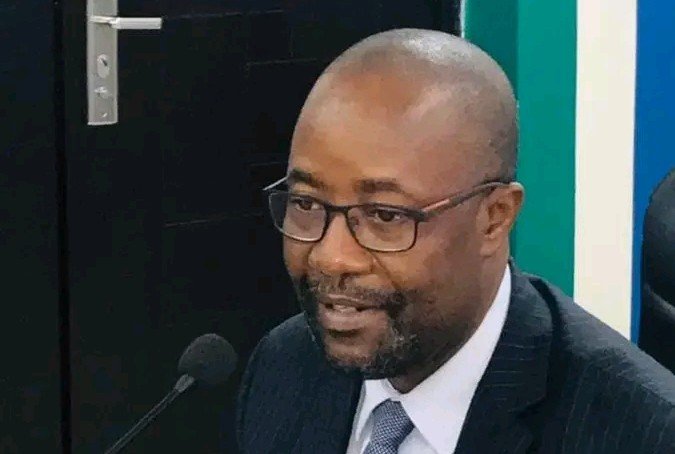
Minister of Employment, Labour and Social Security, Mohamed Rahman Swaray, has reaffirmed the government’s commitment to protecting workers’ rights, expanding social protection, and preparing Sierra Leone’s workforce for the rapidly evolving digital economy.
Delivering his statement during this year’s International Workers’ Day celebration, Minister Swaray highlighted a series of landmark reforms aimed at creating a fairer, safer, and more inclusive labour market.
He noted that the commissioning of a 3,000,000-metric-tonne annual capacity industrial plant represents a significant milestone for Sierra Leone’s economy. According to him, the investment will generate thousands of jobs, stimulate local enterprise, and directly benefit more than 60 percent of the country’s population.
“Development is not merely about impressive statistics,” the minister declared. “It is about improving lives, expanding opportunities, and building a more prosperous future for all.”
Addressing the theme of the changing global labour landscape, Swaray observed that artificial intelligence, digital platforms, and automation are transforming industries at an unprecedented pace. While these technological advancements present immense opportunities, he cautioned that they also pose risks, including job displacement, growing inequalities, and precarious employment, particularly within informal and platform-based economies.
He stressed that workers must be empowered with strong rights, social protection, and a voice in decision-making if Sierra Leone is to successfully navigate the transition to a green and digital economy.
The minister also recalled Sierra Leone’s recent hosting of the inaugural African Labour Ministers’ Meeting in Freetown, which brought together labour leaders and policymakers from across the continent to discuss the future of decent work in the platform economy.
He described the gathering as a major step toward fostering stronger tripartite cooperation among government, employers, and workers.
Under the leadership of President Julius Maada Bio, Swaray said, the government has implemented sweeping reforms to improve the welfare of workers and promote inclusive economic growth.
Among the key achievements highlighted was the increase in the national minimum wage, following extensive consultations with organized labour and employers.
He further announced that the government is preparing to launch an Informal Sector Pension Scheme, which will provide pension and social protection coverage for traders, artisans, market women, bike riders, fishermen, and other self-employed citizens.
Additionally, Swaray revealed that plans are underway to establish a National Employee End-of-Service Benefit Trust Fund to guarantee workers receive their full benefits upon retirement or separation from employment.
The minister also pointed to the successful digitalization of the country’s work permit process, which became fully operational in January 2026, improving efficiency, transparency, and accountability.
He disclosed that the ministry is reviving the Trade Testing Unit to formally recognize skills acquired through informal learning while strengthening labour inspections to ensure safer working environments.
In a major legislative push, Swaray announced that two critical bills—the Occupational Safety and Health Bill and the Workers’ Compensation Bill—will soon be presented to Parliament.
“No job should ever cost a worker their health, their life, or their future,” he emphasized.
Minister Swaray called on workers, employers, development partners, and the informal sector to embrace collaboration in building a resilient and future-ready labour market.
He urged employers to view fair labour practices not as a cost, but as an investment in sustainable business and social stability, while encouraging workers and unions to continue engaging constructively with government.
To those in the informal sector, he delivered a clear message: “You are not on the margins; you are central to our economy.”
As Sierra Leone marked International Workers’ Day, the minister renewed the government’s commitment to building workers’ power through unity, partnership, and shared prosperity.
“Together, government, workers, employers, and partners can build a future founded on dignity, prosperity, and hope,” he concluded.