
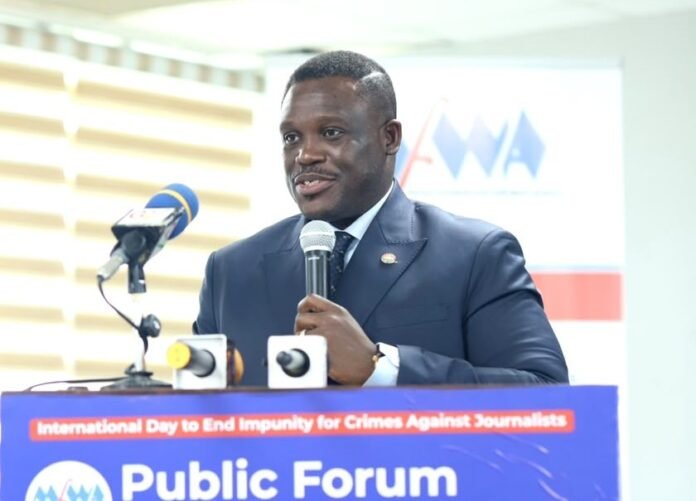
Ghana’s Minister for Communication, Digital Technology and Innovations, Samuel Nartey George, has underscored the government’s unwavering commitment to protecting media freedom, declaring that the state will pursue individuals who attack journalists regardless of their status or uniform.
Delivering the keynote address at a public forum organized by the Media Foundation for West Africa (MFWA) on the theme “Ending Impunity for Crimes Against Journalists in Ghana: Strengthening Safety, Accountability and Press Freedom,” the Minister emphasized that a free and independent press remains the lifeblood of any thriving democracy.
The high-level event, which coincided with the International Day to End Impunity for Crimes Against Journalists, also had the official launch of the Model Safety of Journalists Policy, designed to provide media institutions with a practical framework for physical, digital, legal, and psychological protection.
Highlighting Ghana’s democratic strides, Hon. George noted that the country climbed to 39th out of 180 countries in the 2026 World Press Freedom Index, up from 52nd the previous year, securing the fourth position in Africa.
He attributed the improvement to a deliberate governmental posture favoring openness, engagement, and accountability under the administration of President John Dramani Mahama.
However, the Minister acknowledged that challenges persist, pointing to recent reported incidents of assaults against media personnel.
He stressed that impunity creates an environment conducive to further attacks, asserting that accountability requires prompt reporting, impartial investigations, regular updates to victims, and decisive prosecution where warranted.
”No uniform, no office, no party card and no private influence should place anyone above the law,” the Minister stated, reaffirming that the state will not tolerate violence against media professionals performing their public duties.
Opening the forum, the Executive Director of the Media Foundation for West Africa, Mr. Sulemana Braimah, underscored the urgency of addressing safety concerns within the West African sub-region.
He pointed to regional data showing a worrying rise in violations against media workers and stressed that fighting impunity is an essential prerequisite for safeguarding the public’s right to information.
While calling on law enforcement and state institutions to ensure swift justice for victims, Hon. George also addressed the responsibilities within the media fraternity itself. He urged media owners, editors, and journalists to uphold high ethical standards, enforce self-regulation, correct errors transparently, and rigorously distinguish verified investigative reporting from unverified partisan claims.
Mr. Braimah explained that the newly launched Model Safety Policy offers media organizations structured guidelines, including risk assessments, emergency protocols, and designated safety officers, to better protect field reporters, correspondents, and online journalists.
He also highlighted ongoing initiatives by the foundation, such as legal support funds and networks of media defense lawyers, aimed at assisting journalists facing legal intimidation or threats.
The forum concluded with a renewed multi-stakeholder consensus involving the government, security agencies, civil society, and media leadership to continuously monitor safety gaps, track ongoing investigations, and ensure that press freedom in Ghana remains both proclaimed and robustly protected.