

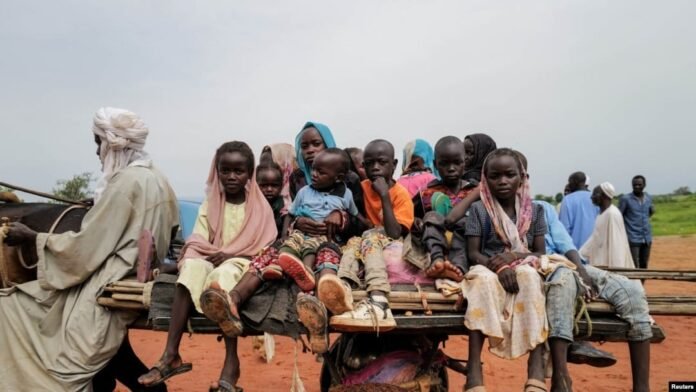
Living conditions for citizens in Sudan are deteriorating as a result of the war that erupted in mid-April 2023 between the army and the Rapid Support Forces, with no hope currently of achieving a humanitarian truce.
The calculations of the war between the two sides of the conflict, and the intersection of regional and international interests, are secondary matters inside Sudan, where the people are suffocating under deteriorating living conditions and exorbitant price increases.
Popular discontent in Sudan has intensified following demonstrations in the city of Gedaref in protest against deteriorating economic conditions and the rising cost of living, amid new calls for unified demonstrations in other states.
The fuel crisis has sharply worsened in the Sudanese capital, Khartoum, and several Sudanese cities, amid record price increases and a total shortage of petroleum products at many official distribution stations.
In the capital, Khartoum, Sudanese citizen Sami Al-Tayeb stands in line with hundreds of other citizens to refuel, a process that requires a long time, potentially costing them their work and business, illustrating the severity of the crisis facing Sudan.
Speaking to “Radio Tamazuj,” he described the seriousness of the deteriorating conditions and the surprise he encountered while waiting at the filling station, explaining: “As citizens, we did not understand the reason for the increase, and the price changed while I was standing in the gasoline line, from 29 pounds to 35 pounds.”
“Angry Ones”
In a dangerous escalation, the revolutionary “Angry Ones” movement, one of the youth organizations active in the September movement, called for an escalation of protests and their expansion across the states.
The movement’s official Facebook page wrote: “The rest of the states will join Gedaref on Thursday, September 25,” referring to a call for a central demonstration on that day. Observers, meanwhile, believe that the new calls for demonstrations come amid growing popular dissatisfaction with the unprecedented rise in the prices of strategic commodities, particularly sugar, flour and fuel, alongside continued political and security instability in the country.
Economic analyst Essam El-Din Khidr described the current fuel crisis as “unprecedented,” noting that it is the result of the accumulation and complexity of the security and economic conditions facing the country. He explained “that the fuel crisis is closely linked to the circumstances of the war and the atmosphere of instability, in addition to large areas of the country falling outside state control and the absence of the role of official institutions, creating a chaotic environment that has affected the efficiency of distribution and oversight.”
The economic analyst attributed “the continued rise in prices and the collapse in the value of the national currency to the severe structural imbalance in the trade balance, as exports have witnessed a sharp decline, covering less than 20% of the country’s needs, as a result of the suspension of most productive, agricultural and livestock activities in regions affected by the war.”
The People Pay the Price for the Army’s Position
Since the outbreak of the war, regional efforts have been underway to curb the conflict and achieve a humanitarian truce, but this has not yet materialized, while army commander Abdel Fattah al-Burhan insists on a military solution despite the humanitarian crisis caused by the war. According to the United Nations, 14 million Sudanese have been displaced, while more than 30 million Sudanese are currently suffering.
Massad Boulos, the US President’s Senior Advisor for Arab and African Affairs, called on Wednesday for the warring parties in Sudan to accept a humanitarian truce in the country.
Boulos wrote on the X platform: “The warring parties in Sudan must accept a humanitarian truce as the first step toward lasting peace.” He added: “The Sudanese people deserve a chance to engage in a political process leading to peace in a unified Sudan.”
The nature of the current conflict shows that Burhan does not care about the suffering of the people or the state, which has become engulfed in chaos. Sudan has now been transformed into an arena for regional and international competition, meaning that these calculations are now controlling the conflict.
Against this backdrop, the moves by Egypt and Saudi Arabia raise many questions about a shift in their approaches to ending Sudan’s bloody war. The two countries have engaged in international mediation efforts, but have politically sided with Burhan, while officials from both countries deny providing military support to the army.
Strikes from Egyptian Territory
Egypt has supported the Sudanese army from the outset, but changed its tactics as a result of developments in Sudan. Reuters revealed last November that a powerful model of Turkish combat drones had been deployed on an airstrip on Egypt’s southwestern border. Satellite images from Vantor, a US company specializing in space technology, showed a large drone on the runway of one of the airports in East Oweinat on September 29, December 28 and January 9.
The New York Times also published images of Akıncı drones at East Oweinat Airport, which it reported were being used to carry out strikes in Sudan.
Riyadh and Red Sea Calculations
Riyadh is no longer merely a mediator between two equal parties, as its political positions have begun to reflect greater interest in Burhan’s camp. The Kingdom of Saudi Arabia had continued to deal with this dangerous and sensitive issue for the Saudi state with limited and insufficient attention, despite its strategic position overlooking the Red Sea and facing Sudan.
The data indicate that Saudi support for Burhan goes beyond the development dimension, forming part of a broader geopolitical strategy aimed at managing regional balances in the Horn of Africa and the Red Sea.
Riyadh treats Burhan as the legitimate representative of the state, particularly since Saudi projects are implemented through ministries under his control in Port Sudan, strengthening his political position and providing him with supportive financial and economic resources.
Meanwhile, Reuters revealed that Saudi Arabia may have mediated a Pakistani arms deal for the Sudanese army worth around $1.5 billion, after which Riyadh requested the cancellation of the deal and informed Islamabad that it would not finance it.
Turkey… al-Burhan’s Aerial Arsenal
Turkey, meanwhile, has emerged as one of the most important foreign parties influencing the course of the Sudanese conflict, throwing its military weight behind the Sudanese army, while hosting in Ankara the Islamist leadership controlling Burhan.
Turkey has exploited the bloody conflict, turning Sudanese territory into a testing ground for the latest technologies of “smart death” and “loitering munitions,” or “suicide drones.”
After Turkey’s costly “Akıncı” aircraft encountered operational difficulties in the field, the army obtained YIHA-III suicide drones, known in Turkish as “Mosquito,” as a cheaper and more flexible option, with costs ranging from $50,000 to $250,000.
Ankara’s military role has expanded through deals worth hundreds of millions of dollars, including the supply of Bayraktar TB2 and advanced Akıncı drones and their control stations. Washington Post revealed through confidential documents that the deals exceeded $120 million in value and contributed to the army’s advances around Khartoum and the city of El Obeid.