

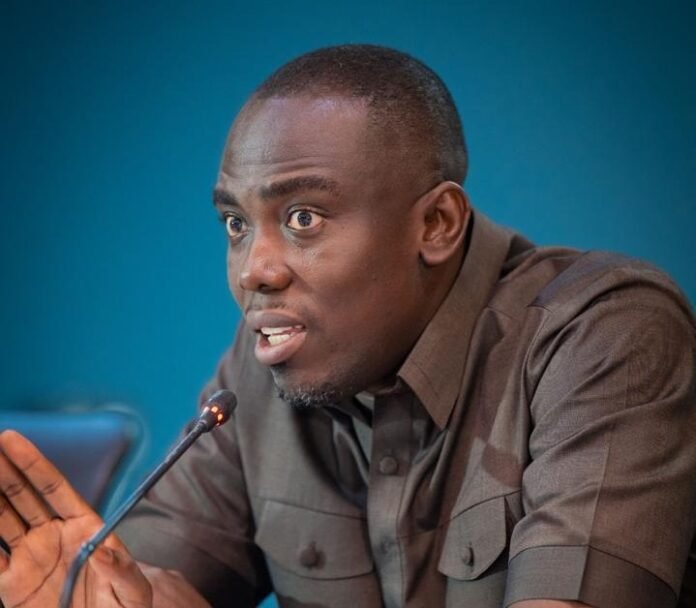
By Akwasi Konadu, Member of Parliament for Manhyia North Connecticut and Deputy Ranking Member of the Parliamentary Committee on Lands and Natural Resources
Ghana is reaching a dangerous point in its long-running battle against illegal mining (Galamsey). The colour of our rivers is changing with turbidity levels becoming unmeasurable. Forests are being degraded, farmlands are disappearing, and communities that once depended on rivers for drinking water and livelihoods are increasingly being forced to find alternatives.
The most disturbing feature of this crisis is not only the destruction itself. It is the growing gap between the political promises made to Ghanaians by the Mahama led 2024 presidential campaign and the reality confronting communities today.
The National Democratic Congress (NDC) came into the 2024 election with emphatic promises on illegal mining. Its manifesto and key members promised that the next NDC government would “wage a ruthless war” against illegal mining and undertake an aggressive programme to reclaim polluted water bodies, degraded lands and devastated forest reserves. As if not sad enough, this position was emphasised a day after the August 6, 2025 helicopter crash that claimed 8 lives by the Hon. Okuzdeto Ablakwa after an emergency cabinet meeting.
Those were powerful words. Ghanaians listened. Communities suffering from galamsey listened. Farmers listened. Chiefs listened. Young people worried about their future listened. But today, the unavoidable question is, where is the ruthlessness promised to Ghana?
Government has announced initiatives and enforcement operations. NAIMOS says it has sustained operations across major galamsey-affected regions, while the lands minister has repeatedly insisted that government remains committed to winning the fight, presumably with tear drops.
Announcements and Press conferences do not restore degraded forests. Statistics do not bring back destroyed livelihoods of farmers who cocoa farms have been illegally excavated for Gold and political declarations do not cleanse polluted water. The test of government is what happens on the ground. And increasingly, the voices coming from communities are deeply troubling.
When Chiefs are forced to become the last line of defence, it tells of a failed Republic. Perhaps the most telling indictment of our national response is that traditional authorities, custodians of ancestral lands and communities are increasingly being pushed to the front line of the anti-galamsey fight.
In Konongo, the Traditional Council resorted to traditional rites in an effort to drive illegal miners away from sites and warned those destroying local water bodies to stop. In Atronie, chiefs have issued stern warnings to illegal miners and declared that their lands and water bodies would not be surrendered to destructive mining. Nananom and the people had to block major roads to protest the severe destruction of local water bodies, loss of farmlands and government inaction.
These actions may be rooted in traditional authority and belief, but the deeper message should concern every Ghanaian. Why should chiefs have to resort to traditional sanctions to defend rivers that are supposed to be protected by the laws of the Republic of Ghana?
Why must traditional authorities confront a menace that the Government possesses the police, military, courts, regulators and appointees to defeat? This is not an argument against traditional authority. On the contrary, the courage being displayed by some chiefs deserves recognition. It is a courage to fight for their very livelihood and the unborn. It is an indictment of a system in which those closest to the destruction sometimes appear more determined to stop it than the president and his government constitutionally empowered to enforce the law.
The situation around the Tano River and other several river bodies provide perhaps the clearest warning. Reports from Tanoso indicate that illegal mining has severely affected the river, with residents saying they have increasingly had to depend on sachet water because the river is no longer suitable for domestic use. And now chiefs and residents in Tano North have petitioned President John Mahama, asking for urgent intervention against illegal mining and the destruction of forests and water resources in the area.
Think about this for a moment. Traditional leaders are petitioning the President to save their own ancestral lands from destruction. The situation is dire. That petition should not be treated as another letter to be received, acknowledged and filed away. It should be treated as an emergency alarm. The President must personally take responsibility for ensuring that the concerns raised by Nananom receive immediate and measurable action.
There is another uncomfortable question. Where is Ghana’s loudest environmental and governance voices? Civil society organisations were once among the most powerful voices challenging illegal mining. Demonstrations were organised. Statements were issued.
Governments were confronted. Accountability was demanded. A ban on all forms of small-scale mining was the mantra.
Today, many Ghanaians perceive a disturbing reduction in the intensity of that pressure. That perception cannot simply be dismissed. Indeed, the criticism has become public. In July 2026, the Ghana Coalition Against Galamsey challenged the government’s assessment of progress and argued that illegal mining remains widespread. Ghana needs more than a call and challenge to the Government’s assessment. Ghana needs the intensity they used to fight galamsey two years ago today.
Civil society must never become courageous only when the political party it opposes is in government. If galamsey was wrong under the previous administration, it remains wrong under the current administration. If polluted rivers were unacceptable yesterday, they cannot become politically convenient today. If the destruction of forest reserves was a national emergency before December 2024, it cannot become a partisan inconvenience afterwards.
The environment has no political party.
The Pra does not flow NPP or NDC.
The Tano does not recognise political colours.
The Birim does not vote.
The forest reserves do not attend party congresses.
Poisoned water does not ask which government polluted it before it enters a community’s life.
The NDC government must be judged by its own promises. It would be intellectually dishonest to pretend that galamsey began with the NDC government. Ghana has struggled with illegal mining for years, under successive administrations. The problem is deeply entrenched and involves miners, financiers, landowners, traditional authorities, political actors, security agencies and other interests.
But that history cannot become an excuse for today’s government. The NDC asked Ghanaians for the mandate to do better. It promised a “ruthless war” against illegal mining. It promised reclamation. It promised protection of water bodies and forests. It called for a total ban on all forms of small-scale mining activities. It therefore must accept scrutiny against the standard it set for itself.
Government cannot simultaneously tell Ghanaians that the fight is being won while communities, chiefs and civil society continue reporting serious destruction on the ground.
If the NDC government genuinely believes that its strategies are working, then it should welcome independent verification.
Publish the data.
Publish the locations of operations.
Publish the number of arrests and prosecutions, not of a selected few for political connivence.
Publish the hectares reclaimed and the associated cost
Publish the water-quality results.
Publish the forest reserves protected.
Let Ghanaians see the evidence.
A government confident in its record should have nothing to fear from transparency.
We need to stop celebrating operations and start measuring results. The obsession with the optics of anti-galamsey operations is becoming dangerous. Seizing equipment is not the same as defeating galamsey. Destroying a machine is not the same as dismantling the network financing it. Conducting an operation is not the same as protecting a river permanently.
Government’s own figures speak of significant operational activity. NAIMOS reported an 87.7 percent operational strike rate in a March 2026 update. This is good. But Ghanaians are entitled to ask the next question, what has changed permanently?
If miners return after security operations leave, the operation has not solved the problem. If financiers remain untouched while workers are arrested, the operation has not solved the problem. If illegal mining simply moves from one community to another, the operation has not solved the problem. If polluted rivers remain polluted and forests remain vulnerable, the operation has not solved the problem.
The ultimate measure must be environmental recovery, deterrence, prosecution and sustained enforcement, not the number of press releases issued.
Galamsey is no longer merely a mining problem.
It is a water-security problem.
It is an agricultural problem.
It is a public-health concern.
It is a food-security problem.
It is an economic problem.
It is a national-security problem, in a sub-region increasingly becoming volatile.
Ultimately, it is a question of whether NDC government has the courage to protect the inheritance of generations yet unborn. A recent analysis by the Africa Center for Strategic Studies has described illegal gold mining and smuggling as a national-security threat, pointing to the involvement of criminal networks with the possibility of undermining the rule of law. This is precisely why Ghana must stop treating galamsey as an occasional political talking point. It requires a national response.
President Mahama must listen to the Chiefs. The petition from the chiefs of Tano North should not be buried under bureaucracy. President Mahama should meet them. He should visit the affected communities, and see for himself the conditions of our water bodies and farm lands. He should listen to farmers. He should listen to residents who can no longer depend on the river they once regarded as a natural inheritance. In the end the president and the NDC Government must act.
Ghana Cannot Afford Another Generation of Promises
The time for beautiful speeches has passed.
The time for campaign promises is over.
The time for blaming the previous administration is far gone.
The time for blaming illegal miners alone has passed.
The time for pretending that this is merely a small-scale mining problem has passed.
Ghana needs results.
Our chiefs are raising the alarm. Our communities are crying out. Our rivers are deteriorating. Our forests are under pressure. Our children will ultimately inherit whatever we choose to protect or whatever we choose to destroy.
The greatest tragedy would be for history to record that Ghana knew exactly what was happening, had the laws and institutions to stop it, heard the cries of its chiefs and communities, watched the rivers deteriorate and still chose political convenience over national survival.
To president John Dramani Mahama and the NDC government, you asked for the mandate. You made the promises. Now deliver.
To the CSOs, do not allow political alignment to silence environmental conscience. Hold every government accountable, especially the one currently in power.
To the chiefs, your resistance matters. Keep speaking. Keep petitioning. Keep demanding action. But the Republic must not force traditional authorities to become the substitute for functioning state institutions.
And to every Ghanaian, Gold can be mined again. Forests can sometimes be replanted. Farmlands can sometimes be restored. But when we permanently destroy the natural systems that give us clean water and sustain life, no government, no political party and no amount of gold will buy back what we have lost
The question before Ghana is therefore no longer whether galamsey is destroying our environment.
We know it is.
The real question is whether those entrusted with power the NDC government and those entrusted with holding power accountable, will finally find the courage to stop it.
Ghana cannot drink gold. Ghana needs its rivers.