

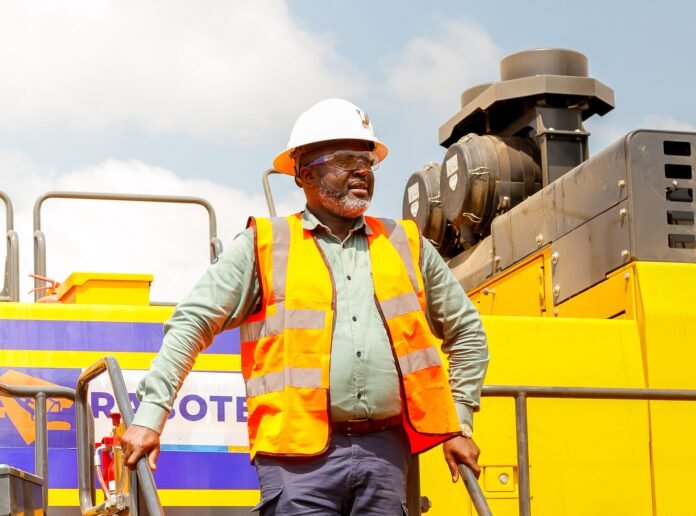
Renowned indigenous mining entrepreneur and Founder of Rabotec Group, Alhaji Ali Ibrahim, has called on Ghana to move beyond exporting raw minerals and focus on developing world-class mining technologies and systems that can compete globally.
Speaking in an interview, Ibrahim said that although Ghana has more than a century of mining experience, the country has yet to transform that knowledge into indigenous innovations that can be exported.
“Ghana should leverage its abundant mineral resources and technical expertise to create homegrown mining solutions that other countries would be willing to adopt,” he said.
“My biggest focus is not just to say Ghana is the heart of mining in Africa. We should be able to develop a system that other nations and continents will come here to pay for because it was created by Ghanaians.”
He cited industry analyses indicating Ghana still holds mineral resources estimated at nearly three times what has been extracted over the past century.
“We have over 300 years of mineral resources ahead of us. It is time for Ghana to create mining systems that the world will come here to buy,” he said.
Ibrahim said this presents an opportunity for young Ghanaian engineers and entrepreneurs.
“If 10 or 15 young engineers come together with a unique mining innovation, I’m ready to invest in them. I want to be part of a legacy that the world will recognise as proudly Ghanaian.”
$1.8bn pipeline across West Africa
Rabotec is currently managing mining and infrastructure projects valued between $1.5 billion and $1.8 billion across Ghana, Guinea, Mali, Sierra Leone and Burkina Faso.
“Currently, we are running projects worth between $1.5 billion and $1.8 billion over a five-year period. That reflects the scale of Rabotec’s operations across Africa,” Ibrahim said.
The portfolio includes contracts worth approximately $350 million in Mali, $285 million in Sierra Leone, $250 million in Burkina Faso, and $250 million in Guinea, where Rabotec handles full-scale mining including drilling, blasting, loading, hauling and mine management.
In Ghana, the company is executing a $400 million mining contract at Asanko Gold following a renewal and expansion of an earlier agreement.
Rabotec also played a key role in the Bissa Gold Project in Burkina Faso between November 2014 and October 2016. Working alongside Outotec, a team of more than 180 Rabotec professionals supplied mill installation crews and expertise to install a 6,000 kW SAG Mill and a 6,000 kW Ball Mill, plus electrical installations and mechanical commissioning. The 3 Mtpa plant is designed to produce about 257,000 ounces of gold annually.
Sustainable mining and TSF leadership
Ibrahim highlighted Rabotec’s leadership in the design and construction of Tailings Storage Facilities — engineered structures to safely contain mining waste.
“TSF construction is one of our strongest areas. We have built most of the large-scale tailings storage facilities in Ghana, and we’ve also delivered major projects outside the country, including in Sierra Leone,” he said.
He said all facilities meet strict regulatory requirements and undergo periodic inspections. Rabotec has obtained ISO certification and is investing in what he called “green mining technologies.”
“We are embracing every environmental and safety requirement. We are investing in green mining technologies because that is where the future of the industry is heading.”
Investing in people
Rabotec employs more than 5,000 people directly and supports an estimated 20,000 livelihoods indirectly, according to Ibrahim. He said the company prioritizes local hiring and skills transfer.
“I have taken people who knew absolutely nothing about mining and today they are supervisors, superintendents, plant operators and industry professionals. That gives me great satisfaction as a CEO,” he said.
Overcoming challenges
The growth has come with setbacks. Ibrahim revealed one Rabotec site was attacked this year by unidentified individuals who set fire to equipment worth nearly $30 million.
“We were hit by a calamity. But we have overcome it and moved on,” he said.
He also flagged regulatory changes as a challenge as more West African countries adopt Ghana-style local content policies.
“Most countries in the sub-region are adopting Ghana’s localisation policies. We comply everywhere we operate, but the changing regulations remain a challenge.”
Quiet philanthropy and mindset change
Beyond business, Ibrahim said his CSR focuses on hospitals, orphanages, flood relief and supporting former prison inmates.
“Not everybody in prison is a criminal. Sometimes circumstances put people behind bars, and when they come out, they deserve another chance,” he said. Several former inmates now work at Rabotec sites as drivers and equipment operators.
He also urged greater confidence in Ghanaian businesses.
“The biggest challenge is not finance. It is Ghanaians believing in Ghanaians,” Ibrahim said. “Our good days are written on water, but our bad days are written on brass.”
Ibrahim is married with children.