
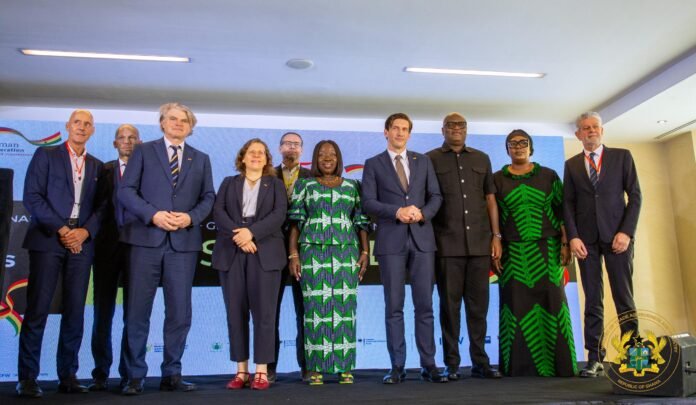
Ghana and Germany have reaffirmed their commitment to strengthening bilateral cooperation and accelerating investment-led growth, as senior government officials, private sector leaders and development partners convened in Accra for the maiden German–Ghanaian Government Negotiations Business Day.
The high-level engagement which is the first time Germany has directly linked a Business Day to its bilateral development negotiations brought together major actors from both countries to align policy reforms, private sector initiatives and long-term investment opportunities.
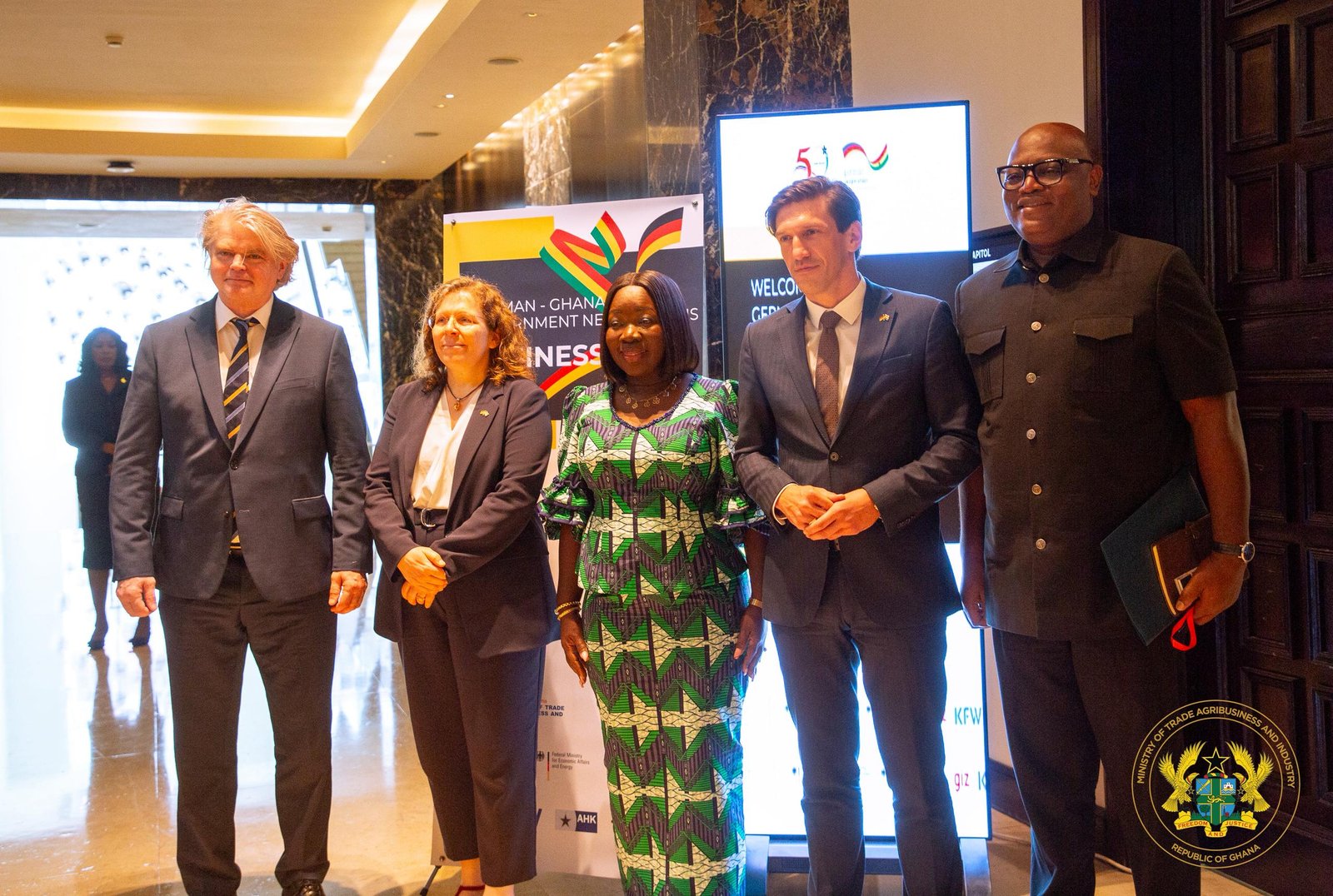
Delivering the keynote address, Minister for Trade, Agribusiness and Industry, Hon. Elizabeth Ofosu-Adjare, underscored Ghana’s determination to pursue industrialisation as the most effective pathway for inclusive and sustainable economic transformation. She stressed the need to shift from raw commodity exports to value addition, calling it essential for ensuring that “Ghanaian resources benefit Ghanaian people.”
Using the example of a smallholder cashew farmer in the Bono Region, the Minister said the nation’s economic potential lies in processing, advanced manufacturing, and developing value chains that retain wealth locally. “Every factory we build empowers farmers. Every value-added product strengthens livelihoods,” she noted.
Hon. Ofosu-Adjare highlighted Germany’s long-standing partnership with Ghana through development cooperation, technical support and private sector engagement. She cited ongoing reforms under her Ministry, including the Business Regulatory Reforms programme aimed at making Ghana the most business-friendly destination in Africa. Through agencies such as the GIPC, Free Zones Authority and the Ghana Enterprise Agency, she said, government is improving investor confidence, promoting industrial parks and expanding agro-processing clusters nationwide.
The Minister also praised GIZ’s extensive support for agribusiness, including training for thousands of women and youth in cashew processing in Techiman and technical assistance for SMEs in supply chain development, processing technologies and international certification.
Touching on emerging opportunities, she invited German investment into Ghana’s digital economy, renewable energy, construction, pharmaceuticals and the garment industry which the government is prioritising as a job creation avenue with plans to establish three new garment factories employing at least 27,000 people.
She further announced Ghana’s intention to establish a Ghana–Germany Industrial and Investment Acceleration Desk to serve as a one-stop interface for German investors. “We love Germany. We want to make doing business very easy,” she said, adding that Ghana remains open, stable and ready for investments that deliver mutual prosperity.
Germany’s Ambassador to Ghana, H.E. Frederik Landshoeft, praised Ghana as a rising regional hub and affirmed that Germany’s expanding interest is driven by alignment between Ghana’s reforms and Germany’s strategic priorities in economic, climate and foreign policy.
He described Ghana as a destination where “confidence meets commitment,” noting that German companies already active in the country from fintech and machinery to energy, logistics and agriculture are not experimenting but deeply invested. “Ghana has stabilised its macroeconomic fundamentals and begun to correct them with discipline,” he said, adding that the country’s fiscal consolidation and predictable governance environment provide rare advantages for investors. He emphasised that Germany is partnering with Ghana “not out of habit, but out of interest.”
Ambassador Landshoeft highlighted five sectors presenting immediate opportunities for deepened German engagement: energy and infrastructure, manufacturing and industrialisation, digital technology, the circular economy, and agriculture and food processing. He also described Ghana as a potential regional gateway to West Africa, with early movers poised to shape the future architecture of regional markets.
On the part of the Ghana Investment Promotion Centre, (GIPC) CEO, Mr. Simon Madjie reinforced Ghana’s commitment to fostering investor confidence and driving growth beyond economic stabilisation. He outlined several reforms underway, including the review of the GIPC Act, revisions to minimum capital requirements and stronger investor protection.
Mr. Madjie called on German businesses to partner with Ghana in sectors such as manufacturing, digital trade, pharmaceuticals, textiles and the 24-hour economy initiative, which he described as a transformative vehicle for prosperity.
He also disclosed ongoing efforts to modernise technology transfer regulations, especially within pharmaceuticals, to encourage the transfer of high-level technology to Ghanaian companies.
The Business Day provided a platform for both sides to discuss concrete investment pathways under Ghana’s industrialisation agenda and Germany’s evolving global economic strategy. The event concluded with a shared commitment to turn dialogue into action and build long-term partnerships that advance innovation, value addition and sustainable growth.