

By. Isaac Christopher Lubogo
I. Prologue: A Sentence That Tilted a Region
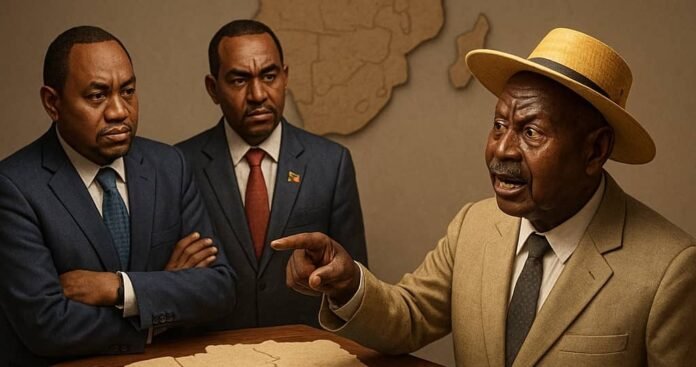
On an otherwise ordinary radio talk show at the State Lodge in Mbale, President Yoweri Kaguta Museveni released a sentence that thundered across East Africa:
“Uganda is landlocked inside here. But where is my ocean? My ocean is the Indian Ocean… I am entitled to that ocean.”
(Daily Monitor report)
He deepened it with metaphor:
“How can you say you are in a block of flats and the compound belongs only to the ground floor? That compound belongs to the whole block.”
And then the line that froze diplomats:
“That ocean belongs to me… In the future, we are going to have wars.”
Within hours, Kenya hurried to calm the waters, reassuring Uganda that it would not block port access and urging regional interpretation rather than alarm.
But beneath the humour and the shock, Museveni’s words open one of the most important—yet neglected—questions in African geopolitics:
What does it mean for a landlocked nation in a maritime century to claim moral or strategic entitlement to a distant ocean?
This discourse explores that question with precision, authority, and philosophic depth.
II. Museveni’s Metaphor: Geography as Justice, Not Accident
Museveni’s metaphor of the “block of flats” is not naïve rhetoric. It is an ideological re-framing.
He is asserting three claims:
1. Geography must serve regional justice, not privilege
If eight East African states share history, markets, energy grids, migration routes, ecosystems, and defence vulnerabilities, then the coastline should not be treated as a private inheritance of the ground-floor tenants (Kenya, Tanzania, Somalia).
2. Access is not favour — it is entitlement
International law allows landlocked states:
“right of access to and from the sea”
(UNCLOS, via Daily Monitor’s legal interpretation)
But Museveni stretches this into moral co-ownership.
This is provocative, but strategically revealing.
3. Vulnerability generates future conflict
His warning of “future wars” was not an immediate threat — it was a structural prediction:
Where access is controlled by sovereign neighbours, insecurity becomes inevitable.
History agrees.
From Ethiopia–Eritrea, Bolivia–Chile, Azerbaijan–Armenia, to South Sudan’s port negotiations—sea access shapes dignity, sovereignty, and war.
Museveni is not announcing conflict.
He is warning of geography’s silent violence.
III. The Legal Reality: Rights Without Sovereignty
Under UNCLOS:
Landlocked states have rights of transit.
Coastal states retain sovereignty over ports and waters.
All practical access depends on bilateral agreements.
Uganda, therefore, has:
access to Mombasa and Lamu via Kenya
access to Dar es Salaam and potentially Tanga via Tanzania
What it does not have is:
control,
predictability,
strategic independence.
Thus Museveni’s frustration:
“How do I build a navy?”
(The East African)
In a maritime century—where naval presence shapes security, trade, and regional authority—landlocked states face existential limits.
IV. The Infrastructure Chessboard: Corridors as Power
East Africa’s corridors are not mere roads.
They are weapons of influence.
1. Kenya’s SGR: The Broken Promise
The Standard Gauge Railway from Mombasa stalled at Naivasha after Chinese financing dried up. Kenya now courts the UAE to revive the extension to Uganda.
Until it is completed, Uganda’s logistics remain hostage to Kenya’s internal politics.
2. Tanzania’s Counteroffer
Dar es Salaam and Tanga aggressively market themselves as a calmer, more dependable alternative.
Tanzania sees opportunity where Kenya sees obligation.
3. Great-power penetration
China, UAE, Europe, India, and the Gulf are pouring billions into:
ports,
rail,
dry ports,
oil pipelines.
Sea access has become a geoeconomic commodity, shaping alliances and dependency.
Thus Museveni’s metaphor hides a truth:
Landlocked states are trapped in geopolitical chokepoints disguised as transit agreements.
V. East African Integration: The Grand Illusion Exposed
The East African Community (EAC) claims:
Common Market
Custom Union
Monetary Union
A future Political Federation
But Museveni’s statement exposes the hollowness:
1. “Unity” is rhetorical, not structural
If Uganda still depends on the goodwill of neighbours for its very connection to the ocean, then integration is paper-deep.
2. Coastal privilege vs Landlocked grievance
Coastal states hold leverage.
Landlocked states hold resentment.
This imbalance is a ticking regional fault-line.
3. The EAC family behaves like competing landlords
The Kenyan reassurance—though friendly—revealed that the ocean is still seen as Kenya’s property, to be extended or withheld as policy allows.
Regionalism collapses where sovereignty monopolises geography.
VI. Defence Dimension: The Unspoken Layer
Museveni explicitly linked sea access to defence:
“Some of the countries have no access to the sea… not only for economic purposes but also for defence.”
In a world where:
offshore gas is discovered off Tanzania and Mozambique,
the Indian Ocean hosts US, Chinese, Indian, French and Gulf naval forces,
maritime trade routes shape national security,
being landlocked is not merely inconvenient.
It is strategically crippling.
Uganda cannot:
protect its maritime imports,
develop naval doctrine,
secure maritime trade lanes.
It must outsource its security to coastal neighbours.
Museveni’s frustration, therefore, reflects a regional security deficit disguised as a logistics issue.
VII. The Domestic Layer: Geopolitics as Political Theatre
No geopolitical claim is innocent of domestic politics.
For a long-serving leader:
managing succession pressures,
speaking to a youthful population,
facing economic anxiety,
confronting regional competition,
the claim to “our ocean” transforms him into:
guardian of national dignity,
defender against historical disadvantage,
champion of structural justice.
It is political capital disguised as foreign policy.
VIII. The Geopolitical Meaning: A New African Question Is Emerging
Across Africa, landlocked frustration is rising:
Ethiopia wants access via Djibouti, Somaliland (Berbera), Eritrea.
South Sudan wants Lamu.
Uganda wants Mombasa/Tanga guarantees.
Rwanda/Burundi/DRC negotiate for Tanzanian access.
Museveni is merely the first to express the coming doctrine:
“Geography will no longer be destiny imposed by colonial borders.”
East Africa must choose between:
1. shared maritime destiny
OR
2. fragmented geopolitical competition.
IX. A Regional Solution: What the EAC Must Do Now
Museveni’s provocation gives the region a choice: escalate or evolve.
1. Encode sea access into enforceable EAC law
No more bilateral favours.
Create a binding, justiciable right guaranteeing transit, port access, and logistics for all landlocked members.
2. Establish a “Common Maritime Space” doctrine
Not shared sovereignty, but shared strategic planning:
joint naval exercises,
regional maritime security,
shared port governance frameworks.
3. Multilateralise corridors
Replace Kenya-only or Tanzania-only control with regional corridor authorities, jointly financed and jointly governed.
4. Create the Landlocked States Compact
Uganda, Rwanda, Burundi, South Sudan, Ethiopia—together—can articulate a common maritime security and trade agenda.
This turns grievance into diplomatic power.
X. Final Verdict: Reckless, Revealing, Necessary
Museveni’s statement is:
Legally imprecise — but not irrational.
Diplomatically provocative — but regionally revealing.
Geopolitically accurate — exposing landlocked vulnerability.
Strategically important — forcing the region to confront its hidden imbalance.
So what does the statement really mean?
Museveni’s “my ocean” is not a claim of ownership;
it is an indictment of a weak regional order.
His warning of “future wars” is not a threat;
it is the voice of a geography that can no longer be ignored.
Uganda does not want the Indian Ocean.
Uganda wants guaranteed, depoliticised, structurally secure access to it.
In that sense, Museveni has asked the question the region fears most:
Can East Africa claim to be a community
if some members still depend on the goodwill of others to touch the sea?
Until this is resolved, the EAC will remain:
a beautiful dream,
an impressive anthem,
a promising market,
but a fragile geopolitical arrangement.
This is the hour to choose:
Integration with depth, or geography with conflict.