
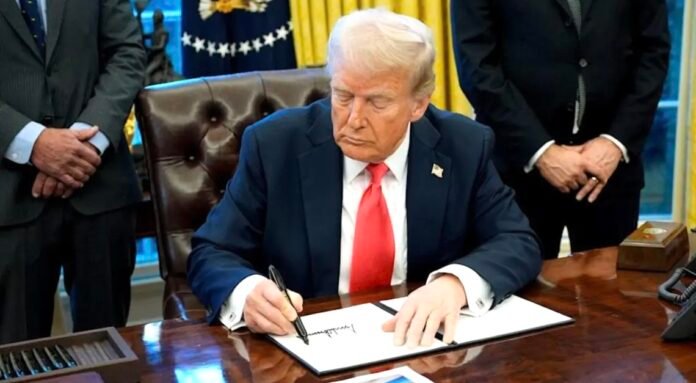
United States President Donald Trump has signed a new executive order authorizing the imposition of tariffs on countries that continue to conduct trade with Iran, significantly escalating Washington’s economic pressure campaign against Tehran ahead of renewed diplomatic engagements expected next week.
The executive order, signed on Friday, February 6, is scheduled to take effect from Saturday, February 7. It empowers the U.S. government to levy tariffs on goods imported from any country found to be directly or indirectly purchasing products or services from Iran. The measure formalizes a warning Trump issued earlier in January, when he signaled his administration’s intention to penalize Iran’s trading partners with tariffs of up to 25 percent.
Under the order, responsibility for determining the specific tariff rates has been assigned to Secretary of State Marco Rubio. While the document does not mandate a fixed rate, it explicitly references 25 percent as a benchmark, suggesting that affected countries could face substantial trade penalties depending on the extent of their commercial ties with Iran.
U.S. officials say the policy is aimed at tightening Iran’s economic isolation and reducing revenues that Washington believes are used to fund activities destabilizing the Middle East. The administration argues that indirect trade has allowed Iran to cushion the impact of existing sanctions and continue exporting energy, industrial products, and other goods.
A number of countries could be affected by the new policy, including China, Russia, Germany, Turkey, and the United Arab Emirates. Among these, China remains Iran’s most significant trading partner. Official trade figures indicate that bilateral trade between China and Iran exceeded $32 billion in 2024, largely driven by oil and petrochemical exports.
The signing of the order comes against the backdrop of renewed diplomatic activity between Washington and Tehran. On Friday, U.S. and Iranian officials held indirect talks in Muscat, Oman, with Omani officials acting as intermediaries. The discussions marked the first known engagement between the two sides since the United States carried out strikes on Iranian nuclear-related facilities in June as part of its involvement alongside Israel in the ongoing conflict.
Speaking to reporters aboard Air Force One after the talks, President Trump struck an optimistic tone. “We likewise had very good talks on Iran,” he said, adding that further discussions were expected early next week. Despite this diplomatic opening, the new tariff authority underscores the administration’s dual-track strategy of combining pressure with negotiation.
Regional tensions remain elevated. A U.S. aircraft carrier strike group continues to operate in Middle Eastern waters, signaling Washington’s readiness to respond to any escalation. Iran, meanwhile, is grappling with significant internal unrest. The country has experienced widespread economic protests since December, driven by inflation, unemployment, and dissatisfaction with government policies.
Iranian authorities have imposed an extended internet blackout in parts of the country, citing security concerns. However, human rights organizations say the restrictions are aimed at limiting the flow of information about the protests. A U.S.-based human rights group reported on Friday that it has verified the deaths of 6,505 protesters, 214 members of the security forces, and 61 bystanders since the unrest began.
The Iranian government has disputed some of these figures and maintains that it is acting to preserve public order. Nonetheless, the reported toll has intensified international scrutiny of Tehran’s domestic response and added urgency to diplomatic efforts aimed at de-escalation.
Analysts note that the new tariff order could complicate U.S. relations with key trading partners, particularly those that maintain significant economic ties with Iran while also doing business with the United States. The move may force affected countries to reassess their commercial relationships or seek exemptions through diplomatic channels.
As the executive order takes effect, attention is likely to focus on how aggressively the U.S. enforces the policy and whether it will influence Iran’s position in the upcoming round of talks. For now, the Trump administration appears determined to leverage economic tools to strengthen its negotiating hand while maintaining pressure on Tehran at a time of heightened regional and domestic instability.
Source: Africa Publicity