

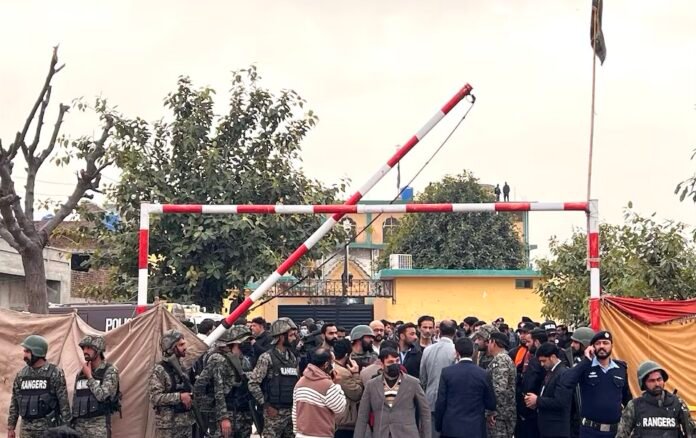
At least 31 people were killed and nearly 170 others injured after a suicide bombing struck a Shi’ite Muslim mosque in Pakistan’s capital, Islamabad, during Friday prayers, according to police and government officials. The attack, which occurred in a semi-urban area on the outskirts of the city, has shaken the heavily guarded capital and renewed concerns over rising militant violence in the country.
The explosion took place at the Khadija Tul Kubra Imambargah while worshippers were gathered for congregational prayers. Emergency responders, police units, and volunteers rushed to the scene as victims were transported to nearby hospitals, where many remained in critical condition late Friday.
Islamabad Deputy Commissioner Irfan Memon confirmed the updated casualty figures in a statement, saying 31 people had lost their lives and 169 injured individuals had been admitted to hospitals across the city. Health officials said medical teams were working around the clock to treat the wounded, some of whom suffered severe injuries.
According to senior police officials, the attacker attempted to enter the mosque complex but was intercepted at the gate by security personnel before detonating the explosive device. The officials, who spoke on condition of anonymity because they were not authorised to brief the media, said the intervention may have prevented even greater loss of life inside the main prayer hall.
Authorities sealed off the area following the blast, launching a large-scale security operation and forensic investigation. Bomb disposal units and counterterrorism officers were deployed, while checkpoints were reinforced across Islamabad as a precaution against further attacks.
Bombings of this scale are relatively rare in Islamabad, which is considered one of Pakistan’s most secure cities due to the presence of government institutions, foreign embassies, and high-level security infrastructure. However, the country has experienced a resurgence of militant attacks in recent years, particularly targeting security forces, religious minorities, and public spaces.
Shi’ite Muslims, who make up a minority in Pakistan’s predominantly Sunni population of about 241 million, have frequently been targeted in sectarian violence. In the past, extremist groups have accused Shi’ites of heresy, leading to repeated attacks on mosques, processions, and community gatherings.
Although no group immediately claimed responsibility for Friday’s bombing, suspicion has fallen on sectarian militant organisations operating in the region. The Pakistani Taliban, also known as Tehreek-e-Taliban Pakistan (TTP), has previously carried out attacks against Shi’ite targets, though authorities have not officially linked the group to this incident.
The attack follows another deadly bombing in Islamabad on November 11, when a suicide attacker killed 12 people and wounded 27 others. Pakistani officials later said that assault was carried out by an Afghan national, though no militant group publicly claimed responsibility.
Political leaders and religious figures across Pakistan condemned the mosque attack, describing it as an assault on both religious freedom and national security. Calls have intensified for stronger intelligence coordination and enhanced protection of religious sites, particularly during large gatherings such as Friday prayers.
As investigations continue, security agencies say they are analysing surveillance footage, explosive materials, and communication records to identify those who planned and facilitated the attack. Authorities have urged the public to remain calm but vigilant, as Pakistan grapples with the renewed threat of militant and sectarian violence.
Source: Africa Publicity