
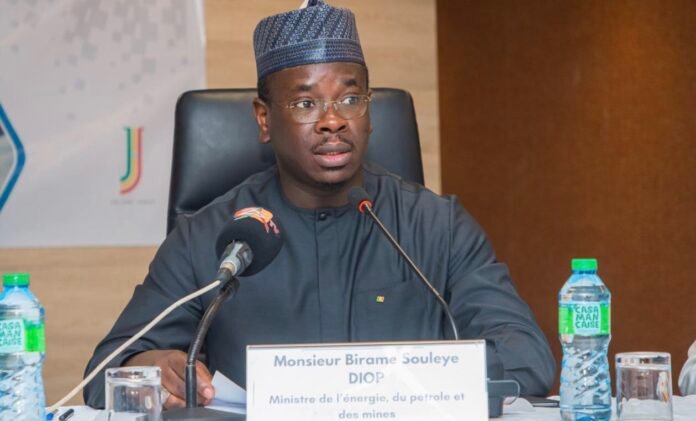
Senegal’s government moved on Thursday to calm uncertainty in the energy sector after public comments from Energy Minister Birame Souleye Diop earlier in the week suggested the state intended to nationalise the Yakaar-Teranga natural gas project. The Ministry of Energy, Petroleum and Mining later issued a formal clarification, stating that the national strategy for the field had been misinterpreted and that the country did not, in fact, plan to nationalise the asset.
The Yakaar-Teranga gas field—considered one of Senegal’s most significant offshore discoveries—has been jointly held by U.S.-based Kosmos Energy, which controls a 90% working interest, and Senegal’s national oil company Petrosen, which owns the remaining 10%. The licence is scheduled to expire in July 2026, unless earlier action is taken.
Minister’s Comments Trigger Industry Reaction
Minister Diop, speaking earlier in the week, had declared that Senegal wanted to “nationalise” the project and grant Petrosen full authority to develop the field. His remarks quickly circulated across energy markets and raised questions about whether Dakar was shifting toward a more state-dominated model for its emerging natural gas sector.
Diop argued at the time that Petrosen had developed sufficient technical capacity to handle the project independently and implied that foreign operators, including Kosmos, had failed to secure the additional partner needed to advance Yakaar-Teranga into a full development phase.
The project has been seeking another international partner for years, a requirement seen as essential for financing and progressing a long-term extraction plan. Despite extensive negotiations, no agreement has been reached.
Kosmos Responds: Willing to Transfer Licence as Scheduled
Kosmos Energy, which took over operatorship of Yakaar-Teranga in 2023 following BP’s withdrawal from the project, issued its own statement acknowledging the government’s direction. The company highlighted the efforts made alongside Petrosen to attract a viable partner and create a commercially sustainable roadmap for development.
However, Kosmos confirmed that if no partner is secured, it will proceed with transferring the licence back to the Senegalese state by the time it expires in July 2026—or sooner if both parties agree.
“Kosmos Energy has worked hard with Petrosen to find a suitable partner and agree a commercially viable development concept for the field,” the company said. “In the absence of a new partner, Kosmos will work with Petrosen to transfer the licence back to the Senegalese state on, or before, the licence expiry.”
The statement signaled Kosmos’s willingness to cooperate with Senegalese authorities and to facilitate a smooth transition.
Energy Ministry Issues Clarification, Calls Kosmos a ‘Strategic Partner’
Faced with growing uncertainty after Diop’s initial remarks, Senegal’s energy ministry published a clarification on social media declaring that the minister’s earlier language had been misunderstood.
The ministry emphasized that Senegal’s strategy “did not imply in any way the nationalisation of the Yakaar-Teranga project”, and described Kosmos Energy as a continuing “strategic partner” in the country’s broader energy agenda.
The government said its main focus was ensuring that the licence transition in 2026 aligns with national priorities, regulatory compliance, and long-term planning for the country’s gas sector.
“The Ministry of Energy, Petroleum and Mining will work closely with Kosmos and Petrosen to ensure the transfer of the licence to the Senegalese state by its expiry in July 2026,” the post stated.
A Delicate Moment for Senegal’s Energy Future
The episode comes at a pivotal time for Senegal, which is positioning itself as a rising energy producer following major offshore oil and gas discoveries over the past decade. The country’s LNG ambitions rely on both foreign investment and the strengthening of domestic expertise within Petrosen.
Industry analysts note that the conflicting signals—first hinting at nationalisation, then reaffirming partnership—may reflect tensions within Senegal’s new government over how quickly it should assert control over strategic natural resources.
While the government insists that its policy direction remains unchanged, the brief uncertainty underscored a broader debate common in emerging energy-producing nations: how to balance investor confidence with long-term national control.
Looking Ahead
As the July 2026 deadline approaches, Senegal faces key decisions about how to structure the next phase of Yakaar-Teranga’s development. Whether the country ultimately brings in new partners, expands Petrosen’s role, or redefines the project model altogether will have major implications for its gas industry and energy revenues.
For now, Senegal is eager to reassure international investors that it remains committed to predictable cooperation—even as it prepares to reclaim control of the licence once the current contract expires.
Source:Africa Publicity