

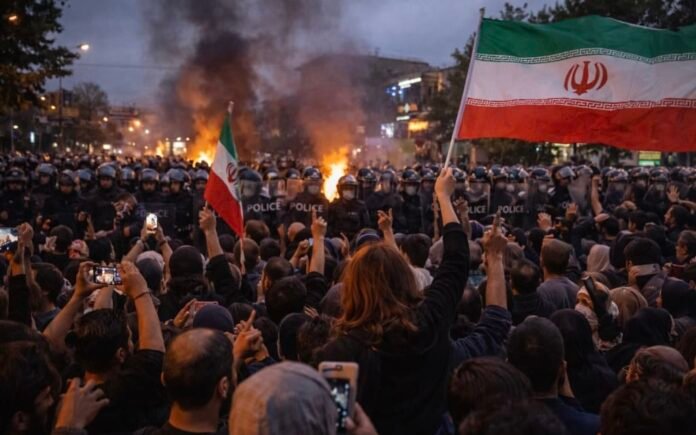
Iranian authorities have signaled they are preparing to intensify their response to the largest wave of anti-government demonstrations the country has seen in years, as unrest spreads across multiple provinces and security forces report mounting casualties.
Statements from Iran’s powerful security institutions over the weekend suggest the leadership is determined to suppress what it describes as violent and foreign-backed disturbances, even as protesters continue to defy internet shutdowns and heavy security deployments.
The warning tone from Tehran came amid fresh reports of clashes, arson, and deaths, and a growing international spotlight on the crisis. A day earlier, U.S. President Donald Trump issued a sharp warning that Washington could intervene if Iranian authorities escalate violence against demonstrators, adding to tensions between the two countries.
Protests Expand Despite Internet Blackout
Protests that began on December 28 over rising prices, unemployment, and inflation have rapidly evolved into broader political demonstrations. Chants calling for economic reforms have given way to slogans demanding the end of clerical rule and directly targeting Supreme Leader Ayatollah Ali Khamenei.
Iran’s near-total internet blackout has made it difficult to independently verify events on the ground, but videos posted on social media and later verified by international media show large nighttime gatherings in Tehran and other cities, with fires burning in streets and crowds chanting anti-government slogans.
One widely circulated video from Tehran’s Saadatabad neighborhood captured a protester claiming demonstrators had taken control of the area while others shouted, “Death to the dictator” and “Death to Khamenei.” Similar scenes have been reported in cities including Karaj, Shiraz, Qom, Hamedan, and Mashhad.
State media acknowledged unrest in several locations, reporting that a municipal building in Karaj, west of Tehran, was set ablaze by what it labeled “rioters.” State television also broadcast funerals for members of the security forces killed during clashes, underscoring the growing toll on both sides.
Security Forces Adopt a Tougher Stance
In coordinated statements, Iran’s elite Islamic Revolutionary Guard Corps (IRGC) and the regular army made clear they view the protests as a direct threat to national security. The IRGC accused “terrorist groups” of attacking military and law enforcement facilities over the past several nights and vowed to defend what it called the achievements of the 1979 Islamic Revolution.
“The safeguarding of security and the Islamic system is a red line,” the IRGC said in a statement aired on state television. The regular army echoed that message, pledging to protect strategic infrastructure, public property, and national interests.
A witness in western Iran, speaking by phone on condition of anonymity, said Revolutionary Guard units had been deployed in the area and were firing live ammunition. Meanwhile, the semi-official Tasnim news agency reported the arrest of 100 people it described as “armed rioters” in Baharestan, near Tehran.
Rising Casualties and Human Rights Concerns
Iranian authorities have not released comprehensive casualty figures, but the Human Rights Activists News Agency (HRANA), an independent rights group, said at least 50 protesters and 15 members of the security forces have been killed so far, with approximately 2,300 people arrested nationwide.
A doctor in northwestern Iran reported that hospitals have been overwhelmed with injured protesters since Friday. According to the doctor, many patients suffered severe beatings, head injuries, broken limbs, and deep cuts. At least 20 people in one hospital had been treated for gunshot wounds, five of whom later died.
The IRGC confirmed that three members of its Basij volunteer force were killed and five wounded during clashes in the southwestern town of Gachsaran. Authorities also reported the stabbing death of a security officer in Hamedan, the killing of the son of a senior military commander in Mashhad, and additional deaths of security personnel in Khuzestan province.
Opposition Voices Grow Louder
As unrest continues, opposition figures abroad have sought to shape the movement’s direction. Reza Pahlavi, the U.S.-based son of Iran’s last shah, issued his strongest call yet for protesters to escalate their actions. In a video posted on social media, Pahlavi urged demonstrators to move beyond street protests and begin seizing and holding city centers, saying the Islamic Republic could be brought “to its knees.”
“Our goal is no longer merely to come into the streets,” he said. “The goal is to prepare to seize city centres and hold them.” Pahlavi also claimed he was preparing to return to Iran, a statement that drew both support and skepticism among protesters, many of whom remain focused on ending clerical rule rather than restoring the monarchy.
Some demonstrators have been heard chanting slogans such as “Long live the shah,” but most calls continue to center on economic grievances and opposition to the current political system.
International Pressure and a Familiar Pattern
Supreme Leader Khamenei has blamed the unrest on foreign enemies, accusing protesters of acting on behalf of the United States and Israel. On Friday, he warned that Iran would not tolerate people acting as “mercenaries for foreigners.”
Iran’s leadership has survived repeated waves of unrest over the past decades, including student protests in 1999, mass demonstrations following the disputed 2009 election, nationwide protests over fuel prices in 2019, and widespread anger in 2022 after the death of a woman in custody over alleged dress code violations.
Whether the current protests will follow a similar trajectory remains unclear. With security forces signaling a tougher crackdown, opposition figures calling for escalation, and international tensions rising, Iran appears to be entering another volatile chapter in its long-running struggle between state power and public dissent.
Source: Africa Publicity