

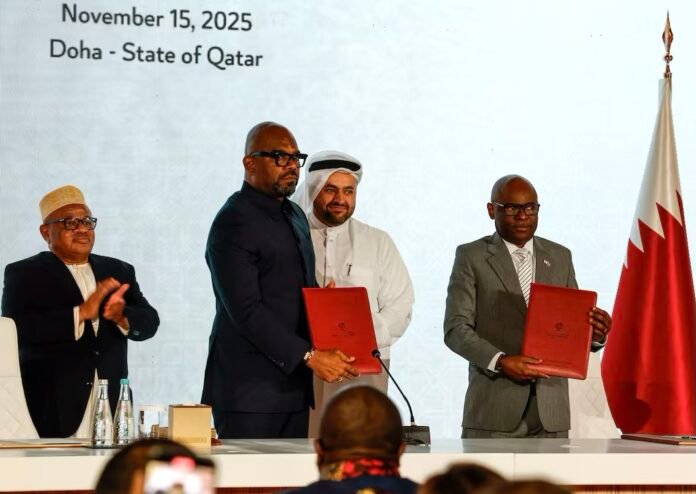
The Democratic Republic of Congo (DRC) and the M23 rebel movement have signed a new framework agreement in Doha aimed at creating a pathway toward ending the escalating conflict in eastern Congo. The deal, formalized on Saturday in the Qatari capital, marks the latest attempt by international mediators — notably Qatar and the United States — to stabilize a region battered by decades of violence, mass displacement, and humanitarian crises.
Although hailed as a noteworthy diplomatic breakthrough, officials emphasized that the accord is only one step in what remains a long and complex peace process. The eastern provinces of North Kivu and South Kivu have seen some of the deadliest fighting in recent years, with thousands killed and hundreds of thousands fleeing their homes amid clashes involving M23 and various armed groups.
Eight-Point Framework Still in Early Stages of Implementation
U.S. Special Envoy Massad Boulos said the new framework addresses eight protocols intended to guide demobilization, reintegration, ceasefire monitoring, and humanitarian coordination. However, he stressed that clear implementation plans for six of the protocols remain under negotiation.
He also acknowledged delays in executing the two previously agreed-upon measures — prisoner exchanges and ceasefire monitoring.
“Progress has been slower than many hoped, but peacebuilding is a gradual process,” he said, noting that immediate changes on the ground should not be expected.
M23’s Territorial Gains and Rwanda’s Denials Complicate Peace Efforts
The conflict intensified earlier this year when M23, widely believed to receive support from neighboring Rwanda — an allegation Kigali continues to reject — captured the strategic city of Goma and expanded its control across North and South Kivu. The group now holds more territory than at any point in its history, raising concerns of further regional destabilization.
Violence Continues Despite Diplomacy
Even as talks advance, violence persists across the region. Local authorities reported that at least 28 civilians were killed on Friday in North Kivu by militants affiliated with the Islamic State, underscoring that multiple armed actors continue to threaten stability beyond the M23 conflict.
Qatar has hosted several rounds of direct negotiations between Kinshasa and M23 since April, focusing on confidence-building steps, humanitarian access, and preliminary principles for long-term dialogue. A declaration of principles signed in July left critical political and security issues unresolved, while an October agreement centered on ceasefire monitoring laid the groundwork for Saturday’s broader framework.
Qatar Calls for Patience and Commitment
Qatar’s Minister of State for Foreign Affairs, Mohammed bin Abdulaziz Al-Khulaifi, urged both sides to prioritize trust and sustained engagement.
“Peace cannot be enforced by force,” he said. “It must be built through confidence, mutual respect, and genuine commitment.”
While the latest agreement offers renewed hope, diplomats and regional analysts caution that translating signatures on paper into lasting peace will require significant concessions, robust international support, and, most critically, a tangible reduction in violence on the ground.
Ghana: NAIMOS TaskForce strikes “Yellow face” illegal mining Site at Wassa Abrehyia
Source:Africa Publicity