

Australia on Wednesday became the first country to enforce a nationwide minimum age for social media access, ushering in a landmark regulatory experiment that could reshape how young people around the world interact with digital platforms. Beginning at midnight local time (1300 GMT), major platforms—including Instagram, TikTok, YouTube and others—were required to block the accounts of Australians under the age of 16 or face penalties of up to A$49.5 million (US$33 million).
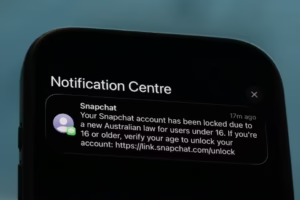
The sweeping new rules, contained in legislation passed earlier this year, represent one of the most ambitious attempts by a government to regulate youth access to social media—an issue that has grown increasingly urgent amid concerns about online harms, privacy violations, and children’s exposure to manipulative algorithms.
Although the policy has drawn sharp criticism from global technology firms and free speech advocates, it has also gained strong support from parents’ associations, child safety experts and educators who argue that years of voluntary safety initiatives by tech companies have failed to protect children.
A High-Stakes Test for Global Policymakers
The implementation marks the end of months of debate about whether a modern society can meaningfully restrict minors from using platforms that have become central to communication, entertainment and education. The rollout is being closely followed by governments worldwide as a potential model for future legislation.
Officials in Denmark, the Netherlands, Malaysia and several U.S. states have already signaled interest in similar age rules. Their renewed urgency stems from increased political pressure to confront tech companies following the 2021 leak of internal Meta documents showing the company was aware its platforms contributed to body-image struggles and mental health risks in some teens, while publicly downplaying those findings.
“While Australia is the first to adopt such restrictions, it is unlikely to be the last,” said Tama Leaver, professor of internet studies at Curtin University. “Many governments see this as a turning point—a demonstration that regulatory power can be exercised even over the world’s largest tech firms. Australia is effectively the canary in the coal mine.”
A spokesperson for the British government, which recently required adult sites to verify users’ ages, said the U.K. is “closely monitoring Australia’s approach” and would not rule out adopting similar measures. “When it comes to children’s safety, nothing is off the table,” they said.
How the Ban Will Work
Ten major platforms are included in the first stage of the policy, among them YouTube, Instagram, TikTok and Snapchat. The government has said the list will evolve as new apps emerge and as young users shift to alternative platforms.
To comply, companies must use verified age checks—ranging from AI-driven age inference tools to facial estimation systems, identity document verification or financial account cross-checking. Most companies have indicated they will cooperate, though the reliability and privacy implications of these technologies remain contested.
Elon Musk’s X is the sole platform that has publicly stated it will not comply, with Musk calling the law “a backdoor attempt to control internet access.” A High Court challenge backed by a libertarian state legislator is expected to move forward in coming months.
Australia Begins a Long-Term National Study
To evaluate the policy’s impact, the eSafety Commissioner—tasked with enforcing the new rules—has partnered with Stanford University and 11 other researchers to conduct a multi-year assessment involving thousands of Australian children. The research aims to examine how reduced exposure to social media affects mental health, academic performance, peer relationships and digital literacy.
The findings, which will be published over at least two years, are expected to influence not only Australian policy but also international debates over youth digital rights and platform accountability.
Industry Backlash and Fears of a Changing Digital Landscape
Tech firms argue the ban raises privacy risks by pressuring users to submit sensitive identity data and could limit young people’s freedom of expression. Civil liberties groups have echoed these concerns, warning that the law may disproportionately affect marginalized youth who rely on online spaces for community and support.
Platforms also face strategic challenges: although they earn minimal advertising revenue from under-16s, they say that cutting off early access disrupts their long-term user pipelines. According to government figures, nearly 86% of Australians aged 8 to 15 used social media before the ban.
Researchers say the new restrictions mark the end of what University of Sydney professor Terry Flew describes as an era when social media was viewed as “a space of limitless self-expression.” He added: “If stringent safeguards had been in place during the early boom years of social platforms, we might be looking at a very different debate today.”
Source:Africa Publicity