
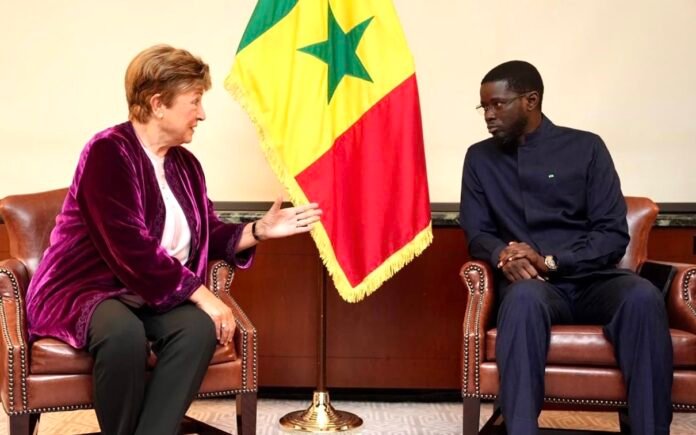
The International Monetary Fund (IMF) says it is working closely with the Senegalese government to design fiscal and debt management reforms that would support a new financial assistance program, as discussions continue amid concerns about the country’s rising debt burden and political uncertainty.
An IMF team recently concluded a mission to Dakar, but left without announcing a new deal to replace the suspended program that was halted earlier this year following revelations of debt misreporting by Senegalese authorities. The suspension has heightened investor caution and weighed heavily on the country’s international bonds.
“The IMF is currently assessing the viability of Senegal’s financing strategy and the reforms needed to underpin any new program,” IMF spokesperson Julie Kozack said during a press briefing on Thursday. “These include efforts to strengthen debt transparency, centralize debt management operations, and improve overall fiscal governance.”
Debt Pressures and Reform Conditions
Senegal’s debt has climbed in recent years as the government ramped up infrastructure and energy investments ahead of the expected start of oil and gas production in 2025. The country’s total public debt now exceeds 70% of GDP, according to IMF and World Bank estimates — a level considered high for a lower-middle-income economy.
Kozack said the IMF and the World Bank are finalizing a joint debt sustainability analysis, using updated macroeconomic and fiscal data, to evaluate Senegal’s capacity to meet its obligations and guide any future lending arrangement.
“The decision on whether to pursue debt restructuring, or any other form of debt operation, is entirely a sovereign choice for the Senegalese authorities,” she emphasized.
Government Pushback on Debt Restructuring
Senegal’s talks with the IMF have been complicated by recent comments from Prime Minister Ousmane Sonko, who accused the Fund of pressuring his government to consider a debt restructuring plan — an option he said Senegal would not accept.
Sonko’s remarks triggered a sell-off in Senegal’s international bonds, with some falling to record lows amid market fears of potential default or further delays in securing IMF support.
The Finance Ministry has since clarified that it remains committed to maintaining dialogue with the Fund and to “strengthening fiscal discipline and transparency.” However, the government continues to face a delicate balancing act between fiscal consolidation and preserving public spending to address unemployment and social unrest.
Political and Economic Uncertainty
Senegal’s economy, one of West Africa’s most stable over the past decade, has been under pressure from slower growth, inflation, and political tensions following the contested 2024 elections that brought Sonko’s ally, President Bassirou Diomaye Faye, to power.
The new administration has pledged to audit past public debt and review existing contracts with foreign investors, particularly in the extractive and energy sectors — a stance that has unsettled some investors and complicated engagement with international lenders.
Analysts say the outcome of negotiations with the IMF could determine Senegal’s short-term access to capital markets and its ability to refinance upcoming Eurobond payments due in 2026.
“Restoring investor confidence and securing an IMF deal are critical for Senegal at this stage,” said Aminata Ndiaye, an economist at the West African Development Policy Institute. “Without external support, financing gaps will widen, and pressure on the local currency could intensify.”
Path Forward
Despite the challenges, the IMF has expressed continued willingness to work with Senegal. Kozack reiterated that discussions are ongoing and constructive:
“We are committed to helping Senegal design policies that preserve debt sustainability, protect social spending, and support inclusive growth.”
With the country’s first oil and gas revenues expected next year, the success of the new IMF-backed reform program could be pivotal for restoring economic stability — and for setting the tone of Senegal’s relationship with international creditors in the years ahead.
Source:Africa Publicity