

By: Isaac Christopher Lubogo
Prologue: When History Refuses Amnesia
In the silent corridors of post–Cold War diplomacy, there lies a broken covenant — whispered in the twilight of 1990 between Western diplomats and the Kremlin, when Mikhail Gorbachev believed that the end of ideological confrontation meant the beginning of mutual respect. Yet, from those whispers arose an empire of encirclement. What was promised as “not one inch eastward” became, in practice, a geopolitical crusade to the very gates of Moscow. And now, the world acts surprised that the bear, once cornered, bares its teeth.
This is not to justify Russia’s aggression, but to illuminate the path that led to it — a path paved with Western duplicity, post–Soviet humiliation, and the ideological intoxication of liberal triumphalism.
I. The Genesis: When Promises Were Spoken, Not Written
The historical record is clearer than propaganda would admit. In February 1990, U.S. Secretary of State James Baker assured Gorbachev that NATO would move “not one inch eastward” if Moscow allowed the reunification of Germany within NATO. This was echoed by West German Foreign Minister Hans-Dietrich Genscher, who reinforced the same guarantee.
Gorbachev, in good faith and in a moment of idealism, dismantled the Warsaw Pact and withdrew Soviet troops from Eastern Europe. The Iron Curtain had fallen, and with it, the ideological scaffolding of the 20th century. Yet, as the ink of cooperation dried, the architects of realpolitik began to redraw the map of influence.
By the mid-1990s, the Clinton administration began pushing for NATO’s eastward expansion — first to Poland, Hungary, and the Czech Republic (1999). The moral language used was “security and democracy,” but behind the veil was a strategic calculus: to prevent the re-emergence of a strong Russia.
II. The Expansion Doctrine: From Containment to Encirclement
After the collapse of the Soviet Union in 1991, Russia was economically crippled, politically unstable, and psychologically humiliated. Western economists — the apostles of the “shock therapy” model — ravaged its economy under the guise of reform. As oligarchs feasted, the Russian state imploded.
NATO, instead of offering partnership through equality, expanded in waves:
1999: Poland, Hungary, Czech Republic
2004: Estonia, Latvia, Lithuania, Slovakia, Slovenia, Bulgaria, Romania
2009–2020: Albania, Croatia, Montenegro, North Macedonia, etc.
By 2021, NATO’s infrastructure was within artillery range of St. Petersburg.
To the Kremlin, this was not “defensive,” it was existential — a betrayal of verbal guarantees and a direct assault on the postwar security balance that once preserved mutual deterrence.
III. The Russian Perception: Betrayal as Catalyst
When Vladimir Putin assumed power in 1999, he inherited not just a wounded nation, but a wounded pride. His Munich Security Conference speech in 2007 was prophetic. He declared:
“The expansion of NATO represents a serious provocation that reduces the level of mutual trust. And we have the right to ask: against whom is this expansion intended?”
That question still hangs unanswered.
From Serbia (1999), to Georgia (2008), to Ukraine (2014 and 2022), each flashpoint reveals not isolated aggression but a pattern of accumulated resentment — Russia’s refusal to be perpetually treated as a defeated empire. When Ukraine sought NATO integration, Moscow interpreted it not as Kyiv’s independence but as Washington’s encroachment.
IV. The Western Narrative: From Promises to Amnesia
The Western bloc rebranded every expansion as “voluntary alignment” and “democratic choice.” Yet the moral hypocrisy was blatant. When Cuba aligned with the Soviet Union in 1962, Washington nearly triggered nuclear war — the Cuban Missile Crisis — under the doctrine of proximity threat. But when NATO moves missiles to the edge of Russia’s border, it is called “deterrence.”
The West forgets that security is reciprocal; one nation’s defense can be another’s provocation. In ignoring this principle, the architects of the new order sowed the seeds of today’s chaos.
V. Ukraine: The Final Fault Line
Ukraine became the ultimate pawn on the geopolitical chessboard. Its Maidan Revolution (2014) and the ousting of pro-Russian President Yanukovych were seen in Moscow as Western-engineered regime change. Crimea’s annexation was illegal, yes — but it was also predictable.
The tragedy is not just war, but the intellectual dishonesty surrounding it. The West, having provoked, now pretends to be purely reactive. Russia, having reacted, now claims to be purely defensive. And the world drowns in the hypocrisy of both.
VI. The Lubogo Reflection: Between Spheres and Souls
This crisis is not only about borders but about betrayed moral architecture. The post–Cold War world was supposed to be governed by trust, cooperation, and mutual restraint. Instead, it became an ideological monopoly of the West masquerading as universalism.
In truth, every empire — whether American or Russian — seeks survival through expansion. NATO’s eastward march is not security; it is empire-building by committee. Russia’s invasion is not liberation; it is vengeance disguised as patriotism. Between these two lies the graveyard of diplomacy.
VII. Toward a Post-Hypocrisy Order
The world must unlearn the arrogance of unilateral virtue. If peace is to return, NATO must acknowledge its duplicity, and Russia must confront its moral decay. A new security framework — pan-European, inclusive, non-bloc-based — must rise where promises are not whispered but codified.
As I often argue:
When justice is applied selectively, peace becomes a temporary ceasefire of lies.
The tragedy of NATO expansion is not that it broke promises to Russia — but that it broke the promise of a new world that could have transcended the old logic of dominance.
The Return of the Bear: Russia’s Unmatched Artillery and the Resurgence of a Cold War Atmosphere
When history repeats, it rarely does so in whispers. It returns with iron and fire. Today, the world stands once again on the edge of ideological frost, not because diplomacy failed, but because deceit triumphed over trust. Russia’s unveiling of ultra-modern artillery and hypersonic missile systems — such as the Kinzhal, Avangard, and Zircon — signals not merely a military evolution, but a geopolitical resurrection.
The Rebirth of Russian Firepower
For decades, the West mocked Moscow’s aging Soviet arsenal, assuming it had faded alongside the Berlin Wall. But under the strategic patience of Vladimir Putin and the quiet genius of Russian military engineers, Russia transformed its artillery doctrine into something the world has never seen before: speed beyond interception, range beyond radar, and precision beyond precedent.
While NATO invested in sanctions, Russia invested in supersonic sovereignty. The Kinzhal missile travels at Mach 10; the Zircon reportedly surpasses Mach 9 — rendering NATO’s defense shields almost ornamental. The Avangard hypersonic glide vehicle, capable of unpredictable flight paths, has rewritten the grammar of deterrence itself.
Ukraine: The Modern Laboratory of Power
Ukraine has become the grim testing ground of 21st-century warfare — where drones meet cyberweapons, and artillery duels have turned cities into smoking syllables of failed diplomacy. Russia’s artillery systems like the 2S35 Koalitsiya-SV and the Tornado-S multiple-launch rocket systems now demonstrate that warfare has moved beyond manpower to machine dominance and algorithmic precision.
This is not just a war over territory — it is an arms exhibition under the veil of tragedy, where Moscow silently whispers to NATO: “You may have surrounded me, but you cannot outgun me.”
The Return of Cold War Logic
We are witnessing not just a battlefield clash, but the re-ignition of a Cold War spirit — ideological, technological, and psychological.
NATO’s response is not unity but panic disguised as principle. The West is rearming at a pace unseen since 1989, while Moscow entrenches itself in an autarkic economy sustained by China, India, and the global South — a new multipolar bloc that challenges Western hegemony.
Sanctions have failed to break Russia; they have hardened it. Isolation has not weakened it; it has reindustrialized it.
Once again, the world divides between narrative power (the West) and artillery power (Russia).
The Lubogo Reflection: The Irony of Civilization
The irony of civilization is this — that the most “advanced” nations cannot resist the primitivism of power. The 21st century was meant to be the age of artificial intelligence, climate cooperation, and human progress. Instead, it has become the century of rearmament and rivalry. The new Cold War is not ideological — it is existential: the West defends its narrative supremacy, while Russia defends its sovereign dignity.
And so, the arms of betrayal have given birth to the artillery of defiance.
When Deterrence Becomes Destiny
As Russia perfects unmatched artillery, and NATO reassembles its Cold War alliances, one truth emerges:
The peace that was betrayed in 1990 now seeks vengeance in 2025.
The ghost of history has returned — armed, advanced, and unapologetic.
Epilogue: The Echo of 1990
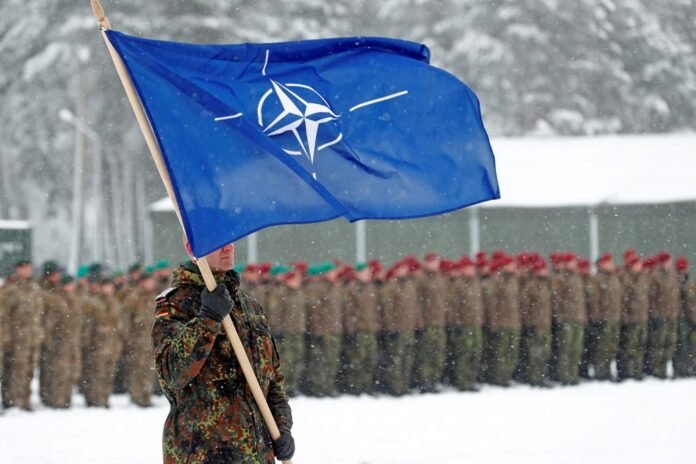
In the end, the world blames Russia — perhaps rightly — but seldom examines the mirror of betrayal that stands behind NATO’s flag. History, however, is unforgiving. Every unkept promise returns as a storm. And in that storm, the ghosts of 1990 still whisper: “Not one inch eastward.”
But eastward they went — and the world burns for it.
The Burevestnik: Russia’s Offensive Shot in the New Cold War
When President Vladimir Putin unveiled the 9M730 Burevestnik — a nuclear-powered, nuclear-capable cruise missile said to have “unlimited range and no equivalent in the world” — it was more than a military announcement; it was a geopolitical gunshot.
In that moment, Moscow signaled to NATO that deterrence had evolved into dominance. The Burevestnik, capable of traversing continents and evading every known missile shield, represents not merely a technological triumph but a strategic declaration: that Russia is no longer reacting to Western pressure, it is reshaping the battlefield geometry itself.
This weapon is less about warfare and more about psychological supremacy — an open defiance of NATO’s combined capabilities. It tells Washington, Brussels, and London that the Cold War’s sequel will not be fought in ideology, but in velocity, precision, and endurance.
Thus, as the Burevestnik roars into military mythology, the message is clear: the New Cold War has officially turned from containment to confrontation — and this time, Russia fired the first offensive shot.