
By Emmanuel Mihiingo Kaija
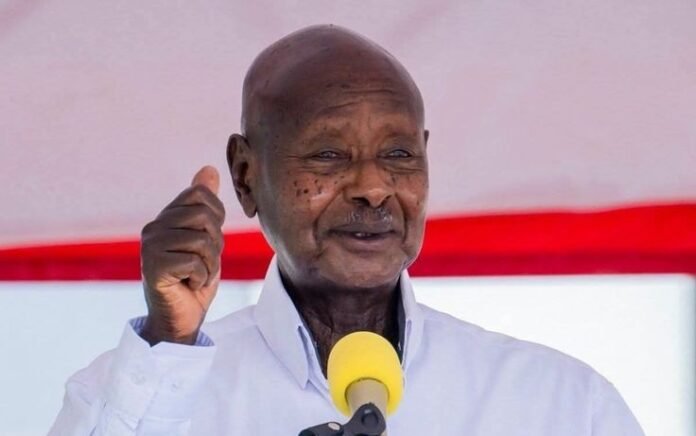
In mid‑December 2025, President Yoweri Kaguta Museveni stood before a crowd in Bukuya Town Council, Kassanda District, and explicitly linked the district’s slow progress on basic services — notably poor road conditions, limited access to clean drinking water in roughly 66 per cent of villages, and gaps in electrification — to the electorate’s decision to elect opposition leaders. He invoked the figure that only 34 per cent of Kassanda’s 569 villages had safe water sources and suggested that this lag behind national averages was evidence of a “mistake” in political choice, and urged residents not to vote opposition candidates in the upcoming January 15, 2026 general election. In making this claim, Museveni also criticised local legislators and district officials for failing to advocate strongly enough for national government support on infrastructure, hinting that partisan allegiance affects bureaucratic responsiveness and prioritisation. While this narrative makes for effective campaign rhetoric — simplifying complex development outcomes into a political cause–effect — it fails to account for the structural drivers of development outcomes in Uganda’s public budgeting, decentralised governance frameworks, and multi‑sectoral investment realities. It also omits critical context on national development programmes such as the Parish Development Model (PDM) and the wider economic constraints that shape how resources flow to local areas across all political contexts, not just those with opposition representation.
Uganda’s national budget architecture demonstrates that the allocation of resources for infrastructure and social services — including roads, water, sanitation, education, and health — is determined through broad, formulaic, and policy‑driven planning processes that do not link development financing to the political party of local leaders. The 2025/26 national budget outlined substantial allocations to human capital development (about 26.1 per cent of total expenditure) and integrated transport infrastructure (about 14.6 per cent), explicitly reflecting government priorities aimed at improving quality of life and connectivity across all districts. Human capital spending in the budget is intended to improve access to healthcare, education, and the expansion of safe water and sanitation services — long‑standing national goals aimed at equitable outcomes rather than partisan rewards. Similarly, transport allocations bolster connectivity nationwide through road maintenance, rehabilitation, and transport services designed to facilitate trade and mobility, not through selective reinforcement in politically aligned regions. These budget priorities emerge from sectoral planning, parliamentary negotiations, and macroeconomic strategies meant to drive socioeconomic transformation, not from localized electoral outcomes.
Beyond the headline numbers, Uganda’s fiscal landscape is shaped by macroeconomic realities that constrain how much can be invested in local development regardless of how a community votes. Public debt has been rising, prompting the government to engage with international financial institutions and external partners to finance large infrastructure, urban development, and service delivery projects. Examples include securing hundreds of millions of euros in concessional funding for national water and sanitation initiatives — such as the Greater Kampala Metropolitan Area water expansion project financed by France, aimed at expanding coverage and improving potable water systems with clear goals aligned to attaining 100 per cent piped water access by 2040. Such funding deals and international commitments are negotiated at the national level and address systemic service gaps — including water access — that affect urban and rural areas alike. These macro‑level financial decisions reflect long‑range development planning, economic growth aspirations, and international cooperation, which cannot be credibly reduced to the political complexion of local MPs.
The institutional capacity of local governments to plan, coordinate, and implement projects under Uganda’s decentralised system is another pivotal determinant of development outcomes that transcends political affiliation. Local government councils and technical teams are responsible for identifying priorities, preparing credible project proposals, managing procurement processes, and ensuring compliance with national standards — functions linked to professional governance capacity rather than electoral politics. For example, major transport infrastructure such as the Myanzi‑Kassanda‑Bukuya‑Kiboga road requires extensive engineering planning, environmental compliance, contractor engagement, and phased execution, tasks that depend on administrative effectiveness, budgeting timelines, and logistical sequencing rather than on which political party wears majority seats in a district assembly. Similarly, safe water provision — a central element of Kassanda’s development challenges — involves assessments of aquifer capacity, borehole drilling, and long‑term maintenance programming that often hinge on technical expertise and cross‑sector coordination managed through central and local government partnerships. The Parish Development Model (PDM) reinforces this perspective by embedding planning, budgeting, and service delivery at the parish level with structured community participation and multi‑sectoral engagement, positioning each parish as the hub for orchestrating development interventions that reflect local priorities within a national framework. This model emphasises production, infrastructure, financial inclusion, and governance pillars that are designed to work across political lines.
It is also important to consider that national programmes and investment frameworks are structured to be inclusive in design, not part of a partisan reward system. The Parish Development Model — a flagship socio‑economic initiative adopted under Uganda’s Third National Development Plan — explicitly aims to deepen decentralisation and ensure that services reach citizens at the lowest administrative level. This initiative integrates governance and community planning mechanisms that enable households to participate in development decision‑making and resource allocation, with goals such as increasing household incomes, expanding financial inclusion through parish SACCOs, enhancing agricultural value chains, and improving social services. In recent policy announcements, the government pledged to double PDM funding per parish, indicating an intention to accelerate grassroots economic transformation across all parishes, not merely those governed by politically affiliated leaders. These enhancements are part of a broader strategy to bridge gaps in service delivery and economic participation , highlighting that development interventions are calibrated in structural terms rather than partisan terms.
Public service challenges — particularly water and sanitation — also have measurable economic impacts that extend beyond political rhetoric. Research from Uganda’s Economic Policy Research Centre (EPRC) shows that inadequate investment in water, sanitation, and hygiene (WASH) services can cost the national economy up to 2.9 per cent of GDP annually in lost productivity, healthcare costs, and premature deaths. This figure underscores that water access and sanitation are not fringe issues but central economic and public health imperatives whose solutions require coordinated, sustained investment across localities. These dynamics reveal that underinvestment, technical bottlenecks, and execution capacity are core determinants of water service outcomes — far more so than simply which party’s candidate occupies a local office.
Finally, framing underdevelopment as a direct result of opposition voting risks undermining democratic accountability and citizen engagement by positioning service delivery as dependent on political allegiance rather than on governance performance. When political discourse conflates loyalty with access to services, it obscures the real avenues through which citizens can engage government — budget process scrutiny, participatory planning mechanisms like PDM, local council oversight sessions, and public expenditure tracking. A more constructive and evidence‑based public conversation would invite scrutiny of how national and local budgets are executed, how institutional governance systems manage project implementation, and how communities can strengthen their own planning and accountability structures to improve outcomes regardless of political composition.
Bibliography
Monitor Reporter. (2025, December 17). 2026 elections: Museveni blames opposition for Kassanda’s poor roads. Daily Monitor. https://www.monitor.co.ug/uganda/news/national/2026-elections-museveni-blames-opposition-for-kassanda-s-poor-roads-5300572
Museveni blames Kassanda’s poor services on opposition voting, asks residents to reverse trend. (2025, December 18). Nile Post. https://nilepost.co.ug/2026-election-watch/310860/museveni-blames-kassandas-poor-services-on-opposition-voting-asks-residents-to-reverse-trend
Government boosts Parish Development Model funding to combat poverty. (2025, January 13). Presidential Initiatives.
https://presidentialinitiatives.go.ug/government-boosts-parish-development-model-funding-to-combat-poverty/
Parish Development Model. (n.d.). Ministry of ICT and National Guidance.
https://ict.go.ug/ims/public/index.php/programs/parish-development-model
Uganda’s 2025/26 budget: strategic priorities and allocations. (2025). PricewaterhouseCoopers Uganda. https://www.pwc.com/ug/en/press-room/ugandas-2025-26-budget-driving-economic-transformation.html
Parliament approves €183m water and sanitation loan. (2025, September 17). Parliament of Uganda. https://www.parliament.go.ug/news/4204/eu183m-water-and-sanitation-loan-approved
Inadequate WASH investment costs Uganda nearly 3% of GDP. (2024, November 27). Economic Policy Research Centre. https://eprcug.org/press-releases/inadequate-investment-in-water-sanitation-and-hygiene-wash-services-cost-uganda-nearly-three-percent-of-gdp/