

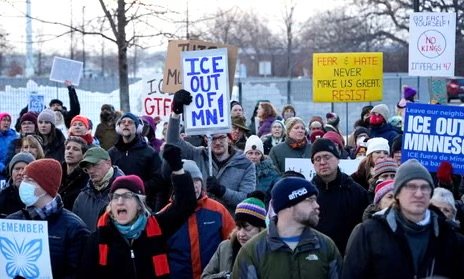
The White House has announced the end of a controversial large-scale immigration enforcement operation in Minnesota, marking a rare pullback for President Donald Trump after weeks of protests, political fallout, and mounting criticism from both Democrats and some Republicans.
Speaking Thursday at a federal field office outside Minneapolis, White House border czar Tom Homan confirmed that the administration would wind down Operation Metro Surge, an aggressive deportation campaign that sent thousands of armed immigration agents into the state earlier this year.
“I proposed, and the president agreed, that this surge operation conclude,” Homan told reporters. “Operation Metro Surge is ending.”
A Massive Operation, a State in Turmoil
The operation, launched in January, involved the deployment of about 3,000 immigration enforcement agents to Minnesota—far above the roughly 150 agents typically assigned to the state. The Trump administration described it as the largest deportation effort in U.S. history, arguing it was necessary to protect public safety.
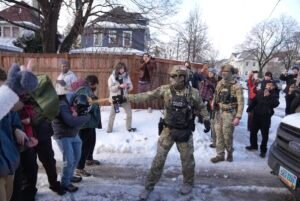
But the surge quickly became a flashpoint. Governor Tim Walz, Minnesota’s Democratic governor, condemned the operation, accusing federal authorities of overreach and warning that heavily armed raids were traumatizing communities rather than making them safer. Thousands of residents poured into the streets of Minneapolis and other cities, staging protests that at times drew national attention.
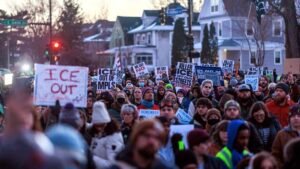
Tensions escalated further after two U.S. citizens, Renee Good and Alex Pretti, were fatally shot by immigration agents in separate incidents while observing or protesting enforcement actions. The deaths sparked outrage and intensified scrutiny of federal tactics in the state.
Political Pressure and Falling Support
The Minnesota operation unfolded against the backdrop of Trump’s long-standing promise of mass deportations, a central pillar of his 2024 campaign. Yet public support appeared to erode as images spread of immigration officers operating in military-style gear.

According to Reuters/Ipsos polling in January, approval of Trump’s immigration agenda fell to its lowest point of his presidency during the height of the surge. Even some Republican lawmakers raised concerns—particularly over how federal officials initially labeled the slain Americans as “domestic terrorists,” a claim later criticized as premature.
Senator Rand Paul, chairman of the Senate committee overseeing homeland security, said the administration’s handling of the deaths damaged its credibility. “People aren’t believing there’s going to be an honest investigation,” he said during a hearing in Washington.
Homan said that while immigration enforcement will continue, it will return to more traditional levels. He previously announced that 700 agents would be withdrawn; on Thursday, he said many of the remaining out-of-state agents would also return home over the next week. He cited “unprecedented coordination” with Minnesota law enforcement as part of the shift.
“ICE will continue to identify, arrest, and remove individuals who pose a risk to public safety,” Homan said, adding that officers would carry out their duties with “professionalism, integrity, and compassion.”
Minnesota Reacts: Relief, Skepticism, and Anger
Governor Walz welcomed the decision but cautioned that the damage would not be easily undone. “The long road to recovery starts now,” he said, pointing to disruptions to schools, local businesses, and families who have lived in fear for weeks.
Minneapolis Mayor Jacob Frey, who joined Walz in suing the Trump administration over the surge, called the impact “catastrophic.” “They thought they could break us,” Frey said, “but a love for our neighbors and a resolve to endure can outlast an occupation.”
Not everyone is convinced the crisis is over. Avonna Starck, a school board member and nonprofit leader, said the community had hoped for a complete withdrawal of federal agents. “They’re not removing all agents,” she said. “That was the goal.”
Community organizer and small business owner Miguel Hernandez echoed that frustration, arguing that there has been no accountability for the operation or the deaths that occurred. “They’re saying it’s over so people stop paying attention,” he said. “But harm was done—and it’s still being done.”
As Minnesota begins to adjust to the scaled-back presence of federal agents, residents remain divided between relief and lingering distrust, with many vowing to continue watching closely what comes next.
Source: Africa Publicity