
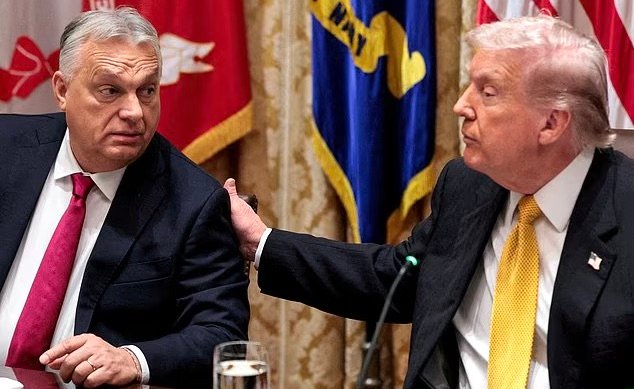
A political storm has erupted across Europe after a US defense news outlet reported seeing what it described as a leaked, unverified American policy document outlining an alleged plan to draw four European Union members—Austria, Italy, Hungary, and Poland—closer to the United States and further from Brussels.The report, published by Defense One, claimed the proposal was framed as part of a broader “Make Europe Great Again” (MEGA) initiative supposedly circulated before the release of Washington’s official National Security Strategy (NSS). The White House, however, has firmly rejected the story, calling the document non-existent and the claims “flatly false.”
The Alleged Contents of the Leak
According to Defense One, the disputed document described an effort to reposition parts of Central and Southern Europe politically and strategically by encouraging stronger bilateral ties with Washington.
Among the most striking allegations:
The United States should “work more closely” with Poland, Austria, Italy, and Hungary with the long-term aim of “pulling them away from the European Union.”
Washington should offer support to political groups emphasizing national sovereignty, cultural traditionalism, and skepticism toward EU federalism.
The plan supposedly promoted backing movements committed to protecting “traditional European ways of life” as long as they remained aligned with US interests.

The alleged draft was said to be a more expansive internal version of the NSS released publicly a week earlier. The publicly released strategy, which sparked controversy on its own, warned of a possible “civilisational erasure” in Europe and questioned the long-term reliability of some European allies.
White House Response
Within hours of the leak gaining traction online, the White House issued a sharp rebuttal.
Deputy Press Secretary Anna Kelly insisted that no alternate or earlier version of the NSS contained such proposals.
“President Trump is transparent and has signed a national security strategy that clearly directs the US government to implement its established principles and priorities,” she said, dismissing the Defense One report as baseless.
The administration expressed frustration at what it described as misinformation spreading rapidly across European media outlets and social platforms.
Context: Tensions Over Migration and European Politics
The controversy comes at a moment when President Trump has repeatedly criticized European leaders.
In recent interviews, he has argued that large-scale migration has weakened national sovereignty, destabilized social unity, and led to political paralysis within the EU.
He has also openly attacked what he calls “politically correct” decision-making in Europe, claiming it is contributing to social decline.
These remarks followed tense conversations between Trump and European leaders—including German Chancellor Friedrich Merz, UK Prime Minister Keir Starmer, and French President Emmanuel Macron—regarding the future of Ukraine and Europe’s role in the ongoing conflict with Russia.
Reactions Across Europe
European leaders quickly pushed back against the idea that Washington might seek to reshape internal EU political dynamics.
António Costa, President of the European Council, condemned any suggestion that the United States should influence which political parties gain power in Europe, saying,
“The United States cannot replace European citizens in choosing which are the right parties and which are the wrong parties.”
Friedrich Merz adopted a more cautious tone, signaling understanding for some US concerns while insisting that Europe must work toward greater independence in defense and strategic decision-making.
Polish Prime Minister Donald Tusk publicly urged continued unity with the US, posting on X that Europe “is your closest ally, not your problem,” emphasizing the shared security concerns of the past eight decades.
Some political figures on Europe’s hard right, including Dutch politician Geert Wilders, welcomed the alleged strategy and argued that it aligned with their long-standing warnings about migration and cultural change. His comments, however, drew sharp criticism from mainstream politicians who argued that such endorsements risk deepening divisions across the continent.
Broader Stakes
The debate has widened beyond the alleged leak itself. Analysts say the incident exposes deepening uncertainty over the future of transatlantic cooperation, especially as Europe confronts questions about defense autonomy, migration pressure, and internal political polarization.
Leslie Vinjamuri of Chatham House described the moment as a potential turning point, warning that any US effort to back nationalist movements within the EU could reshape the post-Cold War order that has underpinned European stability for decades.
Meanwhile, President Trump has continued to criticize EU institutions, including recent regulatory actions such as a major fine imposed on the social media platform X. His comments—suggesting Europe is “going in some very bad directions”—have reinforced fears in parts of Europe that Washington may be recalibrating its strategic priorities.
As the debate continues, European leaders are preparing for further discussions about Ukraine, security cooperation, and the direction of EU-US relations—uncertain whether the alleged leak reflects genuine internal thinking or simply a misinterpreted document that never held official standing.
Source:Africa Publicity