

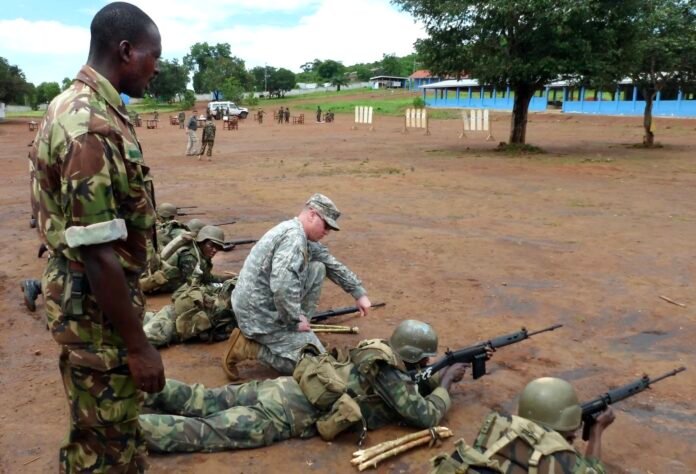
The United States has announced plans to deploy approximately 200 military personnel to Nigeria in the coming weeks as part of an expanded security partnership aimed at countering Islamist militant groups that have destabilized parts of the country for over a decade.
The deployment, first reported by The Wall Street Journal and later confirmed by U.S. and Nigerian officials, represents a notable increase in U.S. military support for Nigeria. The incoming personnel will reinforce a small American team already operating in the country, which has been assisting Nigerian forces primarily with air-strike targeting and intelligence coordination.
According to officials, the U.S. troops will not take part in direct combat operations. Instead, their mission will focus on training, technical assistance, intelligence sharing, and operational planning. The goal is to enhance the Nigerian military’s capacity to conduct more effective and coordinated operations against jihadist groups operating across various regions of the country.
Major General Samaila Uba, spokesperson for Nigeria’s Defence Headquarters, confirmed the development, stating that the American personnel would provide support strictly within a training and advisory framework.
“We are getting U.S. troops to assist in training and technical support,” Uba said, emphasizing that the deployment does not involve frontline combat roles.
The additional troops are expected to help Nigerian forces improve their ability to plan and execute complex joint operations, particularly those that require close coordination between air power and ground troops. This includes advising on mission planning, synchronizing air strikes with troop movements, and improving intelligence-driven operations.
A spokesperson for the U.S. Africa Command (AFRICOM) also confirmed the details of the deployment, noting that the initiative aligns with ongoing efforts to support regional partners confronting violent extremist organizations.
The move follows a series of actions that have steadily deepened military cooperation between Washington and Abuja. In December, the United States carried out air strikes targeting militant elements in Nigeria’s northwestern Sokoto State as part of a joint operation with Nigerian forces. Earlier in the year, a small team of U.S. military specialists was deployed to assist with targeting and operational support.
Nigeria has battled multiple Islamist and armed groups for years, particularly in the northeast, where Boko Haram and its splinter faction, the Islamic State West Africa Province (ISWAP), have waged a prolonged insurgency. In recent years, violence has also spread to the northwest and north-central regions, where armed groups have carried out attacks on civilians and security forces.
The deployment comes amid broader diplomatic engagement between the two countries over Nigeria’s security challenges. The United States has previously expressed concern about widespread insecurity, with President Donald Trump at various times describing the violence—particularly against Christian communities—as “persecution” and “genocide.”
Despite these diplomatic pressures, both governments have continued to identify counterterrorism and regional stability as shared priorities. U.S. officials have indicated that, beyond troop deployment, Washington will continue to support Nigeria by providing actionable intelligence for air operations and by helping to speed up the procurement of military equipment.
Officials on both sides have stressed that the expanded cooperation is intended to strengthen Nigeria’s own capabilities rather than replace them. Major General Uba reiterated that U.S. forces would not be embedded in combat units or directly involved in military operations.
“U.S. troops are not going to be involved in direct combat or operations,” he said, underscoring Nigeria’s continued leadership of all military actions within its territory.
Security analysts view the deployment as a significant, though measured, step in U.S.–Nigeria relations, reflecting Washington’s preference for advisory and capacity-building roles rather than large-scale troop commitments. As the new personnel arrive, attention will likely focus on whether the enhanced training and coordination translate into tangible gains against militant groups and improved security for affected communities.
The deployment is expected to begin within weeks, with further details on locations and duration yet to be officially disclosed.
Source: Africa Publicity