

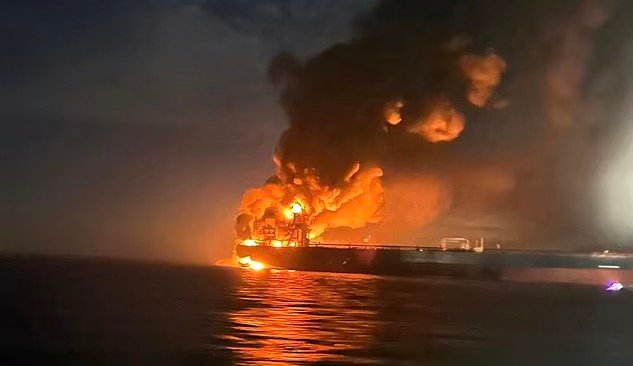
A sanctioned Russian oil tanker operating as part of Moscow’s so-called “shadow fleet” suffered significant damage on Wednesday after being struck by Ukrainian maritime drones in the western Black Sea. The incident marks the latest in a growing series of drone operations targeting vessels accused of helping Russia bypass international oil sanctions.
Drone Strike Halts Movement of 164,000-Ton Tanker
The tanker Dashan, a 902-foot, 164,608-ton vessel reportedly used to transport oil covertly on behalf of the Kremlin, was traveling toward the Russian port of Novorossiysk when it was hit. Ukrainian defense sources say the strike was carried out using “Sea Baby” naval drones, an increasingly prominent component of Kyiv’s strategy to disrupt Russia’s wartime logistics.
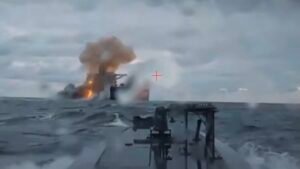
Footage circulating on social media shows an explosion erupting near the stern of the tanker, sending flames and a plume of smoke into the sky. Though the full extent of the damage remains unclear, satellite tracking data indicates that the tanker came to an abrupt stop, suggesting a loss of propulsion or structural impact.
Ukrainian sources described the strike as a joint operation involving the Security Service of Ukraine’s (SBU) 13th Counterintelligence Directorate and the Ukrainian Navy. The Dashan was reportedly traveling without an active transponder—a technique commonly used by ships attempting to conceal their movements.
Russia Blames the UK, Claims Foreign Involvement
Within hours of the attack, Russian military channels moved to assign blame beyond Ukraine. The pro-Kremlin monitoring group Rybar claimed that a British RC-135W electronic reconnaissance aircraft had been patrolling over the western Black Sea during the attack.
According to Rybar, the aircraft later flew toward the tanker’s location and continued monitoring operations near the Crimean coastline. Russia has not provided evidence to substantiate the allegation, and the UK’s Ministry of Defence did not immediately respond to the claims. British and NATO reconnaissance aircraft routinely patrol international airspace over the region as part of ongoing surveillance efforts linked to the conflict.
Fourth Strike in Two Weeks, Russia Says
Russian authorities stated that the incident marks the fourth attack on a Russian tanker in two weeks, underscoring Ukraine’s intensifying campaign against vessels linked to Russia’s wartime economy. Many of these ships—including the Dashan—have been blacklisted by Western governments for participating in sanction-evading oil trades.
The emergence of Russia’s shadow fleet—hundreds of older tankers reflagged under obscure jurisdictions and operating with minimal transparency—has become a central challenge for international regulators attempting to enforce price caps and export restrictions on Russian crude.
Ukraine’s Expanding Naval Drone Strategy
This latest strike follows a series of high-profile drone operations in recent months. Ukrainian sea drones previously hit multiple tankers transporting Russian oil in the Black Sea and near the Bosphorus Strait, producing dramatic fireballs captured on onboard and surveillance cameras.
Video released in earlier incidents shows unmanned naval craft skimming the waves at high speed before colliding with targeted vessels. The resulting blasts generated columns of smoke visible for miles—part of Ukraine’s broader effort to disrupt Russian supply lines, ports, and military infrastructure even far from the frontline.
Officials in Kyiv say the drones used in these operations are part of the “Sea Baby” program, designed by Ukraine’s intelligence and naval forces to carry explosive payloads long distances and strike high-value maritime targets. These drones have also been deployed against Russian bridges, naval ships, and coastal facilities.
Broader Implications for the Black Sea
Analysts say the uptick in drone attacks highlights growing tensions in the Black Sea—a region central to both Russia’s oil exports and Ukraine’s maritime security. The conflict has increasingly shifted seaward as Ukraine seeks asymmetric tools to challenge Russia’s naval dominance.
If attacks continue, they could further complicate global shipping routes, international insurance coverage, and oil market stability, particularly for vessels operating near conflict-adjacent waters.
For now, the Dashan remains immobilized, and both Ukrainian and Russian authorities are monitoring the aftermath as the geopolitical contest over Black Sea control intensifies.
Source:Africa Publicity