

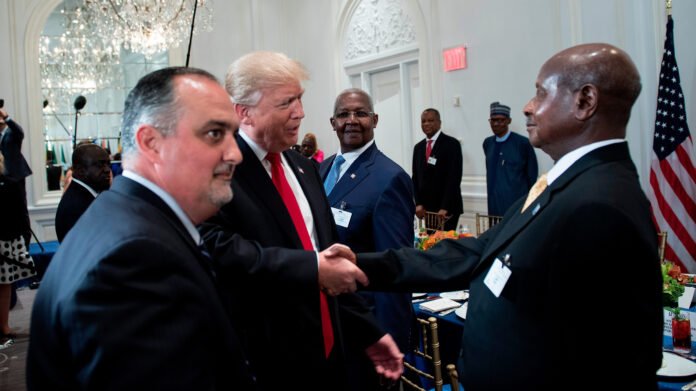
Uganda is set to receive up to $1.7 billion in health-sector funding from the United States over the next five years, becoming one of the latest African nations to enter a long-term partnership under the Trump administration’s redesigned approach to foreign aid. The agreement reflects a broader shift in Washington’s development policy toward encouraging greater financial participation and long-term self-sufficiency among partner countries.
Context of the New Funding Model
The funding package falls under the administration’s “America First Global Health Strategy,” a framework that has already resulted in similar agreements with Kenya and Rwanda in recent days. While the U.S. remains a major global health donor, the strategy emphasizes a gradual transition in which low- and middle-income countries take a more active role in planning, financing, and executing responses to public health threats.
This model is designed to reduce heavy reliance on U.S. aid while promoting stronger domestic health systems. Partner countries are expected to expand their own health budgets and strengthen governance structures to ensure sustainability once donor funding decreases.
Breakdown of U.S. Support
According to a statement released by the U.S. Embassy in Uganda, the funding will be directed toward Uganda’s highest-priority health concerns. The package will include support for:
HIV/AIDS programs, including prevention, testing, and treatment
Tuberculosis control, with a focus on early diagnosis and drug-resistant strains.
Malaria prevention, including insecticide-treated nets and community-level interventions.
Maternal and child health, addressing preventable deaths and improving access to skilled care.
Polio prevention and surveillance, contributing to global eradication efforts.
Additional investments in strengthening laboratory systems, disease surveillance, and emergency preparedness
The arrangement aligns with existing collaborations between Uganda and U.S. agencies, many of which were previously funded through structures like the President’s Emergency Plan for AIDS Relief (PEPFAR) and global health security initiatives.
Uganda’s Commitment to Increased Health Spending
Uganda’s Ministry of Finance announced that the government will contribute an additional $500 million over the course of the partnership. These funds are intended to support the transition toward greater national ownership of health programs.
Finance Minister Matia Kasaija emphasized that the collaboration is intended not only to reduce the burden of infectious diseases, but also to strengthen the foundations of Uganda’s public health system. In a statement posted on X, he highlighted that improvements are expected across national health institutions, the health workforce, and health-service delivery systems.
“This collaboration will yield not only disease-specific outcomes but also significant improvements in national systems, institutions, and workforce capacity,” Kasaija said.
A Changing Landscape for U.S. Foreign Aid
The partnership comes at a moment when U.S. funding patterns have been shifting. While the United States has historically been one of Uganda’s most significant health-sector donors, overall support has declined during the current administration. Reductions followed decisions to cut portions of the foreign aid budget and to close USAID, the agency that previously administered much of the U.S.’s development assistance.
The new strategy does not eliminate U.S. engagement, but restructures it. Instead of multiple agencies overseeing foreign aid, the administration has centralized its approach, aiming for tighter accountability and increased partner-nation responsibility.
Implications for Uganda’s Health Sector
For Uganda, the agreement provides a substantial boost at a time when the health sector continues to face challenges, including shortages of medical personnel, pressure on public hospitals, and the ongoing need to combat infectious diseases that disproportionately affect rural and low-income communities.
If fully implemented, the funding framework is expected to:
Reduce out-of-pocket costs for vulnerable groups
Expand access to life-saving treatments
Strengthen Uganda’s surveillance
Capacity to detect outbreaks early
Support long-term workforce
Development through training and retention programs
Source:Africa Publicity