

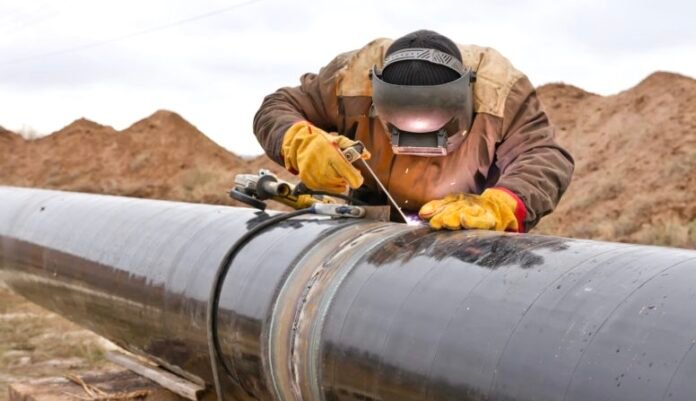
Uganda’s government says construction of the East African Crude Oil Pipeline (EACOP) has reached roughly 75% completion, marking a major step toward launching the country’s long-delayed oil production next year. The announcement comes nearly two decades after Uganda first discovered commercially viable deposits in its Albertine rift basin.
The 1,443-kilometre (897-mile) pipeline—estimated at $5 billion—will transport crude from the oilfields in western Uganda to Tanzania’s Tanga port on the Indian Ocean. Once operational, EACOP will become the world’s longest electrically heated crude pipeline, a design required to keep Uganda’s waxy crude flowing.
Ernest Rubondo, executive director of the Uganda Petroleum Authority, said all pipeline sections have now been delivered to storage and construction sites along the route, adding that the overall petroleum sector has already attracted about $3.3 billion in investment through EACOP alone. TotalEnergies holds a 62% stake in the pipeline, while the remaining equity is shared by China’s CNOOC and the national oil companies of Uganda and Tanzania.
Production Expected in Late 2025 as Mega-Projects Advance
Uganda has set the second half of 2025 as the target for first oil from its multibillion-dollar Tilenga and Kingfisher projects operated by TotalEnergies and CNOOC. Officials say the $15 billion upstream development cannot begin producing unless EACOP is completed and fully tested.
Rubondo reported that drilling and on-site development work is advancing steadily—about 60% complete at the Tilenga fields and 74% at Kingfisher. Between 2025 and 2027, more than $4 billion is expected to be invested in additional production infrastructure, storage facilities, and export preparation.
A Controversial Project Moving Ahead
Although both Kampala and Dodoma have championed EACOP as a major driver of economic growth, the pipeline remains controversial. Environmental groups have raised concerns about risks to wildlife habitats, water sources, and communities along the route, while some Western financiers have backed away from the project following public criticism.
Ugandan officials maintain that the project adheres to international environmental and safety standards and argue that crude exports will provide critical revenue for national development.
With construction reportedly three-quarters complete and upstream operations in their final stages, Uganda says it remains on track to enter the ranks of oil-producing nations by late next year—provided remaining pipeline work proceeds on schedule.
Source:Africa Publicity