

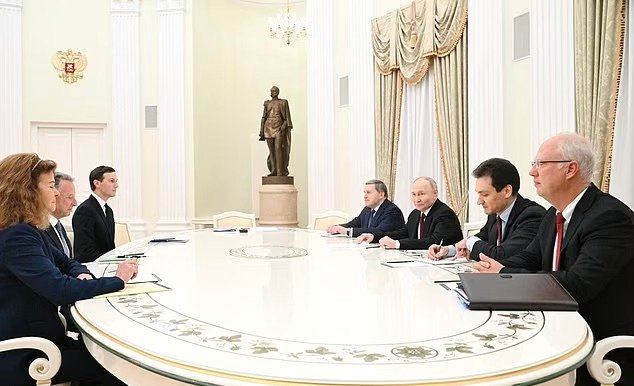
An attempt to revive momentum toward ending the war in Ukraine has faltered after key diplomatic talks in Moscow failed to produce meaningful progress, leading to the sudden cancellation of a planned meeting between Ukrainian President Volodymyr Zelensky and representatives of former U.S. President Donald Trump. The abrupt change in schedule has raised new doubts about the viability of any near-term settlement, even as rhetoric from the Kremlin grows more confrontational.
On Tuesday, Trump’s envoys, Steve Witkoff and Jared Kushner, concluded nearly five hours of discussions with Russian President Vladimir Putin at the Kremlin. The meeting was intended to move forward a U.S.-backed peace initiative that Trump had promoted as a realistic path toward ending the conflict. The discussions, however, proved to be far more difficult than expected, exposing deep divisions on fundamental issues such as territory, security arrangements, and Ukraine’s future political direction.
Following the Moscow talks, Witkoff and Kushner were due to travel to Brussels for a follow-up meeting with President Zelensky. That meeting was expected to provide Ukraine with an update on the discussions and offer Kyiv the chance to respond directly to the proposals put forward in Moscow. But late Tuesday night, plans changed. Instead of heading to Europe, the American delegation reportedly flew directly back to Washington, D.C.
A journalist with the Kyiv Post later confirmed on social media that the Brussels meeting had been called off and that Zelensky was returning to Ukraine. No official explanation was provided by Kyiv or Washington, but the timing of the cancellation strongly suggests that the lack of progress in talks with Russia made further discussions unnecessary — or potentially counterproductive.
At the same time, tensions were heightened by a stark warning from Putin. Speaking amid the collapsed momentum, the Russian leader stated that Moscow was “ready” for broader conflict if challenged by Europe. He warned that any direct confrontation would be so devastating that there would be “nobody left to negotiate peace with” afterward. The comments added to growing concern among European leaders, who already fear that Russia’s ambitions extend beyond Ukraine.
Only a month ago, there were renewed hopes that an end to the war might be within reach when Trump unveiled a 28-point peace framework aimed at Moscow and Kyiv. Modeled loosely on the structure of the Gaza ceasefire initiative that Trump’s circle had earlier supported, the plan was marketed as a comprehensive solution that could stop the fighting and stabilize the region. Initial optimism, however, quickly gave way to skepticism.
Analysts pointed out that the proposal failed to meet many of Russia’s most rigid demands — commonly referred to as its “maximalist” position. These demands include international recognition of annexed Ukrainian land, the demilitarization of Ukraine, and a commitment to new national elections within 100 days. Without these guarantees, Russian officials have signaled little willingness to compromise.
Ukraine, on the other hand, found even the diluted version of the proposal unacceptable. A revised 19-point draft scaled back some original concessions, such as abandoning NATO ambitions altogether or giving up the entire eastern Donbas region. Still, critical elements remained highly controversial. Among the most sensitive requirements were a partial withdrawal by Ukrainian forces from areas of Donetsk currently under Kyiv’s control, a vague promise of long-term security without clear enforcement mechanisms, and a mandated reduction of Ukraine’s military by roughly 25 percent. Zelensky’s government viewed these terms as dangerous and one-sided, arguing that they would leave the country vulnerable to future attacks.
Despite the tense backdrop, the Kremlin did acknowledge Trump’s efforts. On Wednesday, spokesperson Dmitry Peskov described the talks as a normal part of a complex diplomatic process, noting that it was the first direct exchange of views between the two sides on this particular plan. However, he also made clear that Russia had firmly identified elements it deemed “unacceptable.”
Both the American and Russian delegations agreed that the specific details of the discussions would remain confidential. Still, senior Russian presidential adviser Yuri Ushakov confirmed that one of the greatest hurdles — the fate of four partially occupied Ukrainian regions that Russia claims as its own — remains unresolved. “So far, a compromise hasn’t been found,” he admitted, adding that without agreement on territorial questions, the Kremlin sees “no resolution to the crisis.”
Ukraine has consistently and publicly rejected the idea of surrendering any land that has been seized. For Kyiv, territorial integrity is not negotiable, and any proposal involving withdrawal or formal recognition of Russian control is considered a non-starter.
When asked whether the meetings had brought peace closer or pushed it further away, Ushakov offered a cautious and ambiguous answer. He said the talks had not made the situation worse but emphasized that extensive work remained to be done in both Washington and Moscow if progress was ever to occur.
Meanwhile, worry continues to spread across Europe. Several countries have reported increased activity from Russian drones and military aircraft near their borders, as well as alleged sabotage operations targeting infrastructure and communication networks. Many European leaders fear that if Russia succeeds in achieving its objectives in Ukraine through force or intimidation, it could embolden further aggression against neighboring states.
In the end, what was once presented as a promising diplomatic push now appears stalled, at least for the moment. The cancellation of the Zelensky meeting, the lack of any compromise on territory, and Putin’s warning to Europe all point to a hard reality: a peaceful resolution to the war in Ukraine remains outhill and uncertain, with no clear path forward in sight.
Source:Africa Publicity