

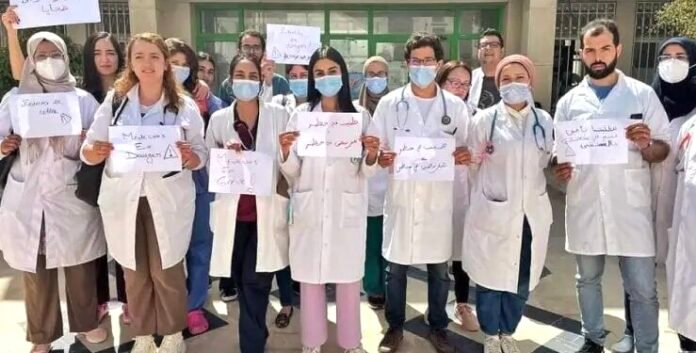
Tunisia’s public health sector came under renewed pressure on Wednesday as thousands of young doctors launched a nationwide strike, demanding better wages and urgent reforms to prevent what they describe as the imminent collapse of the medical system.
The walkout, one of the largest health-sector protests in recent years, reflects growing anger within a country already gripped by social unrest, chronic shortages, and deepening economic turmoil. Tunisia has been facing waves of demonstrations over failing public services, pollution crises, and rising living costs—unrest that collectively represents the most significant challenge to President Kais Saied since he consolidated power in 2021.
“We are exhausted and underpaid, and we’re working with tools that barely function,” said Marwa, a young doctor who withheld her surname for security reasons. She joined hundreds of colleagues in central Tunis, all wearing white coats and carrying signs such as “Save our hospitals” and “Dignity for doctors.”
A Health System Under Strain
Doctors at the protest said their frustrations stem not only from stagnant wages but from collapsing infrastructure across public hospitals. Many facilities lack basic medical supplies, rely on outdated machines, and struggle to retain staff as young professionals increasingly migrate to Europe and Gulf countries for better pay and working conditions.
“We’re witnessing a mass flight of talent,” said Wajih Dhakkar, head of the Young Doctors’ Organisation. “If authorities continue to ignore the seriousness of this crisis, we will escalate our actions. We intend to stand at the forefront of Tunisia’s broader social movement.”
The strike led to widespread service disruptions, though emergency care remained operational. Several medical associations warned that without immediate investment, Tunisia risks a long-term deterioration in healthcare outcomes, including delayed surgeries, reduced specialist services, and rising preventable mortality.
A Wider Climate of Unrest
Public frustration has been building across multiple sectors. Transport workers and bank employees have staged their own wage strikes in recent months, citing eroding purchasing power. In the southern city of Gabes, thousands continue to protest hazardous pollution linked to a state-run chemical plant, intensifying pressure on local authorities.
President Saied, however, has dismissed claims of state mismanagement, alleging that “infiltrators” and “saboteurs” are deliberately manufacturing crises to destabilize the country. Critics argue that his consolidation of executive power—after suspending parliament and rewriting parts of the constitution—has weakened public institutions and left little room for dialogue.
Tunisia’s Health Ministry did not respond to repeated requests for comment on the strike or on concerns raised by medical professionals.
As the country’s economic outlook worsens and public services degrade, analysts warn that Tunisia could see more disruptive protests in the months ahead unless the government finds a way to address mounting grievances across multiple sectors.
Source:Africa Publicity