

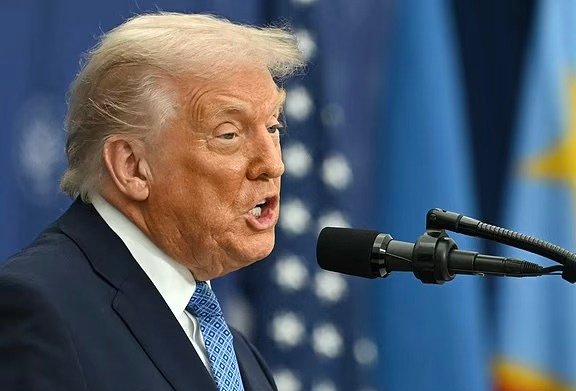
A new national security strategy linked to former U.S. President Donald Trump has issued a stark warning about the future of Europe, claiming that the continent could become “unrecognizable ” within the next two decades if current political, demographic, and migration trends continue.
The document, which reflects the hardline “America First” worldview that defined much of Trump’s presidency, paints an alarming picture of Europe’s future. It argues that large-scale migration, declining birth rates, cultural shifts, and political divisions are contributing to what it calls a process of “civilisational erosion” across several European countries.
According to the strategy paper, some members of the North Atlantic Treaty Organisation (NATO) could become “majority non-European” in demographic terms within a few decades if current trends persist. The document frames this projection as more than theoretical, suggesting that the pace of demographic change in some countries is accelerating and could fundamentally alter Europe’s cultural identity.
While critics argue that such language mirrors talking points often associated with far-right political groups, supporters of the viewpoint claim it reflects concerns shared by a growing number of European voters who are worried about immigration levels, eroding national identity, and the weakening of traditional values.
The strategy paper is also sharply critical of several European governments, accusing them of restricting freedom of expression and suppressing political opposition in the name of protecting democracy. It points specifically to laws and regulations that limit or monitor extremist rhetoric, arguing that these measures have, in some cases, been used to silence dissenting voices, particularly those critical of mass immigration policies.
“Europe has, in too many cases, replaced free expression with fear of saying the wrong thing,” the document suggests, calling on Western nations to recommit themselves to “core liberties” such as open speech, fair political competition, and national self-determination.
Another major area of focus is NATO and the ongoing war in Ukraine. The Trump-linked plan voices strong opposition to any further expansion of NATO, describing the alliance’s eastward push over recent decades as destabilising and provocative from a geopolitical perspective. This position could undermine Ukraine’s long-standing desire to join the alliance as it continues to defend itself against Russia’s invasion.
The document argues that NATO should no longer be viewed as a permanently expanding military bloc and that the United States should work to prevent both the “perception and the reality” of endless enlargement. It suggests that such a shift in approach would reduce tensions with Russia and potentially create a pathway for negotiations and an end to the war.
European governments are also accused of standing in the way of peace efforts. Although a majority of European citizens may support an end to the conflict in Ukraine, the document claims that political leaders have failed to reflect that sentiment in their policies. It describes this disconnect as a sign of “democratic breakdown,” in which elites make decisions that do not represent the will of ordinary people.
Beyond security and migration, the strategy also highlights Europe’s weakening position in the global economy. It points out that the continent’s share of global economic output has contracted as China, India, and other emerging markets continue to grow. While acknowledging that this is partly due to shifting global power balances, the document claims that Europe’s heavy regulation, slow innovation, and divided political leadership have further damaged its competitiveness.
“This economic decline,” the paper argues, “is overshadowed by a deeper crisis — a crisis of identity and confidence.” It suggests that Europe must rediscover a sense of cultural and civilisational pride if it hopes to reverse its downward trajectory.
At the heart of the strategy is a call to strengthen what it refers to as “Western identity.” It urges European nations to focus on what it views as shared historical, cultural, and philosophical traditions, and to resist what the document describes as the pressures of globalism and multiculturalism.
Political analysts say the language used in the strategy closely aligns with themes promoted by right-wing parties that have gained momentum in several European countries, including Italy, France, the Netherlands, and Germany. These parties often campaign on promises to reduce immigration, restore national sovereignty, and challenge international institutions.
Whether the ideas in the document will translate into direct U.S. policy changes remains unclear. However, the strategy provides a glimpse into how a future Trump-led administration could reshape relations with Europe, rethink America’s role in NATO, and adopt a far more confrontational stance toward European leadership.
For now, the document stands as both a warning and a political statement — one that reflects growing tension between traditional Western alliances and a rapidly changing global order.
Source:Africa Publicity