

By Isaac Christopher Lubogo
Introduction: Uganda’s Four Pillars of Musical Consciousness
To ask “Who is the best ever?” among Bobi Wine, Bebe Cool, Radio, and Chameleone is to ask a deceptively simple question.
It is like asking:
Who is greater—Mutebile the economist, Kanyeihamba the jurist, or Kaguta the revolutionary?
Who defines Busoga—Gabula the Kyabazinga, the Nile, or the Basoga themselves?
These four musicians are not just artists.
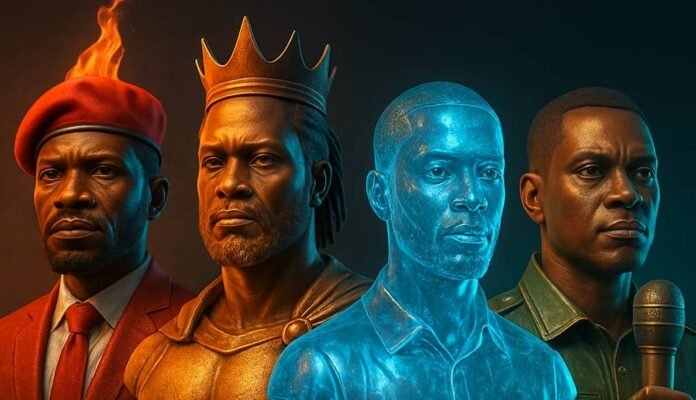
They are archetypes—four different philosophies of Ugandan music, four distinct continents of talent, and four competing versions of the Ugandan soul.
Ranking them requires not excitement, but philosophical sobriety.
Let us therefore weigh them not like fans, but like scholars—examining legacy, technical skill, cultural impact, political imprint, and artistic evolution.
1. Bobi Wine: The Voice of Defiance and the Politics of Rhythm
Bobi Wine is not merely a musician; he is a consciousness, a movement, a historical rupture.
Strengths
Lyrical courage: songs like Kadingo, Ghetto, Time Bomb, and Tuliyambala Engule moved from metaphor to manifesto.
Social relevance: no Ugandan artist has ever weaponized lyrics with such political effect.
Charisma and authenticity: he embodies the archetype of the “Ghetto Philosopher”—raw, fearless, unfiltered.
Limitations
Musically inconsistent; the message often outshines the melody.
His political evolution has overshadowed his musical craft.
Conclusion
Bobi Wine is the most influential, not the most vocally gifted. His power lies not in voice but in verbal fire and symbolism.
He is a historical figure, not just an entertainer.
2. Bebe Cool: The Architect of Longevity and The Unapologetic Showman
Bebe Cool is the engineer of Uganda’s modern music industry: disciplined, strategic, stubbornly ever-present.
Strengths
Longevity unmatched—over 20 years of relevance across generations.
Vocal depth: the richest baritone among the four.
Performance mastery: his stage ethics—timeliness, organization, rehearsal—are near-military.
Versatility: from ragga to reggae to Afrobeat to dancehall.
Limitations
Emotional disconnect; his voice moves the ear but rarely the soul.
Perceived arrogance overshadows artistry.
Conclusion
Bebe Cool is the most professional musician Uganda has produced—structured, consistent, resilient.
Not the most loved, but undeniably the most durable machine in the industry.
3. Radio (Mowzey Radio): The Poet, The Prophet, The Fallen Comet
Radio is the one artist who transcended Uganda and entered immortality through sheer vocal mysticism.
Strengths
The best lyricist in Ugandan music history.
A voice so delicate and emotional that it felt biologically engineered to haunt the human nervous system.
Songwriting genius behind dozens of hits—his pen built careers for other musicians.
Versatility at a spiritual level: ballads, Afro-fusion, RnB, dancehall, inspirational music—he floated effortlessly.
Limitations
A short career; death interrupted genius.
His brilliance was sometimes buried under Weasel’s wildness.
Conclusion
Radio is the most talented of the four.
Not the most influential.
Not the biggest performer.
But purely in craftsmanship, creativity, and emotional intelligence—he stands alone.
His voice was a tender violence.
His pen was a miracle.
His absence remains a national wound.
4. Jose Chameleone: The Titan, The Transformer, The Cultural Chameleon
Chameleone is the largest musical force Uganda has ever produced: a continental identity, an unstoppable experiment, a stubborn survivalist.
Strengths
Most dynamic and adaptable: Swahili hits, Luo hits, Congolese guitar blends, Afro-pop classics.
Stage power: his concerts feel like controlled riots—high voltage, unpredictable, unforgettable.
Regional dominance: he conquered Kenya, Tanzania, Rwanda, Burundi—an East African titan.
Limitations
Inconsistent vocal discipline; relies more on energy than technique.
Personal controversies overshadow artistry.
Conclusion
Chameleone is the biggest star Uganda has ever exported.
He is the Lion of East African pop.
He may not have Bobi’s politics, Bebe’s structure, or Radio’s delicacy, but he has the widest footprint.
The Final Verdict: Who Is the Best?
A Philosophical Adjudication
If greatness is defined by:
1. Influence → Bobi Wine
He shook a nation, not just the charts.
2. Longevity and professionalism → Bebe Cool
He survived every wave and still stands.
3. Raw talent and emotional genius → Radio
He touched the soul in ways we do not have language for.
4. Regional dominance and star power → Chameleone
He remains the most transnational Ugandan act in history.
So who is the “best ever”?
If the question means “the most complete musical package Uganda has ever produced,”
the crown goes to:
Jose Chameleone
He combines:
longevity
regional influence
voice
stagecraft
adaptability
hit-making power
reinvention
He is the only one who ticks all boxes.
But, if the question means “the greatest talent Uganda has ever heard,”
the answer shifts dramatically to:**
Mowzey Radio
His voice was a spiritual instrument.
His pen was supernatural.
His artistry was a level Uganda may not see again.
If the question is about influence, courage, and national impact, no debate:
Bobi Wine
He stopped singing and started rewriting the country.
If the question is about consistency across decades:
Bebe Cool
He is a machine with no expiry date.
Therefore, the truly intelligent answer is:
There is no “best ever.”
There are four different kings on four different thrones.
Together, they form the Holy Quadrant of Ugandan Music:
Bobi Wine — The Conscience
Bebe Cool — The Machine
Radio — The Genius
Chameleone — The Giant
Remove any one of them, and Ugandan music collapses into incompleteness.