

By Isaac Christopher Lubogo
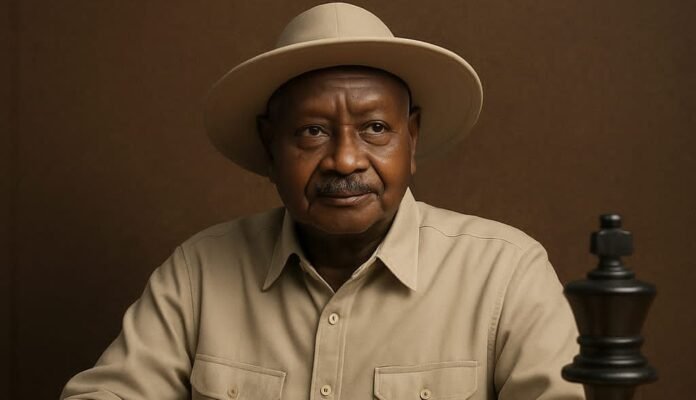
If Africa’s political history were a chessboard, then most of its leaders are pawns who imagined themselves kings, only to be swept aside by time, ego, or revolution. But once in a generation, there emerges a player so calculating, so intellectually fluid, so biologically wired to survive the collapse of ideologies, that even time itself pauses, not to dethrone him, but to study him.
That man is Yoweri Kaguta Museveni.
Where others shout revolutions, Museveni whispers blueprints. Where others collapse under criticism, he invites it with a cup of tea, a calm pen, and a rope you never notice until it’s too late. His genius is not simply in his staying power, it is in his ability to redefine leadership as a constant psychological calibration, where enemies become instruments, and opponents become unwitting choirboys in the orchestra of his longevity.
Most African presidents die of either rigidity or fear. Museveni, in contrast, feeds on evolution. He is the master of political osmosis, absorbing threats, co-opting resistance, mutating ideologically while remaining still at the helm. He has survived coups, rebellions, donor fatigue, generational disillusionment, and even his own promises, each time emerging stronger, like a serpent shedding not just skin, but shape and species.
He is, in essence, a philosopher king in fatigues, a hybrid of Machiavelli and Marcus Aurelius, blending military realism with stoic patience, cloaked in the deceptive garb of the village sage.
This is not merely about how Museveni has ruled long, but why he will continue to rule, even long after his body is gone. His ideas, networks, psychological architectures, and loyalist machinery are designed not just to survive succession, but to render it irrelevant. He has created a self-replicating system, part ideology, part personality cult, part bureaucratic maze, that ensures that Museveni-ness will remain long after Museveni.
So let the world mock his hat, or lament his age. Let the opposition shout louder than the storms of Rwenzori. What they miss is this: Museveni is not clinging to power. Power is clinging to Museveni.
And that, precisely, is why he will rule for a hundred years and more, not by breath, but by architecture.
The Rope, the Bread, and the Mind: Museveni’s Political Alchemy.
“The supreme art of war is to subdue the enemy without fighting.”
Sun Tzu, The Art of War
In the highlands of African political strategy, there stands one shepherd cloaked not in brutal tyranny, but in the paradoxical grace of psychological mastery, Yoweri Kaguta Museveni. Where other strongmen rule by the gun alone, Museveni wields something more dangerous: ideas.
While many African rulers have fallen to coups, insurrections, or the rot of their own rigidity, Museveni has mutated, not like a reptile shedding skin, but like a grandmaster reshuffling pawns and queens on a board of perpetually shifting ideologies. His strength lies not in brute force, but in allowing his critics just enough rope, while handing them bread with the other hand.
The Rope of Freedom: How Museveni Weaponizes Liberty.
Where most despots tighten their grip when threatened, Museveni loosens it, with deliberate intent. He opens intellectual spaces, forms ideological schools like Kyankwanzi, and invites opponents to speak, nay, to shout. What appears to be democratic space is, in fact, a brilliantly architectured maze: those who do not study the floor tiles carefully, fall into self-made traps.
Take Dr. Kizza Besigye, once his personal physician and fellow revolutionary. Museveni welcomed Besigye’s opposition with calm, never visibly shaken. He allowed rallies, let the press fume, and even permitted legal petitions. But behind the scenes, Museveni tightened the rope: travel restrictions here, court cases there, strategic police blockades that quietly drained the political oxygen from Besigye’s lungs.
Quote:
“Give your enemies the stage and let them forget the script.” Museveni is rumored to have said in one of his internal strategy sessions.
The Bread of Power: Feed Your Enemies Until They Forget Their Hunger.
A dictator might jail critics, but Museveni feeds them, both literally and symbolically. Those who insult him one year are given state jobs the next. He does not fight hunger with steel, but with strategic generosity.
Consider Nobert Mao, once an ardent critic, now holding a ministerial post. Or Betty Kamya, who thundered against NRM until Museveni offered her a seat at the table, and she ate and is still eating as an advisor.
Museveni understands that the human ego is hungrier than the stomach. He starves not the body but the soul, until opponents accept the warm bread of relevance over the cold meal of moral integrity.
Nietzsche warned:
“Whoever fights monsters should see to it that in the process he does not become a monster.”
But Museveni flips this: he lets his enemies become the monsters, while he watches.
Ideological Schooling: The Intellectual War Machine.
Unlike other leaders who rely solely on security apparatus, Museveni builds schools of thought. His cadres are not just trained in war; they are baptized in ideology. In Kyankwanzi, they don’t merely learn loyalty, they learn to argue, to think, to defend policy with Marxist precision.
He invokes Frantz Fanon, Kwame Nkrumah, and occasionally Mao Zedong, but filters them through a uniquely Musevenist lens. The NRM’s staying power lies in its ability to re-invent its mission, seasonally ideologize even its economic blunders, and co-opt youthful rage with internships, cash, and shallow promises of revolution.
Dramatization: The Goat and the Golden Rope.
Imagine this:
A goat bleats against the fence. It is hungry, angry, and loud. Museveni arrives not with a whip, but with a bowl of salt and a loose leash. He opens the gate.
“Come,” he says, “speak.”
The goat runs free, jubilant, liberated. It eats. It shouts. It dances. But the rope is still tied, just long enough to roam, but not to escape. In time, the goat forgets the rope exists. It grows fat on freedom, then lazy, then complacent.
When it finally tries to bolt, to truly flee, the rope snaps it back. Not violently. Just enough to remind it: you were never truly free.
The Master of Psychological Warfare.
Museveni’s genius is this: he understands that the mind is the battlefield.
He lets you speak, until your voice becomes background noise.
He lets you rise, until you are so visible, your weaknesses become televised.
He lets you fight, until your fists are tired and your audience gone.
And then, calmly, he remains. With his hat, his notebook, and that quiet smile that says: You played your move. I anticipated it five years ago.
Machiavelli wrote:
“It is better to be feared than loved, if you cannot be both.”
But Museveni bends even this. He chooses to be understood, so deeply, so ominously, that even love or fear become irrelevant.
Museveni, the Grandmaster of Self-Destruction Politics.
Yoweri Museveni has done what few African leaders have managed: he has ruled not by extinguishing opposition, but by studying it, feeding it, mimicking it, and letting it collapse under its own contradictions.
His critics often defeat themselves, by becoming too loud, too greedy, too inconsistent. And when they fall, Museveni does not gloat. He simply offers them a ministerial post and a cold soda.
In the end, it is not the gun that wins. It is the chessboard. And Museveni? He is the player who lets the pawn feel like a queen, until checkmate.
Take ways;
Museveni as a Master of Time Manipulation.
Angle: Introduce him as a man who doesn’t just rule time but bends it.
Idea: While most leaders are trapped in electoral cycles, Museveni treats time as elastic—extending it when necessary, slowing it when threatened, and even pausing it by distracting the nation with ideological narratives, constitutional amendments, or national dialogues.
Quote to inspire:
“He who controls the past commands the future. He who commands the future conquers the present.” – George Orwell
The Art of Controlled Chaos
Angle: Museveni allows dysfunction to brew, corruption scandals, internal party wrangles, opposition chaos, but never to the point of collapse. This chaos makes him indispensable.
Analogy: Like a chemist carefully letting acid bubble in a sealed beaker, knowing precisely when to add the base.
Add a line like:
“He governs like a man who holds a live grenade, pin still in, finger still firm, and he dares the nation to flinch.”
Museveni’s Use of Intellectual Erosion.
Angle: Many of his opponents burn out not because they are silenced, but because they are made irrelevant. Museveni’s genius is in neutralizing intellectual threats through co-option, ideological fatigue, or subtle ridicule.
Example: His debates with professors and international scholars, where he turns complex critique into folkloric parables, reducing their rage into academic footnotes.
Quote:
“The best way to destroy the intellect is not to crush it, but to amuse it.” — Pascal, paraphrased
The Mythos of Museveni: Creating a Meta-Human Brand.
Angle: Museveni is no longer just a man, he is a myth. Just like Nyerere became “Mwalimu” and Mandela became “Tata Madiba”, Museveni is “Mzee” but not in age, in cultural dominion. His name functions as a political gravitational force.
Phrase suggestion:
“He is the constellation around which Uganda’s political astrology orbits, fated, feared, and foreseen.”
Museveni’s Pre-emptive Strategy: Anticipating Rebellion Before It Breathes.
Angle: He doesn’t respond to threats. He pre-emptively smothers them, not with bullets, but with invitations, cash, or bureaucracy. His enemies die not from assassination, but from paperwork and irrelevance.
Phrase suggestion:
“He doesn’t kill revolutions. He files them under ‘Awaiting Funding.”
If Africa’s political history were a chessboard, then most of its leaders are pawns who imagined themselves kings, only to be swept aside by time, ego, or revolution. But once in a generation, there emerges a player so calculating, so intellectually fluid, so biologically wired to survive the collapse of ideologies, that even time itself pauses, not to dethrone him, but to study him.
That man is Yoweri Kaguta Museveni.
Where others shout revolutions, Museveni whispers blueprints. Where others collapse under criticism, he invites it with a cup of tea, a calm pen, and a rope you never notice until it’s too late. His genius is not simply in his staying power, it is in his ability to redefine leadership as a constant psychological calibration, where enemies become instruments, and opponents become unwitting choirboys in the orchestra of his longevity.
Most African presidents die of either rigidity or fear. Museveni, in contrast, feeds on evolution. He is the master of political osmosis, absorbing threats, co-opting resistance, mutating ideologically while remaining still at the helm. He has survived coups, rebellions, donor fatigue, generational disillusionment, and even his own promises, each time emerging stronger, like a serpent shedding not just skin, but shape and species.
He is, in essence, a philosopher king in fatigues, a hybrid of Machiavelli and Marcus Aurelius, blending military realism with stoic patience, cloaked in the deceptive garb of the village sage.
This is not merely about how Museveni has ruled long, but why he will continue to rule, even long after his body is gone. His ideas, networks, psychological architectures, and loyalist machinery are designed not just to survive succession, but to render it irrelevant. He has created a self-replicating system, part ideology, part personality cult, part bureaucratic maze, that ensures that Museveni-ness will remain long after Museveni.
So let the world mock his hat, or lament his age. Let the opposition shout louder than the storms of Rwenzori. What they miss is this: Museveni is not clinging to power. Power is clinging to Museveni.
And that, precisely, is why he will rule for a hundred years and more, not by breath, but by architecture.
The Rope, the Bread, and the Mind: Museveni’s Political Alchemy
_“The supreme art of war is to subdue the enemy without fighting.”_
Sun Tzu, The Art of War
In the highlands of African political strategy, there stands one shepherd cloaked not in brutal tyranny, but in the paradoxical grace of psychological mastery, Yoweri Kaguta Museveni. Where other strongmen rule by the gun alone, Museveni wields something more dangerous: *ideas.*
While many African rulers have fallen to coups, insurrections, or the rot of their own rigidity, Museveni has mutated, not like a reptile shedding skin, but like a grandmaster reshuffling pawns and queens on a board of perpetually shifting ideologies. His strength lies not in brute force, but in allowing his critics just enough rope, while handing them bread with the other hand.
The Rope of Freedom: How Museveni Weaponizes Liberty
Where most despots tighten their grip when threatened, Museveni loosens it, with deliberate intent. He opens intellectual spaces, forms ideological schools like Kyankwanzi, and invites opponents to speak, nay, to shout. What appears to be democratic space is, in fact, a brilliantly architectured maze: those who do not study the floor tiles carefully, fall into self-made traps.
Take Dr. Kizza Besigye, once his personal physician and fellow revolutionary. Museveni welcomed Besigye’s opposition with calm, never visibly shaken. He allowed rallies, let the press fume, and even permitted legal petitions. But behind the scenes, Museveni tightened the rope: travel restrictions here, court cases there, strategic police blockades that quietly drained the political oxygen from Besigye’s lungs.
Quote:
_“Give your enemies the stage and let them forget the script.”_ Museveni is rumored to have said in one of his internal strategy sessions.
The Bread of Power: Feed Your Enemies Until They Forget Their Hunger
A dictator might jail critics, but Museveni feeds them, both literally and symbolically. Those who insult him one year are given state jobs the next. He does not fight hunger with steel, but with strategic generosity.
Consider Nobert Mao, once an ardent critic, now holding a ministerial post. Or Betty Kamya, who thundered against NRM until Museveni offered her a seat at the table, and she ate and is still eating as an advisor.
Museveni understands that the human ego is hungrier than the stomach. He starves not the body but the soul, until opponents accept the warm bread of relevance over the cold meal of moral integrity.
*Nietzsche* warned:
_“Whoever fights monsters should see to it that in the process he does not become a monster.”_
But Museveni flips this: he lets his enemies become the monsters, while he watches.
Ideological Schooling: The Intellectual War Machine
Unlike other leaders who rely solely on security apparatus, Museveni builds schools of thought. His cadres are not just trained in war; they are baptized in ideology. In Kyankwanzi, they don’t merely learn loyalty, they learn to argue, to think, to defend policy with Marxist precision.
He invokes *Frantz Fanon, Kwame Nkrumah,* and occasionally *Mao Zedong,* but filters them through a uniquely Musevenist lens. The NRM’s staying power lies in its ability to re-invent its mission, seasonally ideologize even its economic blunders, and co-opt youthful rage with internships, cash, and shallow promises of revolution.
Dramatization: The Goat and the Golden Rope
Imagine this:
A goat bleats against the fence. It is hungry, angry, and loud. Museveni arrives not with a whip, but with a bowl of salt and a loose leash. He opens the gate.
“Come,” he says, “speak.”
The goat runs free, jubilant, liberated. It eats. It shouts. It dances. But the rope is still tied, just long enough to roam, but not to escape. In time, the goat forgets the rope exists. It grows fat on freedom, then lazy, then complacent.
When it finally tries to bolt, to truly flee, the rope snaps it back. Not violently. Just enough to remind it: you were never truly free.
The Master of Psychological Warfare
Museveni’s genius is this: he understands that the mind is the battlefield.
He lets you speak, until your voice becomes background noise.
He lets you rise, until you are so visible, your weaknesses become televised.
He lets you fight, until your fists are tired and your audience gone.
And then, calmly, he remains. With his hat, his notebook, and that quiet smile that says: You played your move. I anticipated it five years ago.
Machiavelli wrote:
_“It is better to be feared than loved, if you cannot be both.”_
But Museveni bends even this. He chooses to be understood, so deeply, so ominously, that even love or fear become irrelevant.
Museveni, the Grandmaster of Self-Destruction Politics
Yoweri Museveni has done what few African leaders have managed: he has ruled not by extinguishing opposition, but by studying it, feeding it, mimicking it, and letting it collapse under its own contradictions.
His critics often defeat themselves, by becoming too loud, too greedy, too inconsistent. And when they fall, Museveni does not gloat. He simply offers them a ministerial post and a cold soda.
In the end, it is not the gun that wins. It is the chessboard. And Museveni? He is the player who lets the pawn feel like a queen, until checkmate.
Take ways;
Museveni as a Master of Time Manipulation
Angle: Introduce him as a man who doesn’t just rule time but bends it.
Idea: While most leaders are trapped in electoral cycles, Museveni treats time as elastic—extending it when necessary, slowing it when threatened, and even pausing it by distracting the nation with ideological narratives, constitutional amendments, or national dialogues.
Quote to inspire:
_“He who controls the past commands the future. He who commands the future conquers the present.”_
— George Orwell
The Art of Controlled Chaos
Angle: Museveni allows dysfunction to brew, corruption scandals, internal party wrangles, opposition chaos, but never to the point of collapse. This chaos makes him indispensable.
Analogy: Like a chemist carefully letting acid bubble in a sealed beaker, knowing precisely when to add the base.
Add a line like:
_“He governs like a man who holds a live grenade, pin still in, finger still firm, and he dares the nation to flinch.”_
Museveni’s Use of Intellectual Erosion
Angle: Many of his opponents burn out not because they are silenced, but because they are made irrelevant. Museveni’s genius is in neutralizing intellectual threats through co-option, ideological fatigue, or subtle ridicule.
Example: His debates with professors and international scholars, where he turns complex critique into folkloric parables, reducing their rage into academic footnotes.
Quote:
_“The best way to destroy the intellect is not to crush it, but to amuse it.”_
— Pascal, paraphrased
The Mythos of Museveni: Creating a Meta-Human Brand
Angle: Museveni is no longer just a man, he is a myth. Just like Nyerere became “Mwalimu” and Mandela became “Tata Madiba”, Museveni is “Mzee” but not in age, in cultural dominion. His name functions as a political gravitational force.
Phrase suggestion:
_“He is the constellation around which Uganda’s political astrology orbits, fated, feared, and foreseen.”_
Museveni’s Pre-emptive Strategy: Anticipating Rebellion Before It Breathes
Angle: He doesn’t respond to threats. He pre-emptively smothers them, not with bullets, but with invitations, cash, or bureaucracy. His enemies die not from assassination, but from paperwork and irrelevance.
Disclaimer:
The views expressed in this commentary are solely those of the author and do not in anyway reflect the opinions or editorial policy of Africa Publicity