
By. Isaac Christopher Lubogo
Introduction: The Philosophy of Endurance and the Politics of Certainty
In the vast theatre of African politics, very few leaders have mastered the delicate science of continuity, adaptability, and ideological relevance the way President Yoweri Kaguta Museveni has. For nearly four decades, he has transformed Uganda’s political ecosystem into what can best be described as a philosophy of endurance—a synthesis of revolutionary consistency and pragmatic adjustment.
Museveni’s political genius lies not merely in survival, but in systemic reinvention without rupture. His most profound signature has always been that quiet yet unshakable conviction that stability is itself a development policy. While others have traded populism for fleeting applause, Museveni has consistently traded applause for longevity—knowing that leadership is not about excitement but about continuity.
He once remarked, “The problem of Africa is not the people but the leaders who do not know where they are going.” Today, even his fiercest critics concede that he has not only known where Uganda is going but has drawn the map, built the road, and marshalled the convoy.
There is a reason the current political temperature points towards an outcome that appears mathematically predictable—an overwhelming 80% victory margin that seems less speculative and more structural. The evidence is empirical: an organised party machinery, a fragmented opposition, and a citizenry that—after tasting the fruits and flaws of modern governance—remains anchored in the comfort of continuity.
This is not merely a projection of political loyalty; it is a reflection of what Museveni himself calls “the logic of revolutionary patience.”
He has turned the NRM into more than a political entity—it is an institution of governance literacy, an academy of ideological evolution, and a mirror through which Uganda’s national character is continuously negotiated and redefined.
In the African political imagination, only a few leaders have reached this equilibrium. Kwame Nkrumah had it in the form of intellectual radicalism; Julius Nyerere refined it into moral socialism; Nelson Mandela symbolised it through reconciliation; and Museveni, in his own distinct idiom, has expressed it as developmental realism—the conviction that you cannot transform a society by rhetoric, but by systems.
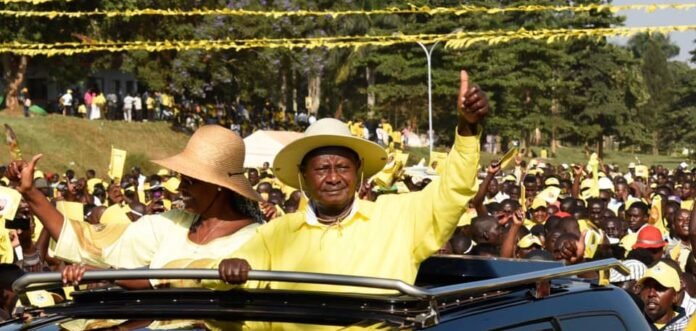
As Uganda edges toward another election, the pattern is unmissable. The political stage is not chaotic—it is curated. The rallies are not accidental—they are orchestrated. The crowds are not merely enthusiastic—they are convinced. In spite of institutional challenges and administrative imperfections, the NRM has achieved what few post-liberation movements in Africa have managed: to remain both relevant and resilient four decades on.
Museveni’s enduring appeal rests on an unspoken truth—that in a world of ideological volatility, Uganda has chosen predictability over peril.
He has indeed “nailed it,” not because he is flawless, but because he understands what Africa’s most brilliant minds—Nyerere, Sankara, Nkrumah—understood too late: that revolutions do not survive on ideals alone; they survive on organisation, stability, and time.
This, then, is the backdrop upon which the coming election unfolds—a moment less about competition and more about consolidation; less about rebellion and more about recalibration. It is the golden hour of destiny, where political philosophy meets institutional maturity, and where Museveni’s long experiment with continuity finds its most decisive vindication yet.
1. The Nation at the Crossroads of Momentum
Uganda stands at a decisive juncture. The 2026 electoral cycle is not emerging in a vacuum—it is unfolding within a moment of organisational maturity, infrastructural visibility, and psychological consolidation of the ruling establishment.
Across the country, the political landscape reflects remarkable mobilisation coherence. The NRM’s ongoing nationwide engagements, led by its Chairman, reveal a political machine that remains both agile and deeply entrenched. These are not random spectacles; they are strategic calibrations of continuity.
As Julius Nyerere observed, “Unity will not make us rich, but it can make it difficult for Africa and the African people to be disregarded and humiliated.”
In the Ugandan context, unity under stability has become the new political currency. What is unfolding is not mere campaigning—it is the reassertion of an existing social contract built on peace, predictability, and control.
2. The Theatre of Order versus the Noise of Disarray
Political power rewards structure, not spontaneity. The opposition’s disorganisation contrasts sharply with the NRM’s institutional discipline. What once appeared to be vibrant multi-party competitiveness has largely fragmented into regionalised grievances and personality-driven contests.
Meanwhile, the NRM has transitioned from being a liberation movement to a governance organism. It now functions less as a political party and more as a system of national administration—its networks extending from Cabinet to village level, its narrative consistently reinforced by visible deliverables.
Nelson Mandela once cautioned that, “A nation should not be judged by how it treats its highest citizens, but its lowest ones.” The logic of the current political season demonstrates that for many citizens, the calculus of governance has shifted from ideological aspiration to tangible outcomes—roads, electricity, health centres, schools. These have become the silent, everyday campaigns.
3. The Mathematics of Political Timing
Politics, like economics, follows the principle of alignment—timing, resources, and sentiment must converge for success. The present moment provides that convergence for NRM aspirants.
The Chairman’s tours have become de facto referenda on legitimacy. They demonstrate that the party still commands loyalty across multiple demographic tiers, especially rural constituencies where stability and continuity resonate most.
Kwame Nkrumah once remarked, “Revolutions are brought about by men who think as men of action and act as men of thought.” The NRM, at this stage, operates within that duality—it has transformed the abstract philosophy of “stability” into a lived political infrastructure.
This is what political scientists call institutional incumbency advantage—the ability to project both power and deliverance simultaneously.
4. The Anatomy of Advantage
An honest political autopsy of Uganda’s environment reveals four critical arteries that sustain NRM’s dominance:
1. Infrastructure as Ideology: Roads, hospitals, power grids, and dams have turned policy into presence. Paul Kagame once noted, “We cannot depend on what we do not control.” The NRM’s approach to infrastructure reflects this pragmatism—control through development.
2. Security as Social Capital: The generational memory of conflict has institutionalised a national aversion to instability. The NRM continues to convert that collective psychology into political stability.
3. Organisation as Power: From the Secretariat to the parish cell, the party’s tiered structure ensures continuity in mobilisation and messaging. It reflects Nyerere’s assertion that “People cannot be developed; they can only develop themselves through organisation.”
4. Continuity as Credibility: Investors, farmers, and technocrats alike view the predictability of governance as a safer bet than experimental leadership. Continuity has thus evolved from a slogan into an asset class.
Together, these four elements have produced what might be termed the NRM equilibrium—a balance between delivery and dominance.
5. The Philosophy of the Candidate in the Golden Hour
The electorate of 2026 is not the electorate of 2001. Ugandans are more informed, economically pragmatic, and politically self-aware. The populist rhetoric that once swayed crowds now competes with digital literacy, youth unemployment data, and service-delivery expectations.
Hence, any NRM candidate in this moment must retool their approach beyond loyalty and slogans. The successful aspirant will need to embody three non-negotiable traits:
Authenticity: Politics today demands rootedness. The most persuasive candidate is one who reflects community identity rather than political abstraction. Thomas Sankara’s words remain timeless: “You cannot carry out fundamental change without a certain amount of madness.” That “madness” is conviction—the courage to stand for ideas, not positions.
Competence: The electorate is increasingly policy-conscious. A candidate must speak in the language of deliverables—parish development, fiscal accountability, and job creation.
Ethical Intelligence: Corruption fatigue is real. Voters are not looking for saints, but for leaders who exhibit restraint and transparency. Jomo Kenyatta’s admonition remains apt: “Our children may learn about heroes of the past; our task is to make ourselves the architects of the future.”
6. The Spiritual and Psychological Alignment of Timing
Beyond the mechanics of politics, timing carries psychological and sociological weight. The NRM’s current momentum benefits from what analysts call political normalisation—where the electorate’s perception of legitimacy merges with habit.
As President Museveni once observed, “A revolution that does not conserve itself is a failed revolution.” The NRM’s staying power is not accidental; it is built on strategic conservation—renewing legitimacy through policy outputs rather than ideological novelty.
In this sense, the 2025–2026 period represents the consolidation phase of that conservation. The system is not reinventing itself—it is refining its endurance model.
7. The Doctrine of Preparation and Political Intelligence
Elections are not won on polling day—they are manufactured in months of silent groundwork. The decisive factor will not be rhetoric but readiness.
The serious NRM candidate must:
Conduct granular voter mapping by parish.
Build coalitions with youth, women, and business associations.
Translate national programmes like PDM and Emyooga into locally contextualised narratives.
Employ digital communication strategically to engage a youthful, data-driven electorate.
Kwame Nkrumah’s counsel resonates here: “We face neither East nor West; we face forward.” The candidate who faces forward—grounded, pragmatic, data-literate—will embody the evolution of NRM’s political intelligence.
8. The Perils of Hesitation
In politics, the penalty for indecision is irrelevance. Timing defines trajectory. While others debate whether the moment is right, the field is already taking shape.
As Mandela reminded Africa, “We must use time wisely and forever realise that the time is always ripe to do right.” Those who delay risk entering a race already concluded in the minds of the electorate.
9. The Emerging Historical Context
When Uganda’s contemporary political chronicle is reviewed, the NRM’s continued dominance will not be seen merely as longevity—it will be studied as a case of adaptive incumbency.
The 2026 electoral climate reveals an entrenched political order recalibrating itself efficiently while competitors remain distracted. That efficiency, rooted in structure and stability, is what has made the NRM’s brand of governance resistant to decay.
Julius Nyerere foresaw such an epoch when he wrote, “It can be done, play your part.” The NRM, through disciplined succession, infrastructural expansion, and ideological coherence, continues to play its part in the African experiment of state endurance.
Thus, the golden hour is less about divine favour and more about strategic synchrony—a rare moment when political structures, economic resources, and public psychology align.
Conclusion
The evidence before us suggests that this is not simply another electoral season; it is a recalibration of Uganda’s political continuity. The NRM’s dominance is not merely sustained by nostalgia—it is anchored in infrastructure, organisation, and ideological pragmatism consistent with the philosophies of Africa’s founding thinkers.
As long as the opposition remains ideologically thin and structurally inconsistent, and as long as the ruling system continues to deliver functional stability, this remains the most advantageous moment for any disciplined, reform-minded NRM aspirant to emerge.
In the final analysis, the golden hour is not about fortune—it is about foresight. Those who recognise alignment between timing and preparation will not just contest; they will define the political architecture of Uganda’s next chapter.
Disclaimer:
The views expressed in this commentary are solely those of the author, Isaac Christopher Lubogo, and do not in anyway reflect the opinions or editorial policy of Africa Publicity