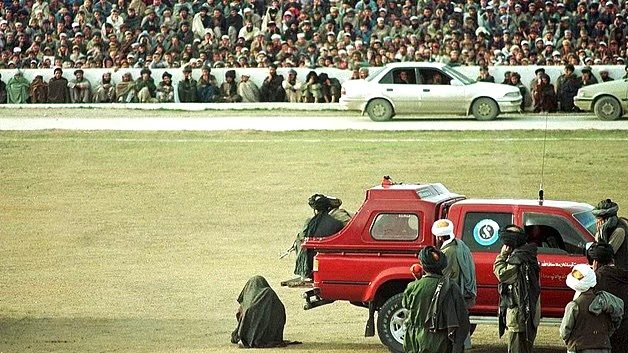
Afghanistan has once again become the focus of international attention following the continuation of public executions under Taliban rule. In a recent case in Khost province, thousands of people gathered at a sports stadium to witness a punishment carried out in line with the Taliban’s strict interpretation of Islamic law. The act was performed by a 13-year-old boy from the victim’s family, marking one of the most shocking examples of how deeply the current justice system has impacted Afghan society. While Taliban authorities insist that justice was carried out according to legal and religious processes, many critics argue that involving a child in such an act reflects a serious moral and human rights failure.
According to Afghanistan’s Supreme Court, the condemned man had been found guilty of involvement in the killing of 13 members of the boy’s family, including women and children, in an attack that occurred in January 2025. Officials stated that the case did not proceed hastily. It reportedly passed through three levels of the judicial system, including a trial court, an appeals court, and the supreme court. The final authorization was given by the Taliban’s highest leader, Hibatullah Akhundzada. Before the sentence was carried out, the family of the victims was offered the chance to forgive the offender, a decision that would have spared his life. However, the family chose to move forward under the principle of “Qisas,” also known as retaliatory justice.
Scene where 13 year-old-boy executed his family’s killer
Since returning to power in 2021, the Taliban has publicly enforced punishments as part of its interpretation of Sharia law. This most recent incident reportedly brings the number of public executions to at least twelve. These events are often held in open spaces or stadiums and are sometimes promoted through official announcements encouraging citizens to attend. The Taliban claims that such measures deter crime and strengthen public order, but human rights organizations argue that they instead encourage fear, normalize violence, and suppress opposition.
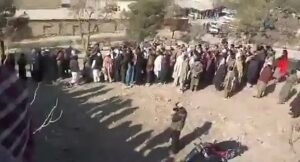
Ambulance transporting the body of the murdered convict after the public execution
Reactions within Afghanistan are divided. Some citizens, worn down by years of war and insecurity, believe that harsh punishments are necessary to maintain stability. They argue that fear of severe consequences prevents people from committing violent crimes. Others, however, strongly oppose the practice but remain silent due to fear of retaliation. Speaking out against Taliban policy is dangerous, and many Afghans feel they have no voice in shaping their country’s future.
The international response has been overwhelmingly critical. Richard Bennett, the United Nations Special Rapporteur on Human Rights in Afghanistan, condemned the use of public executions, describing them as cruel, inhumane, and inconsistent with international law. He has repeatedly called for an end to such punishment, along with greater protections for Afghan civilians. In July, the International Criminal Court issued arrest warrants for Taliban leaders on accusations of serious human rights violations, particularly the systemic oppression of women and girls.
Under Taliban rule, women and girls face some of the harshest restrictions in the world. Secondary and university education for girls has been suspended, and women are barred from most jobs. Their presence in public life is controlled through strict dress requirements and movement restrictions that often require them to be accompanied by a male guardian. These policies have erased decades of progress made in women’s rights and have caused immense suffering among millions of Afghan women who once pursued careers, education, and independence.
Despite these severe conditions, Afghanistan has experienced an increase in foreign tourism. Thousands of visitors entered the country in 2024, with more arriving in early 2025. Social media influencers and travel vloggers have posted videos showing peaceful streets, historical sites, traditional clothing, and luxury hotels. Some have claimed that Afghanistan is misunderstood and safer than people believe. These videos have attracted attention and controversy, as critics argue that influencers are sharing only a carefully managed and limited view of the country.
Afghan activist and scholar Dr. Orzala Nemat has strongly criticized these portrayals, stating that they hide the suffering of Afghan citizens. While tourists can move around freely and enjoy hospitality, Afghan women cannot walk freely, work openly, or access education. According to her, the online content does not reflect the reality faced by the average Afghan citizen under Taliban restrictions.
Further controversy arose when Afghan-American businessman Yosaf Aryubi promoted Afghanistan as a travel destination using shocking marketing tactics. One of his videos, which resembled hostage scenes used by extremist groups, angered many viewers. Though the video later revealed itself to be a tourism promotion, it caused outrage and was widely criticized for its insensitivity.
Even as tourism grows, Western governments including the United States and several European countries continue to warn their citizens against traveling to Afghanistan due to safety risks and lack of legal protection. Despite these warnings, the number of visitors continues to rise, creating a confusing contrast between official warnings and positive online portrayals.
Another public execution in late 2024 in Badghis province followed nearly the same pattern. A man convicted of murdering a couple, including a pregnant woman, was put to death after the victims’ family refused forgiveness. Once again, the decision was approved by the Taliban leadership and executed in front of large crowds, reinforcing the government’s reliance on fear-based justice.
These developments reveal a country deeply divided between the image shared with the outside world and the reality experienced by its citizens. While some see Afghanistan through the lens of tourism and tradition, others see a nation gripped by repression, limited freedom, and constant surveillance. The future of Afghanistan remains uncertain as the Taliban continues to strengthen its control. Meanwhile, millions of Afghans live with restricted choices, reduced rights, and a justice system that continues to attract international condemnation.
Source:Africa Publicity
For inquiries on advertising or publication of promotional articles and press releases on our website, contact us via WhatsApp: +233543452542 or email: info@africapublicity.com