

By: Isaac Christopher Lubogo
1. Introduction: From Individual Error to Structural and Constitutional Harm
In public discourse, when Ugandans say that “hospitals are killing people,” they are rarely making a literal epidemiological claim. Rather, they are articulating a collective moral judgment about a health system that repeatedly fails to prevent avoidable deaths. The appropriate analytical lens for this phenomenon is therefore not individual medical negligence, but systemic iatrogenic and institutional failure—harm arising from the structure, financing, governance, and prioritisation of the health system itself.
Iatrogenic harm refers to injury or death resulting from medical care or from the conditions under which such care is delivered. When such harm becomes predictable, widespread, and recurrent, responsibility necessarily shifts away from frontline health workers and toward the State, which designs, funds, regulates, and supervises the health system.
This chapter argues that Uganda’s health outcomes reflect a persistent performance gap between constitutional obligations and actual state investment. This gap has transformed many public hospitals from sanctuaries of healing into sites of foreseeable and preventable mortality, thereby constituting not merely poor governance, but a constitutional injury and a violation of the right to health and life under Ugandan law.
2. Uganda’s Health System as a Site of Structural Vulnerability
Uganda’s Constitution recognises health as a fundamental concern of the State and obliges government to ensure access to basic medical services. However, empirical indicators demonstrate a chronic mismatch between constitutional obligation and institutional capacity.
Uganda’s per-capita health expenditure, estimated at approximately USD 27 per person per year, remains far below the level required to deliver even a basic essential health package (UNICEF, 2025). By contrast, UNICEF estimates that a minimum of USD 86 per capita is necessary to provide adequate primary health services in low-income settings (UNICEF, 2025).
This disparity is not merely technical; it is existential. No health system can outperform the resources that sustain it. Under such constraints, hospitals become structurally predisposed to failure. Medicine stock-outs, staffing shortages, delayed diagnostics, dysfunctional referral systems, and compromised infection prevention are not anomalies—they are systemic features of underfunded institutions.
3. Budgetary Choices and the Political Economy of Health Neglect
Health outcomes do not deteriorate in a vacuum; they reflect budgetary and political priorities.
For the FY 2025/26, Uganda’s total national budget stands at approximately UGX 72.38 trillion (MoFPED, 2025/26). Of this amount, the health sector allocation is about UGX 5.87 trillion, representing roughly 6–8% of the total budget, depending on classification methodology (MoFPED, 2025/26; UNICEF, 2025).
This allocation falls well below the Abuja Declaration target of 15%, to which Uganda committed itself as a member of the African Union (African Union, 2001; Africa CDC, 2025). At the same time, other sectors command substantially larger shares:
Security, governance, and rule of law receive close to UGX 9.9 trillion.
Debt refinancing, amortisation, and arrears together consume well over UGX 16 trillion, significantly constraining fiscal space for social services (MoFPED, 2025/26).
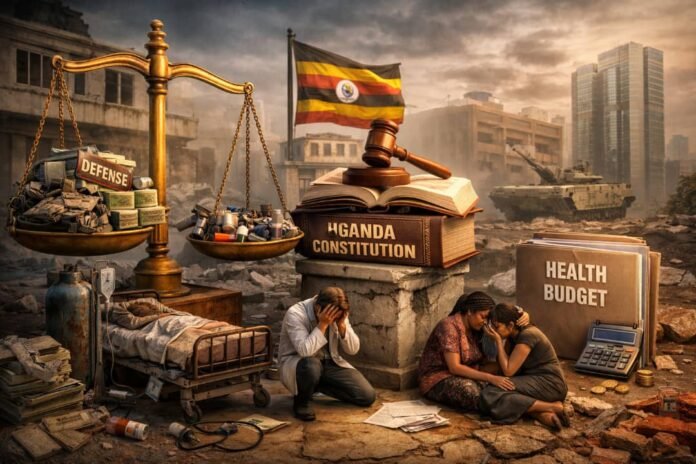
These figures demonstrate that Uganda’s health crisis is not primarily a technical or managerial failure. It is a political economy choice. The State has consistently prioritised debt servicing, infrastructure expansion, and security expenditure over the biological survival and wellbeing of its population.
4. How Underfunding Translates into Preventable Deaths (Systemic Iatrogenic Harm)
The pathway from chronic underfunding to death is neither mysterious nor accidental.
First, delayed access to care becomes normalised. Patients frequently arrive at hospitals after exhausting private clinics, herbal remedies, or informal care because public facilities lack medicines or require out-of-pocket payments. By the time admission occurs, disease has often progressed beyond reversible stages.
Second, hospital-acquired complications increase. Inadequate infection prevention and control, overcrowding, unreliable water and sanitation, and frequent equipment downtime expose patients to secondary harm—classic manifestations of iatrogenic risk in resource-constrained systems.
Third, human resource exhaustion undermines quality of care. Chronic understaffing, delayed remuneration, poor working conditions, and burnout generate moral injury among health workers, reducing vigilance, continuity of care, and clinical supervision.
In such an environment, hospitals do not “kill” through intent. They do so through predictable structural neglect embedded in institutional design.
5. Institutional Failure and the Ethics of State Responsibility
From an ethical and governance perspective, the State bears responsibility for foreseeable harm arising from institutional design and sustained omission. Where evidence consistently shows that low health financing correlates with poor outcomes, continued underinvestment amounts to passive violence—harm caused not by direct action, but by deliberate neglect.
The repeated failure to meet agreed health-financing benchmarks, despite population growth and persistent disease burden, constitutes institutional failure. This failure is compounded where accountability mechanisms—such as mortality audits, procurement oversight, and performance monitoring—exist largely on paper and lack enforcement.
The Ugandan health crisis is therefore chronic, structural, and foreseeable, not episodic or accidental.
6. The Constitutional Architecture of the Right to Health in Uganda
Although Uganda’s Constitution does not contain a single, freestanding provision titled “right to health,” Ugandan courts have consistently recognised the right to health through a composite constitutional interpretation, grounded in:
Objective XIV(b) of the National Objectives and Directive Principles of State Policy, obliging the State to ensure access to health services.
Article 8A, which elevates the National Objectives to binding principles of governance.
Article 45, preserving unenumerated rights recognised under international law.
Article 39, guaranteeing the right to a clean and healthy environment.
Article 22, protecting the right to life, interpreted to include conditions necessary to sustain life.
The right to health in Uganda is therefore derivative but justiciable, particularly where state action or inaction results in preventable death.
7. Judicial Recognition of the Right to Health in Uganda
7.1 CEHURD & Others v Attorney General
Constitutional Petition No. 16 of 2011 (Supreme Court, 2020)
This is the foundational right-to-health decision in Uganda. The Supreme Court held that:
the right to health is justiciable;
preventable maternal deaths raise serious constitutional questions;
courts cannot abdicate responsibility merely because issues involve resource allocation.
The Court rejected the political question doctrine and affirmed that systemic failure in public health services can violate Articles 22 and 45 of the Constitution.
7.2 CEHURD & Another v Nakaseke District Local Government & Attorney General
High Court Civil Suit No. 111 of 2012
The High Court found the State liable where a maternal death resulted from:
absence of a doctor,
lack of essential medicines, and
failure of referral mechanisms.
The Court held that failure to provide basic health services violated the right to life and health, establishing state liability for institutional negligence.
7.3 Law and Advocacy for Women in Uganda (LAW-U) v Attorney General
Constitutional Petition No. 13 of 2018
The Constitutional Court reaffirmed that socio-economic rights must be progressively realised and that failure to take reasonable legislative and administrative measures may violate the Constitution.
8. Systemic Iatrogenic Harm and the Right to Life
Ugandan courts have clarified that the right to life under Article 22 extends beyond protection against unlawful killing to include conditions necessary to preserve life.
In CEHURD v AG, the Supreme Court expressly linked maternal mortality, health system failure, and Article 22 violations. Where hospitals predictably lack oxygen, blood, drugs, or skilled personnel, deaths are no longer accidental; they are foreseeable outcomes of state omission.
9. Budgetary Choices, Proportionality, and Constitutional Accountability
Uganda’s health allocation—approximately 6–8% of the national budget—falls far below the Abuja target of 15% and internationally accepted per-capita thresholds (UNICEF, 2025).
Ugandan jurisprudence has established that:
scarcity of resources is not an automatic defence; and
the State must demonstrate reasonable prioritisation.
Failure to prioritise health while expanding expenditure in non-life-preserving sectors raises constitutional proportionality concerns.
10. International Law as an Interpretive Aid
Under Article 45, Ugandan courts rely on international instruments, including:
ICESCR, Article 12 (right to the highest attainable standard of health);
African Charter on Human and Peoples’ Rights, Article 16 (right to health).
In CEHURD v AG, these instruments were expressly used to interpret Uganda’s constitutional obligations. Systemic iatrogenic harm violates the duties to respect, protect, and fulfil the right to health.
11. Conclusion: From Governance Failure to Constitutional Breach
Systemic iatrogenic and institutional failure in Uganda’s health sector is not merely a governance deficit. It is a constitutional violation. Ugandan jurisprudence has firmly established that:
preventable deaths caused by health system failure are justiciable;
budgetary excuses cannot shield the State from accountability; and
the right to health is inseparable from the rights to life and dignity.
When hospitals become predictable sites of preventable death due to state neglect, the Government violates its constitutional duty to protect life and health. The crisis is therefore not only medical—it is constitutional.
References
African Union (2001) Abuja Declaration on HIV/AIDS, Tuberculosis and Other Related Infectious Diseases. Abuja: AU.
Africa Centres for Disease Control and Prevention (2025) Health Financing in Africa: Progress Toward the Abuja Target. Addis Ababa: Africa CDC.
Centre for Health, Human Rights and Development (CEHURD) & Others v Attorney General, Constitutional Petition No. 16 of 2011 (Supreme Court of Uganda, 2020).
CEHURD & Another v Nakaseke District Local Government & Attorney General, High Court Civil Suit No. 111 of 2012.
Law and Advocacy for Women in Uganda (LAW-U) v Attorney General, Constitutional Petition No. 13 of 2018.
Ministry of Finance, Planning and Economic Development (MoFPED) (2025/26) Budget Speech and National Budget Framework Paper. Kampala: Government of Uganda.
Republic of Uganda (1995) The Constitution of the Republic of Uganda. Kampala: Government Printer.
UNICEF (2025) Uganda Health Sector Budget Brief: FY 2025/26. Kampala: UNICEF Uganda.
Disclaimer:
The views expressed in this commentary are solely those of the author and do not in anyway reflect the opinions or editorial policy of Africa Publicity