
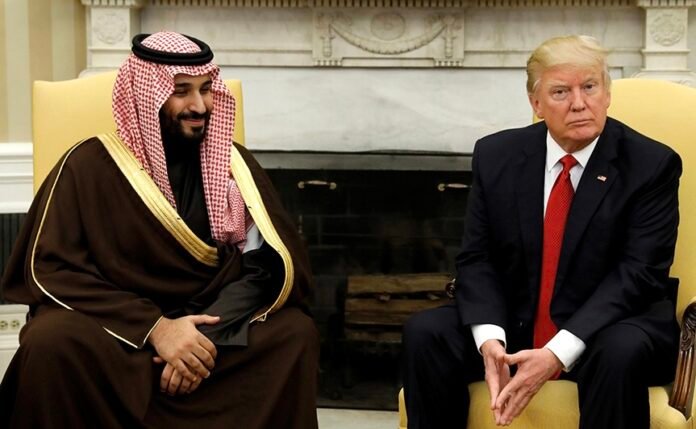
Saudi Arabia is reinforcing its long-standing position that any decision to formally normalise relations with Israel will only come if a credible, irreversible pathway to an independent Palestinian state is agreed — even as former U.S. President Donald Trump publicly expresses confidence that Riyadh will soon join the Abraham Accords.
According to multiple Gulf diplomatic sources who spoke to Reuters, the Crown Prince, Mohammed bin Salman (MbS), has relayed through quiet channels — ahead of his White House visit later this month — that Saudi Arabia’s terms have not changed: there must be an agreed roadmap leading to Palestinian statehood under the two-state solution before Riyadh is ready to recognise Israel.
Analysts say this position is strategically consistent with the Kingdom’s stance for decades — Saudi Arabia initially set this condition in the 2002 Arab Peace Initiative — but it now comes at a moment of heightened regional sensitivity. The Gaza war of 2023, Israel’s ongoing offensive, and deep public anger in the Arab world continue to make normalisation politically radioactive.
“There is simply no scenario in which MbS abandons linkage to Palestinian statehood,” said Jonathan Panikoff, a former senior U.S. intelligence official now at the Atlantic Council. He added that MbS will likely use the Washington visit to push Trump to more explicitly support Palestinian sovereignty, not less.
Why this visit matters
This will be the Crown Prince’s first visit to Washington since the murder of journalist Jamal Khashoggi in 2018. Since that crisis, Saudi leadership has pursued a more autonomous foreign policy — including deepening ties with China — but still sees the U.S. as its essential long-term security partner.
The Saudis and Americans are now working through a new defence and investment framework that would formalise U.S. military support for the Kingdom. This deal, however, is expected to fall short of a full, Senate-ratified treaty Riyadh once wanted. The current package:
• expands U.S.–Saudi defence industry cooperation
• accelerates future U.S. weapons sales
• includes provisions limiting Saudi defence technology integration with China
• could, in the future, be upgraded into a full treaty if conditions are met
Officials from both sides say they are likely to close this narrower deal now, rather than let the talks collapse over Israel normalisation — which remains stalled.
Why normalisation looks unlikely right now
Israel’s current leadership under Benjamin Netanyahu is firmly opposed to Palestinian statehood — making it politically impossible for Saudi Arabia to justify establishing relations at this time. Israeli military operations against Hamas in Gaza have further hardened Arab public opinion, which Riyadh is sensitive to given its role as custodian of Islam’s holiest sites.
Senior Saudi officials have recently called for:
• a time-bound Israeli withdrawal from Gaza
• an international security mechanism inside Gaza
• the Palestinian Authority to return and govern Gaza
• internationally guaranteed steps toward an independent state
The Iran factor — now less urgent
Interestingly, one of the original drivers for Saudi-U.S. defence negotiations — the threat of Iran — has softened. Israeli strikes on Iranian infrastructure and the weakening of Tehran-backed militias (Hamas, Hezbollah, and the Houthis) over the last year have reduced immediate Saudi security pressure.
This has made it less urgent for Riyadh to accept a politically costly defence treaty that would require Congressional approval and might force Riyadh to sharply curtail cooperation with China.
Bottom line
Saudi Arabia is showing that it will not normalise ties with Israel just because Washington wants a diplomatic win.
Palestinian statehood remains the price.
The Kingdom is willing to continue advancing U.S.–Saudi security integration — but will not trade that for Israel recognition without concrete concessions from Israel itself — concessions which neither Israel’s government nor Washington is currently prepared to deliver.
IPR Ghana to Host 2025 National Public Relations Summit in Takoradi
Source:Africa Publicity