

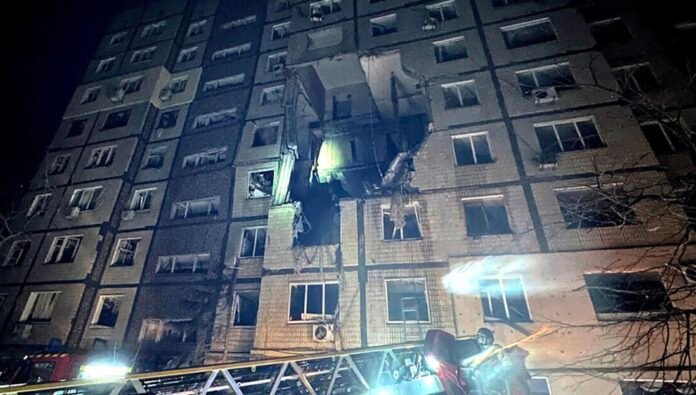
Russia launched another extensive overnight air assault targeting Ukraine’s critical energy infrastructure late Friday into early Saturday, killing at least three civilians and heavily damaging power facilities across multiple regions, according to Ukrainian authorities.
Ukraine’s Air Force reported that Russia deployed more than 450 attack drones and at least 45 missiles in the latest wave — one of the largest concentrated barrages in recent weeks. President Volodymyr Zelenskiy condemned the attack and said the escalation shows Moscow’s ongoing strategy of trying to cripple Ukraine’s electricity supply before winter temperatures reach their peak.
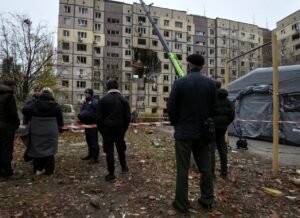
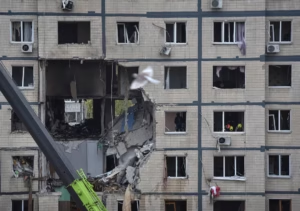
• In the city of Dnipro, a drone struck a residential block, killing two people and injuring at least 12.
• One civilian was also killed in the Kharkiv region.
Prime Minister Yulia Svyrydenko stated that significant damage was recorded at major power facilities in the Kyiv, Poltava, and Kharkiv regions. Some of these power stations are key nodes in Ukraine’s national grid — and their damage is expected to worsen localised power deficits.
Local authorities said two large cities in Poltava region — Kremenchuk (around 200,000 residents) and Horishni Plavni (about 50,000 residents) — temporarily lost most of their electricity supply and switched to generators to secure access to critical water services.
Zelenskiy Reiterates Call for Expanded Sanctions on Russia’s Energy Sector
Zelenskiy argued once again that the only effective response from the international community is to further tighten sanctions — particularly complete restrictions on Russian energy exports, which remain a major revenue stream for Moscow’s war budget.
“For every strike by Moscow targeting ordinary citizens and energy networks, there must be a direct sanctions response against all Russian energy without exceptions,” he said on Telegram.
Russia Claims the Attacks Are Retaliatory
Russia’s Defence Ministry confirmed it conducted what it described as a “massive strike” involving long-range precision missiles and drones aimed at Ukrainian weapon production sites and energy systems. Moscow also claimed its forces continued to gain ground in eastern battle zones near Kupiansk and Pokrovsk — though those claims remain unverified.
Since the beginning of Russia’s full invasion nearly four years ago, Ukraine’s power network has been repeatedly targeted. Naftogaz, Ukraine’s state energy firm, said that in this autumn alone Russia has attacked gas infrastructure facilities at least nine times in just two months — signalling a deliberate campaign to drain Ukraine’s heating capacity ahead of winter.
Ukraine, for its part, has responded by continuing long-range drone strikes aimed at Russia’s oil and fuel infrastructure, seeking to cut Moscow’s ability to finance ongoing operations.
Recovery Efforts Underway
Ukrainian emergency teams and energy engineers are working to restore damaged electricity grids, water pipelines, and heating services. Authorities warned that rolling blackouts remain possible in multiple regions as infrastructure is repaired and generation capacity is rerouted.
The Ukrainian air force reported that 406 Russian drones and nine missiles were intercepted during the attack — but 26 missiles and 52 drones still managed to penetrate air defenses and hit 25 separate targets.
U.S. Withdraws From Upcoming G20 Summit in South Africa Amid Dispute Over Human Rights Abuse
Source:Africa Publicity