
By Mahmud Tim Kargbo
Sierra Leone’s post-war recovery initially held promise under President Ahmad Tejan Kabbah, who guided the nation from conflict towards stability. His administration secured extensive debt relief through the Heavily Indebted Poor Countries Initiative, reducing the debt-to-GDP ratio to 20 percent by 2006.
(http//:www.imf.org/en/News/Articles/2015/09/14/01/49/pr06178). By 2007, foreign reserves had rebounded to approximately US$510 million (http//:www.data.imf.org/regular.aspx?key=61545854), while poverty rates declined from 70 percent in 2003 to 66 percent in 2007 (http//:www.data.worldbank.org/indicator/SI.POV.DDAY?locations=SL). Public optimism was cautious but tangible, with citizens expecting that Kabbah’s successor, Ernest Bai Koroma, would consolidate accountability, maintain fiscal discipline, and build a platform for broad-based prosperity.
Instead, both Ernest Bai Koroma and Julius Maada Bio squandered this inheritance. Koroma presided over patronage and exploitation of state resources, while Bio, despite campaign promises of reform and “bread and butter” development (http//:www.reuters.com/article/us-leone-election-idUSKCN1GO0LE), has overseen worsening debt and economic stagnation. By 2023, Sierra Leone’s external debt had risen to US$3.05 billion, with debt-to-GDP surpassing 72 percent (http//:www.imf.org/en/Countries/SLE), reversing the debt-free platform of 2007. These loans, often contracted on non-concessional terms, did nothing to improve living standards, instead enriching elites and their external partners. The resulting poverty, exclusion, and lawlessness have revived the very dangers and alienation that once fuelled the country’s eleven-year civil war.
Rootlessness in Sierra Leone is not a philosophical abstraction but a chronic governance failure. It is written into the country’s audit reports, migration statistics, and the unfulfilled promises of reform. Between 2007 and 2025 Sierra Leone has remained locked in a cycle of unresolved audit queries, fiscal indiscipline, and persistent outward migration, all of which have deepened public alienation and cynicism.
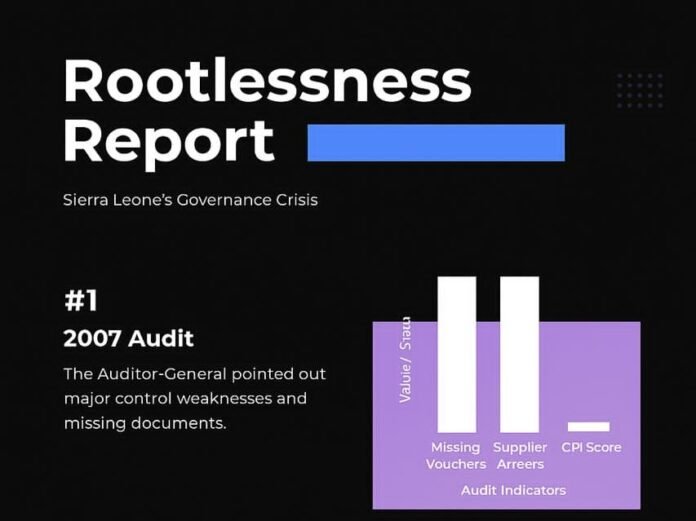
The trail begins in 2007 when the Auditor-General issued a qualified opinion on the Consolidated Fund. The report stated: “The Auditor-General’s opinion on the financial statements of the Government of Sierra Leone was qualified due to material control weaknesses. Vouchers were missing, domestic debt was not reconciled, and segregation of duties remained inadequate” (Audit Service Sierra Leone, 2007, p. 12). Supplier arrears stood at Le40,534 million, a staggering figure for a fragile post-war economy. That same year, Transparency International gave Sierra Leone a corruption perception score of just 2.1 out of 10 (https://www.transparency.org/en/cpi/2007). Net migration turned negative according to World Bank data (https://data.worldbank.org/indicator/SM.POP.NETM), a trend that would persist for the next two decades.
The following years saw little progress. In 2008 and 2009, audit reports again highlighted unreconciled balances and procurement breaches, while the CPI score stagnated at 2.2 out of 10 (https://www.transparency.org/en/cpi/2008, https://www.transparency.org/en/cpi/2009). By 2010 the Auditor-General flagged irregular payments and weak internal controls, with the CPI inching only to 2.4 out of 10 (https://www.transparency.org/en/cpi/2010). Migration figures in this period confirmed a steady outward flow.
By 2011 the audit reports still pointed to payroll fraud and unreconciled balances. Sierra Leone scored 2.5 out of 10 on the CPI (https://www.transparency.org/en/cpi/2011). The Truth and Reconciliation Commission had already warned in 2004: “Cynicism has become the hallmark of public life in Sierra Leone. Citizens believe that leaders act with impunity and accountability is the exception rather than the rule” (TRC Report, Vol. 2, p. 23). That assessment was proving prophetic.
In 2012 the Audit Service reported unreconciled balances and persistent procurement breaches (Audit Service Sierra Leone, 2012). Transparency International introduced a new scoring scale, and Sierra Leone scored 31 out of 100 (https://www.transparency.org/en/cpi/2012). The World Bank recorded a net migration outflow of more than 10,000 people that year.
From 2013 to 2015, ghost workers and procurement anomalies remained a recurring theme in the audits. Sierra Leone’s CPI score hovered at 30–31 out of 100, before dipping to 29 in 2015 (https://www.transparency.org/en/cpi/2013, https://www.transparency.org/en/cpi/2014, https://www.transparency.org/en/cpi/2015). Legal reforms such as the Audit Service Act 2014 and the Public Financial Management Act 2016 promised structural improvements but implementation was weak. Migration data in this period confirmed that citizens were still leaving in significant numbers.
In 2016 and 2017, the situation remained unchanged. That year’s audit report revealed ghost workers and missing government vehicles: “Verification exercises revealed individuals receiving salaries who had long ceased to be in service. Government vehicles and other fixed assets could not be physically accounted for” (Audit Service Sierra Leone, 2017, p. 64). The CPI score was stuck at 30 out of 100 (https://www.transparency.org/en/cpi/2017). Civil society activists were increasingly vocal. The Campaign for Good Governance noted: “Every year the Audit Service does its job, and every year Parliament shelves the report. Without enforcement, the fight against corruption is meaningless” (Campaign for Good Governance statement, 2017, http://www.cggsl.org/). At the same time, the International Organisation for Migration began assisting stranded Sierra Leoneans along irregular routes, a stark reminder of the human cost of systemic failure (https://www.iom.int/).
Case Study 1: Ibrahim’s Journey Through Libya
In 2019 Al Jazeera reported on Sierra Leoneans stranded in Libya. One of them, Ibrahim, recounted:
“I risked my life because there is no work back home. You see the leaders stealing, but nothing changes.”
(Al Jazeera, 2019, https://www.aljazeera.com/news/2019/12/17/sierra-leoneans-stranded-in-libya)
He had borrowed money to travel via Mali and Niger but ended up detained in Tripoli. The International Organisation for Migration eventually repatriated him. His story illustrates how unresolved governance failures push citizens into perilous migration routes.
Between 2018 and 2020, the cycle repeated. Audit Service reports identified payroll anomalies and tax failures, while CPI scores flatlined between 30 and 33 (https://www.transparency.org/en/cpi/2018, https://www.transparency.org/en/cpi/2019, https://www.transparency.org/en/cpi/2020). In 2020 the Anti-Corruption Commission Commissioner, Francis Ben Kaifala, declared: “Corruption is the reason Sierra Leone remains underdeveloped despite its abundant resources. If we fail to fight it decisively, our democracy will never work” (ACC Sierra Leone Press Briefing, 2020, https://www.anticorruption.gov.sl/). Yet enforcement remained inconsistent.
Case Study 2: Mariama’s Search For Dignity In Italy
In 2021 the International Organisation for Migration profiled Mariama, a young woman from Sierra Leone who survived the Mediterranean crossing.
“I did not want to leave, but I felt I had no choice. I wanted education and work. At home it was impossible.”
(IOM Voices of Returnees, 2021, https://www.iom.int/)
She eventually settled in northern Italy but regularly sends money to her family in Kambia. Her remittances are part of the 4.6 percent of GDP that Sierra Leone derived from citizens abroad in 2023 (World Bank, https://data.worldbank.org/indicator/BX.TRF.PWKR.DT.GD.ZS?locations=SLE).
By 2021 and 2022, the audits were still flagging anomalies in payroll and procurement. Sierra Leone’s CPI score rose slightly to 34 (https://www.transparency.org/en/cpi/2021, https://www.transparency.org/en/cpi/2022). The World Bank’s Public Expenditure Review that year bluntly noted: “Weak institutions and limited accountability in Sierra Leone undermine fiscal policy and service delivery. Unless governance improves, the country will remain vulnerable to shocks and unable to achieve inclusive growth” (World Bank, 2022, https://documents.worldbank.org/). In Parliament, a member of the Public Accounts Committee admitted: “Our mandate is to ensure compliance, but year after year, recommendations are ignored. This undermines the authority of Parliament itself” (PAC Parliamentary Hansard, 2022, https://parliament.gov.sl/).
Case Study 3: Abdulai, The Graduate Who Gave Up
In late 2024 a university graduate named Abdulai prepared to emigrate.
“We keep hearing about reforms, but nothing changes. The best option for my generation is to seek dignity elsewhere.”
(interview, 2024, Freetown)
His statement echoed the TRC’s 2004 warning that “if government does not take firm steps to end impunity and build a culture of civic responsibility, the same conditions that led to conflict will resurface in other guises” (TRC Report, Vol. 2, p. 57).
In 2023 the Auditor-General found NLe730 million in domestic revenue arrears, unverified vehicles, and ghost workers still on the payroll (Audit Service Sierra Leone, 2023, p. 102). Transparency International gave Sierra Leone a CPI score of 34 (https://www.transparency.org/en/cpi/2023). By 2024 the CPI score nudged up to 35 (https://www.transparency.org/en/cpi/2024). Macrotrends recorded net migration at minus 12,769, meaning more citizens left than entered that year. (https://www.macrotrends.net/countries/SLE/sierra-leone/net-migration). Parliament tabled the 2023 audit report in December, but most of its queries remained unresolved.
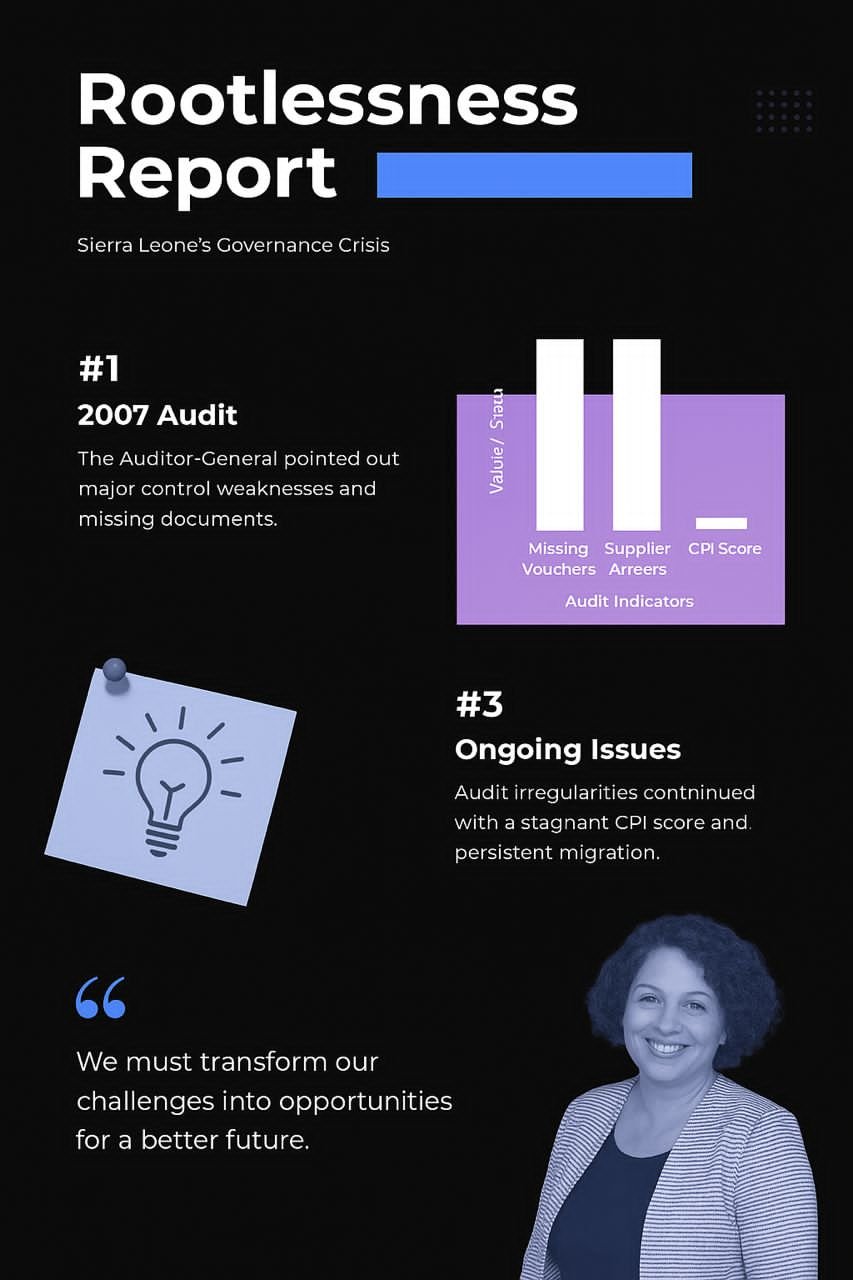
Now in 2025, the story continues to echo the same themes: unresolved audits, stagnant CPI scores, and persistent outward migration. Audit irregularities, international corruption rankings, and human testimonies all point to one conclusion. Unless Sierra Leone moves from issuing audit findings to enforcing sanctions, from acknowledging TRC recommendations to implementing them with binding timelines, and from tolerating corruption to prosecuting it, the country will remain trapped in rootlessness. Its people will continue to migrate in search of dignity abroad, while its institutions produce reports that gather dust in Parliament.