

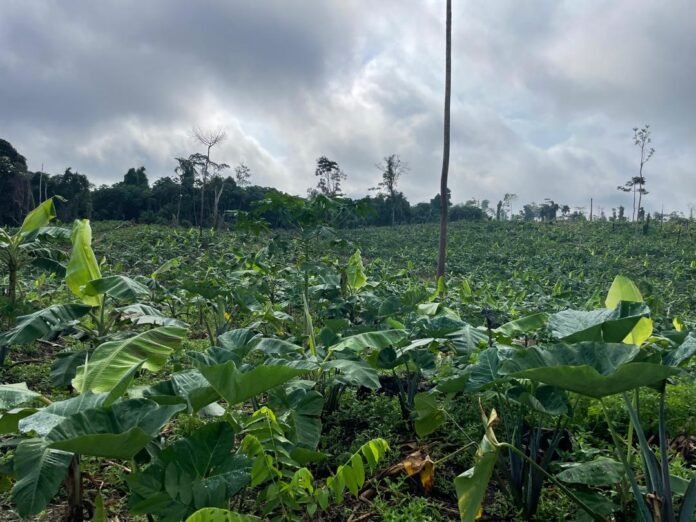
Ghana is fast losing its forest resources to agriculture expansion and other human induced practices. To address this challenge the United Nations Development Programme (UNDP), in partnership with the Ghana Cocoa Board, Forestry Commission of Ghana and local Farmer Unions, is implementing the Environmentally Sustainable Production Practices in Cocoa Landscapes Phase IV (ESP Phase IV). Building on the successes of previous phases, this initiative is transforming how communities manage land integrating, forest restoration and conservation in cocoa farming landscapes, fostering sustainable livelihoods and protecting Ghana’s forests.
Sustainable Cocoa Farming Practices
The ESP project not only empowers farmers but also supports Ghana’s broader land and tree tenure policy reforms. The initiative addresses systemic challenges that impede sustainable land use practices by providing concrete policy recommendations and facilitating dialogues with key stakeholders such as the COCOBOD and the Forestry Commission.
At the policy level, the project supports Ghana’s land and tree tenure reforms by facilitating dialogue and providing evidence to guide sustainable land-use decisions. These efforts complement national strategies aimed at reducing Ghana’s annual deforestation rate of 2% and achieving SDG 15 on protecting life on land.
Community Engagement and CREMA Impact
The project has established two Community Resource Management Areas (CREMA) involving about 65 communities in the Asunafo North Municipal Assembly (Ahafo Region) and Wassa East District (Western Region). By promoting community rights to manage and benefit from natural resources, the initiative fosters collaboration and ownership.
The CREMA approach is empowering the communities to manage natural resources sustainably. By organizing residents into resource management groups, CREMA fosters ownership and equips members with tools to safeguard forests while exploring eco-friendly income streams like small-scale businesses and agroforestry.
Mercy, a cocoa farmer from Wassa East, describes the CREMA activities as a life-changing experience.”Before, it was hard to imagine a future beyond cocoa farming,” she shares. “Now, we’re learning to protect our forests while finding new ways to earn a living.”
For Mercy, this means transitioning to shade-grown cocoa, grown beneath the canopy of timber trees. The benefits are immediate: healthier soils, more resilient crops, and a restored landscape capable of sustaining future generations.
Looking ahead, the project seeks to scale up forest restoration models, strengthen CREMA systems, and enhance Ghana’s contributions to global climate goals and enhance resilience of cocoa growing communities. With every tree planted and every livelihood diversified, the project reinforces its vision of a sustainable future where thriving farms coexist with flourishing ecosystems—one community and one forest at a time.
According to Emmanuel Tawiah, a cocoa farmer in Ahenkro, a community in Wassa East District, these practices are transformative. “I used to think clearing more land for farm expansion was the only way to improve my yield and income,” he reflects. “But I didn’t realize the cost to our forests, weather, and soil,” he added. Now, Emmanuel is adopting agroforestry techniques and integrating trees on his cocoa farm to provide shade to his cocoa tress and to enhance biodiversity. “The soil is richer, and my farm looks healthier,” he concludess, his face lighting up with hope.
Beekeeping as an Alternative Livelihood
To reduce dependency on forest resources, the project is introducing additional livelihood options like beekeeping, providing some 80 beehives to CREMA members. Through the CREMAs, community members are receiving training on sustainable beekeeping practices, including hive management, honey extraction, and product marketing.
Isaac Kwetey, also a cocoa farmer from Ahenkro, shares his experience: “The CREMA introduced beekeeping, and I received training. Out of four beehives, three are already colonized.” While his cocoa farm remains his primary income source, Isaac sees beekeeping as a valuable opportunity. “I see the beekeeping initiative as a way to diversify income and conserve our environment.” He emphasized.