

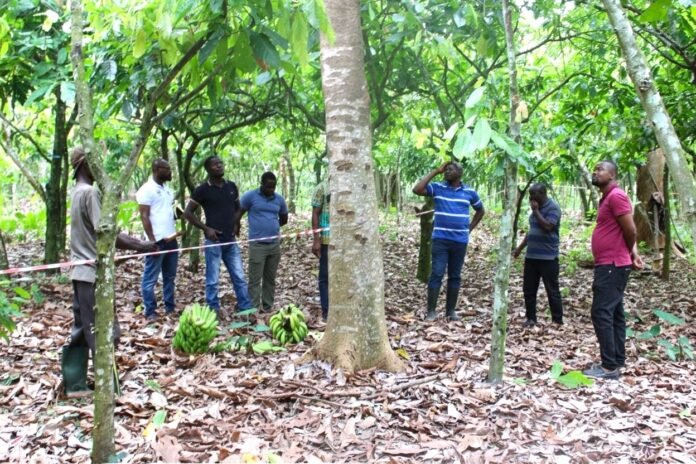
Climate change continues to pose a significant threat to Ghanas environment, economy and rural livelihoods. Among the most affected are the forest reserves, many of which have suffered decades of degradation from unstainable farming, logging and land-use pressures. Yet within these challenges lies the opportunity to restore the degraded forests where individuals are restoring forests through community-driven approaches that also improves livelihoods.
The Modified Taungya System (MTS) comes off as one of Ghanas most promising and cost-effective pathways to achieve both climate mitigation and poverty alleviation. Although forests and agriculture are addressed separately in global policy discussions, Ghanas experience tells a different story. The countrys forest and agroforestry landscapes are deeply interconnected, forming more than a quarter of its land area and supporting livelihoods of over half of the population. With between 5085% of the population involved in agriculture, and depending on the context, agriculture is often cited as one of the major drivers of deforestation and degradation.
Despite global progress in reducing forest loss, Ghana continues to record one of the highest deforestation rates in the world underscoring the urgency need of innovative restoration models like the MTS.
Through the Environmental Sustainability Project (ESP), the United Nations Development Programme (UNDP) in Ghana, through its collaboration with the Forestry Commission is implementing a large-scale forest restoration intervention based on the MTS mechanism in the Ayum and Pra-Sushen Forest Reserves. As part of the ESP IV project, this intervention for the 2025 planting period alone, seeks to among others restore 170ha of degraded forests in both reserves with 200,000+ seedlings (ofram, emire, cedrela, mahogany, and masonia) using the Modified Taungya System (MTS).
Forests provide a host of ecosystem services such as micro climate regulation, air quality, provision of products (timber and non-timber forest products), etc. which benefits both cocoa farming in the landscape as well as the quality of life for rural communities.
The intervention is designed to also help farmers in the forest-fringe communities who need farmlands to access them and work together with the project for mutual benefits.
In 2025, 225 farmers have been awarded an average of 2 acres of land each to farm and plant economic tree seedlings. The MTS approach affords farmers 4-5years to make additional incomes from farming on the very rich soils of the forest reserves. In return, farmers will plant and nurture over 200,000 trees until the canopy closes. At the end of the project, the participating farmers would have the opportunity to earn additional income from the sale of the farm produce (plantain, vegetables, maize, cocoyam etc.) to support their households. Farmers also boast of a share in the trees planted. The arrangement is such that the farmer and government (Forestry Commission) has 40% (each) stake in the trees planted, whiles 15% and 5% of the tree proceeds benefits the Traditional Authority (stool) and community respectively and the participating farmers entitled to the remaining 40%.
This structure not only incentivizes proper care of the trees but embeds local ownership in forest restoration.
The ecological benefits are equally compelling. Restored forests improve microclimates, enhance soil fertility, regulate water systems, and support biodiversity. These gains, in turn, contribute to broader climate resilience, especially for communities whose livelihoods are tightly connected to the land. Healthy forest ecosystems also support cocoa farming in surrounding landscapes, reinforcing the link between forest conservation and agricultural productivity.
What emerges from the Modified Taungya System is a holistic model of restoration, one that is people-centred, climate-smart, and economically inclusive. By bringing farmers, traditional authorities, and government together around great stewardship, MTS shows how degraded forests can be restored in a way that benefits both people and the planet.
As Ghana continues its journey toward climate resilience, models like the Modified Taungya System offer a blueprint for scaling nature-based solutions while empowering communities. Through ongoing collaboration under the Environmental Sustainability Project, UNDP and the Forestry Commission are showing that forest restoration is a livelihood opportunity, a climate strategy, and a pathway to sustainable development.