

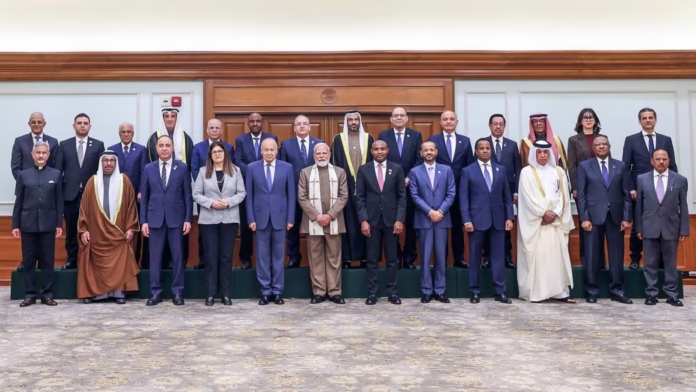
Prime Minister Narendra Modi met with a high-level delegation of Arab leaders on Saturday during the second India-Arab Foreign Ministers’ Meeting (FMM). The meeting underscored India’s deepening ties with the Arab world, which the Prime Minister described as part of India’s “extended neighbourhood.”
Commitment to Regional Peace and Gaza
A central theme of the discussions was the ongoing conflict in the Middle East. Prime Minister Modi conveyed India’s “continued support for the people of Palestine” and welcomed international efforts toward stability, specifically citing the Gaza peace plan.
Key Diplomatic Context:
- Gaza Peace Board: The meeting follows an invitation from U.S. President Donald Trump for India to join the Gaza Peace Board. While India has yet to finalize its decision, the Prime Minister’s welcoming of peace efforts signals a proactive diplomatic stance.
- UNSC Resolution 2803: External Affairs Minister S. Jaishankar emphasized that ending the Gaza conflict based on UN Security Council Resolution 2803 remains a “widely shared priority.”
Security and “Zero-Tolerance” for Terrorism
During the ministerial session, External Affairs Minister S. Jaishankar raised serious concerns regarding global security, particularly the threat of cross-border terrorism.
- Self-Defense: Jaishankar asserted that societies targeted by terrorism have an inherent right to defend themselves.
- Universal Norms: He called for “zero-tolerance for terrorism” to become an uncompromising universal norm, remarks widely interpreted as a reference to regional security challenges involving Pakistan.
Economic and Technological Synergy
The Prime Minister expressed confidence that the partnership is entering a new era of growth. Key areas of enhanced cooperation identified include:
- Technology & Innovation: Sharing India’s people-centric technological advancements.
- Energy Security: Leveraging the region’s role as a primary energy source for India.
- Food & Health Security: Recognizing the mutual dependence between India and the Arab League members in these vital sectors.
- Expatriate Communities: Acknowledging the millions of Indian nationals living and working across Arab nations.
Institutional Mechanism and Participation
The India-Arab FMM is the highest institutional mechanism for the partnership, formalised in 2002. This latest meeting saw unprecedented participation, with all 22 Arab League member states represented.
- Attendees: Included Foreign Ministers from Oman, Palestine, Sudan, Comoros, Somalia, and Libya.
- Represented Nations: Egypt, Saudi Arabia, Qatar, Jordan, Kuwait, and others were represented by deputy ministers or senior diplomats.
India currently holds Observer status to the League of Arab States, and this meeting is seen as a major fillip to both collective and bilateral ties between New Delhi and the pan-Arab body.
Source: The Indian Express
Related Posts:
INDIA: BJP Secures Second Term in PMC and PCMC as Pawar-Led Alliance Falters
INDIA: Massive Protests Rock Dehradun as Fresh ‘VIP’ Allegations Revisit Ankita Bhandari Murder Case
INDIA: J&K Police Book Three Diaspora Members for ‘Weaponising’ Social Media to Incite Unrest