

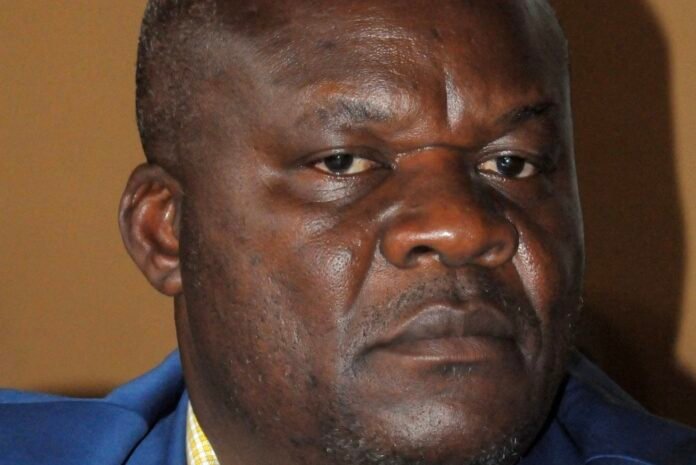
A French criminal court has sentenced former Congolese rebel leader Roger Lumbala to 30 years in prison after finding him guilty of complicity in crimes against humanity committed during the Second Congo War, court officials confirmed on Monday.
The ruling follows a landmark trial that international justice advocates say represents a significant expansion of accountability for atrocities committed during one of Africa’s deadliest conflicts. Prosecutors had pushed for a life sentence, arguing that Lumbala bore senior responsibility for widespread abuses.
Presiding judge Marc Sommerer said the court concluded that Lumbala ordered, facilitated or knowingly supported acts including:
Torture and other inhumane treatment
Summary executions
Sexual violence amounting to torture and sexual slavery
Forced labour
Looting and pillage
The crimes were linked to a military campaign known as “Erasing the Board”, carried out in 2002 and 2003 in northeastern Democratic Republic of Congo.
At the time, Lumbala led the Rally for Congolese Democracy–National (RCD-N), a Uganda-backed armed group that operated alongside the Movement for the Liberation of the Congo (MLC). The campaign targeted civilians from the Nande and Bambuti communities, who were accused of supporting rival militias.
Lumbala, now 67, was arrested in January 2021 under France’s universal jurisdiction laws, which allow French courts to prosecute crimes against humanity even when committed outside France. His trial began last month. He refused to testify, disputing the legitimacy of the French court, but was present when the verdict was delivered. His lawyer, Hugues Vigier, declined to comment after the ruling.
The Second Congo War, which lasted from 1998 to 2003, involved nine African countries and resulted in the deaths of more than five million people, many from hunger and disease. While several cases linked to the conflict have been heard at the International Criminal Court, this trial marked the first time a Congolese national has been prosecuted by a national court for crimes connected to the war.
Legal experts say the case demonstrates how national courts can complement international tribunals. Yasmine Chubin, legal director at the Clooney Foundation for Justice, which participated in the proceedings as a civil party, said universal jurisdiction broadens avenues for justice by allowing more arrests than the limited number pursued by the ICC.
Among those who testified was Pisco Paluku Sirikivuya, a nurse from Mambasa in eastern Congo, who travelled to Paris to recount abuses committed by RCD-N fighters in Ituri province, including the killing of his uncle and attacks on civilians.
“I am moved and very satisfied with this verdict. We have waited so long,” Sirikivuya said after the judgment.
“We hope this serves as a warning to those who continue to bring suffering to the people of Congo, especially in Ituri.”
The ruling is expected to resonate beyond France, as human rights groups continue to push for wider use of universal jurisdiction to address unresolved crimes from past conflicts.
Source:Africa Publicity
Read Also…
Kenya Endorses Two New State Funds to Finance Infrastructure Without More Debt
M23 Claims Capture of Burundian Troops as Fighting Escalates in Eastern DR Congo