

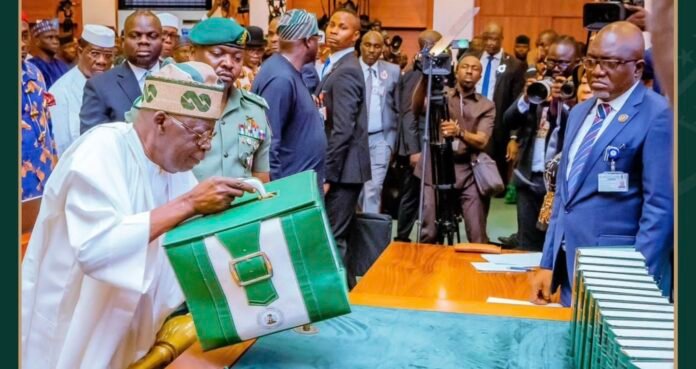
President Bola Tinubu of Nigeria on Friday presented the N58.18 trillion 2026 Appropriation Bill to the National Assembly, proposing N5.41 trillion for defence and security, the largest single allocation in the spending plan.
The proposed figure reinforces a trend that has defined the administration’s fiscal priorities, marking the third consecutive year that security spending has taken precedence over other sectors such as infrastructure, education and health.
Addressing a joint session of the Senate and House of Representatives, Tinubu said sustained investment in security was critical to economic recovery, investor confidence and social stability, particularly amid ongoing threats from terrorism, banditry and kidnapping.
“Security is the bedrock of development,” the President told lawmakers, adding that growth in other sectors would remain fragile without peace and stability across the country.
Budget Framework and Key Allocations
The presentation followed an emergency meeting of the Federal Executive Council earlier in the day, chaired by Vice President Kashim Shettima, where the 2026 budget framework was approved. Total expenditure was pegged at N58.47 trillion, reflecting rising pressures from debt servicing, personnel costs and security operations.
Under the proposal:
Defence and security: N5.41 trillion
Infrastructure: N3.56 trillion
Education: N3.52 trillion
Health: N2.48 trillion
The security allocation again places the sector ahead of all others, continuing the pattern seen in the 2024 and 2025 budgets.
Focus on Modernisation and Intelligence
Tinubu said the funds would be used to modernise the armed forces, improve intelligence-led policing, strengthen border surveillance and enhance coordination among security agencies.
“We will invest in security with strict accountability. Security spending must translate into real security outcomes,” he said.
He also announced plans to overhaul Nigeria’s national security framework, including the introduction of a new counter-terrorism doctrine based on unified command structures, stronger intelligence sharing and community-level stabilisation.
Tougher Stance on Armed Groups
As part of the proposed reset, the President declared that all armed groups operating outside state authority—such as bandits, kidnappers, militias, violent cult groups and armed gangs—would be formally designated as terrorists. He said their financiers, informants and enablers would also fall under the same classification.
According to Tinubu, the move is aimed at closing legal and operational loopholes that have allowed violent groups to persist.
Balancing Security and Development
While acknowledging the strain on public finances, the President argued that prioritising security was unavoidable and closely linked to broader development goals.
“Without security, investment cannot thrive. Without education and health, productivity will suffer. And without infrastructure, jobs and enterprise cannot expand,” he said.
Tinubu urged lawmakers to give speedy consideration to the budget proposal, describing it as a key instrument for consolidating recent economic reforms and restoring public confidence in the government’s ability to protect lives and property.
Source:Africa Publicity