
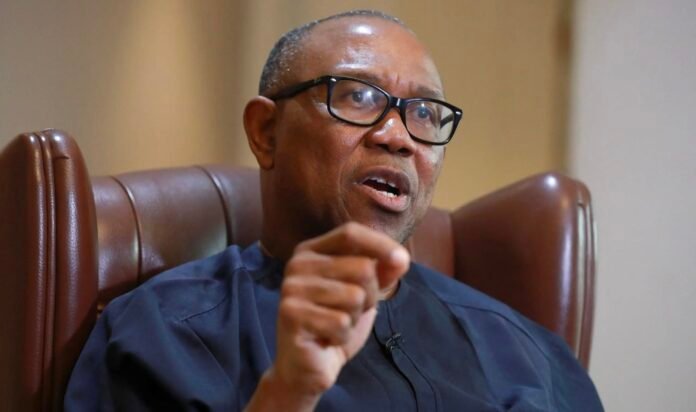
Former Anambra State Governor Peter Obi has cautioned that Nigeria risks deepening hardship and weakening national unity if it continues to impose heavier tax burdens on an already impoverished population. He stressed that sustainable economic growth must be built on honesty, transparency, and productivity, not by extracting more from the poor.
Obi made the remarks in a statement shared on X, addressing taxation, leadership responsibility, and the social contract between government and citizens. Drawing on his experiences with leaders worldwide, he said transformative nations thrive because their leaders unite citizens around a shared vision anchored on truth.
“As I travel the world and meet leaders who have transformed their nations, one lesson is clear: lasting economic and social progress begins with national consensus. Transformative leaders share a defining quality, honesty. Government must be transparent and truthful because citizens deserve nothing less from those who lead them,” Obi said.
Taxation as a social contract
Obi emphasized that taxation should function as a genuine social contract, grounded in fairness, clarity, and concern for citizens’ welfare. He warned that opaque or punitive tax policies risk becoming instruments of confusion rather than drivers of development.
“If taxation is to function as a genuine social contract, it must be rooted in sincerity, fairness and concern for the welfare of the people. Without transparency, taxation becomes a tool of confusion and burden rather than a mechanism for growth and development,” he said.
He further argued that Nigeria’s fiscal challenge is not merely about raising revenue, but about empowering citizens and enabling economic growth. Obi noted that Nigerians are being asked to pay higher taxes without explanation or visible public benefits, undermining trust in government.
Empowering small businesses
Highlighting the role of entrepreneurship, Obi said small and medium-sized enterprises (SMEs) are the foundation of sustainable growth.
“The solution begins with empowering small and medium-sized enterprises in every community. You cannot tax your way out of poverty; you must produce your way out of it,” he said.
Thriving SMEs, he explained, create jobs, raise incomes, and naturally expand the tax base, offering a far more sustainable path to prosperity than increasing levies on the poor.
Alleged tax law irregularities
Obi also raised concerns over what he described as a potentially forged tax law, claiming that the version currently in use does not match the one passed by the National Assembly. He noted that reports indicate the legislature itself acknowledged discrepancies between the approved and gazetted versions.
“For the first time in Nigeria’s history, a tax law has reportedly been forged. Yet citizens are being asked to pay higher taxes under this manipulated framework, without transparency, explanation or corresponding benefits,” he said.
He warned that celebrating increased government revenue while citizens grow poorer represents a failure of governance rather than success.
“There is no virtue in celebrating increased government revenue while the people grow poorer. Any tax system that makes citizens poorer violates the fundamental principles of good governance and sound fiscal policy,” Obi stated.
Obi’s statement underscores the need for tax reforms that prioritize transparency, fairness, and citizen welfare, alongside policies that boost production and empower local businesses, as a pathway to genuine national prosperity.
Source: Africa Publicity