

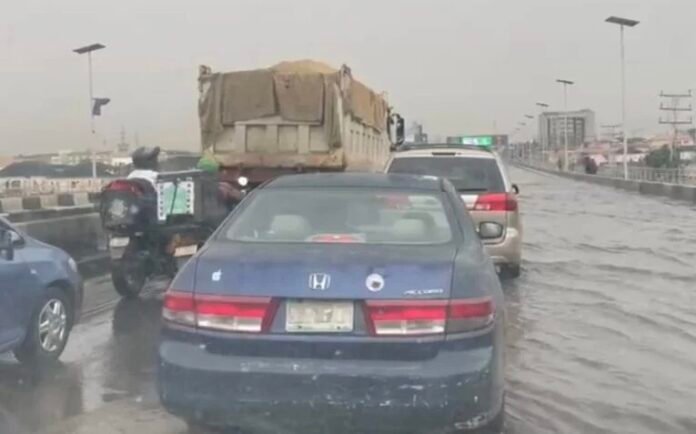
A brief spell of rainfall in Lagos on Friday resulted in unexpected disruption for motorists and commuters after floodwater collected on the Odo Iyaloro Bridge near Maryland, bringing traffic to a near standstill for several hours. The incident once again highlighted concerns about urban drainage maintenance and the vulnerability of key transport routes in Nigeria’s commercial capital, even during relatively mild weather conditions.
Eyewitnesses and road users reported that the rainfall itself was not intense, yet water quickly gathered on the bridge surface instead of flowing away through drainage outlets. Many motorists pointed to blocked or poorly maintained drainage channels as the primary cause of the flooding, arguing that routine clearing and infrastructure upkeep could have prevented the buildup. The stagnant water reduced lane space and forced vehicles to slow down significantly, creating long queues that stretched far beyond the immediate area.
Traffic Impact Across Major Routes
The congestion did not remain confined to the bridge. As vehicles struggled to pass through the flooded section, traffic spilled onto adjoining highways and arterial roads, including parts of the Lagos–Ibadan Expressway and Ikorodu Road. Drivers heading toward Maryland, Ikeja, and nearby districts experienced prolonged delays, with some commuters reporting extended travel times well beyond their usual schedules. Commercial bus operators, private car owners, and delivery vehicles were all affected, leading to missed appointments and disrupted business activities during peak daytime hours.
Transport observers noted that the Odo Iyaloro Bridge is a critical link for daily movement within the metropolis, connecting residential zones with business and industrial areas. When such a corridor becomes partially inaccessible, even for a short period, the ripple effect can paralyze surrounding routes due to Lagos’ already dense traffic patterns. The incident underscored how a localized infrastructure problem can quickly escalate into a citywide mobility challenge.
Commuter Experiences and Public Reaction
Several stranded commuters expressed frustration over what they described as a recurring problem during the rainy season. Some passengers were seen disembarking from commercial vehicles to walk across certain stretches in an attempt to reach connecting transport faster. Others remained inside vehicles for extended periods as drivers navigated the waterlogged portion cautiously to avoid engine damage or accidents.
Drivers interviewed at the scene largely agreed that the situation was preventable. They cited clogged gutters, debris accumulation, and insufficient drainage capacity as recurring issues that often go unaddressed until severe flooding occurs. A number of road users urged municipal agencies and environmental maintenance teams to adopt more proactive clearing schedules, especially ahead of forecast rainfall periods.
Infrastructure and Maintenance Concerns
Urban planning experts frequently emphasize that effective drainage systems are essential in coastal and high-rainfall cities such as Lagos. Even moderate showers can lead to water retention if channels are obstructed by refuse, sediment, or construction debris. Over time, neglected drainage networks reduce their discharge efficiency, increasing the likelihood of flash flooding on roads and bridges.
The Maryland axis has previously experienced periodic waterlogging, particularly during the rainy months, making the latest incident part of a broader pattern rather than an isolated occurrence. While large-scale flooding often draws attention, smaller but frequent disruptions like this can cumulatively impact productivity, fuel consumption, and public safety.
Calls for Preventive Measures
In the aftermath of Friday’s gridlock, motorists and local residents renewed calls for improved road and drainage maintenance. Suggestions from the public included regular desilting of gutters, enforcement against illegal dumping of waste into waterways, and periodic inspections of critical transport infrastructure. Some also advocated for better traffic management responses during sudden weather-related disruptions, such as deploying traffic officers promptly to redirect vehicles and reduce bottlenecks.
Although the rainfall was described as light, the resulting standstill demonstrated how quickly urban transportation systems can be overwhelmed when supporting infrastructure underperforms. For many Lagos commuters, the episode served as another reminder that preventive maintenance and coordinated planning remain key to ensuring smoother mobility in one of Africa’s busiest cities.
Source: Africa Publicity