

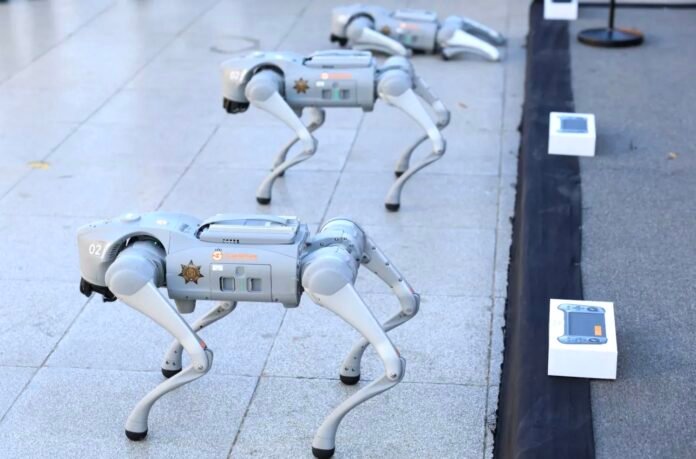
Mexican authorities have announced plans to deploy robotic dogs to support police operations during the 2026 FIFA World Cup, as part of enhanced security measures aimed at protecting officers and spectators during the global football tournament.
The announcement was made on Monday, February 10, with officials confirming that the four-legged robotic units will be used to assist law enforcement in high-risk and hard-to-access locations, particularly around World Cup venues. The robots are designed to enter potentially dangerous environments ahead of human officers and transmit live video footage back to command teams in real time.
The 2026 World Cup, scheduled to run from June 11 to July 19, will be jointly hosted by Mexico, the United States, and Canada, marking the first time three countries have co-hosted the tournament. Mexico is expected to host several high-profile matches, drawing thousands of international visitors and significantly increasing security demands.
Robots Purchased for Monterrey Metropolitan Area
The robotic dogs were acquired by the Guadalupe city council, part of the Monterrey metropolitan area in northern Mexico. Guadalupe will host one of the tournament’s official venues, the BBVA Stadium, which will be temporarily renamed Estadio Monterrey for the duration of the World Cup. The stadium is scheduled to host four matches during the competition.
According to local authorities, the robotic units were purchased at a cost of 2.5 million pesos, reflecting a growing investment in technology-driven policing as cities prepare for large-scale international events.
Capabilities and Demonstration
In a demonstration video released by the local government, one of the robot dogs is shown navigating an abandoned building, walking on four mechanical legs and climbing stairs—albeit with visible difficulty. The footage highlights the robot’s ability to move through confined and potentially unsafe spaces without putting officers at immediate risk.
The robot is also seen transmitting live video images to police officers following behind at a safe distance. In the demonstration scenario, the robotic unit encounters an armed individual and issues a verbal command through a built-in loudspeaker, instructing the person to drop the weapon.
Authorities stressed that the demonstration was meant to showcase the robot’s technical capabilities rather than represent a real-world encounter.
Purpose: Officer Safety and Early Assessment
Mayor of Guadalupe, Héctor García, explained that the robotic dogs are intended to serve as a first-response support tool rather than a replacement for police officers.
“The purpose of these robots is to support police officers during initial interventions, especially in situations where there may be a threat,” García said. “The priority is to protect the physical safety of officers.”
He added that the robotic units would be deployed only in specific situations, such as suspected altercations, abandoned structures, or locations where police visibility and safety could be compromised.
Part of Broader World Cup Security Strategy
Security preparations for the 2026 World Cup are expected to be extensive, given the size of the tournament and the number of host cities across three countries. In Mexico, federal, state, and municipal authorities are coordinating efforts to manage crowd control, prevent crime, and respond quickly to emergencies.
The use of robotic dogs reflects a broader global trend in policing, where technology such as drones, body cameras, facial recognition systems, and robotic surveillance tools are increasingly being introduced to enhance situational awareness and reduce risks to personnel.
Officials emphasized that the robots will operate under human control and supervision at all times, with decisions remaining in the hands of trained officers.
Public Reaction and Oversight
While authorities have promoted the initiative as a safety-focused innovation, the deployment of robotic surveillance tools has also raised questions in other countries about privacy, accountability, and appropriate use of force. Mexican officials have not indicated any plans for the robots to be armed, stating that their primary role is observation, communication, and reconnaissance.
As the World Cup approaches, local governments are expected to provide further details on how the technology will be integrated into broader security operations.
With millions of fans expected to attend matches and related events, officials say the goal is clear: use technology to improve preparedness, reduce risks, and ensure a safe environment for players, visitors, and residents during one of the world’s largest sporting events.
Source: Africa Publicity