

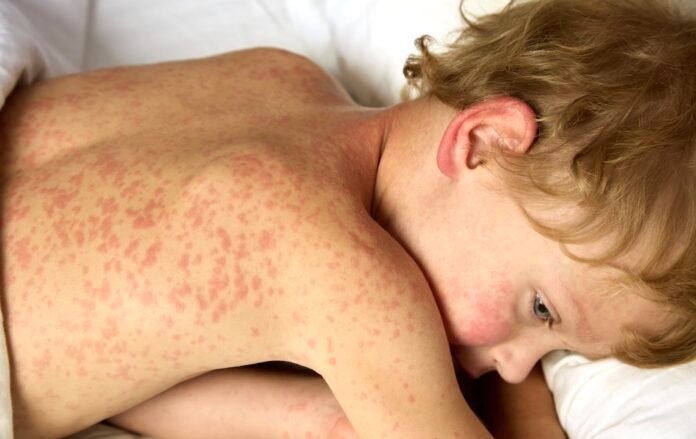
A growing measles outbreak in the United Kingdom is forcing children, especially in London, to potentially miss up to three weeks of school as health officials work to contain the highly contagious virus.
Nearly 100 cases have been confirmed so far in 2026, with the majority affecting primary school-aged children. Enfield, in north London, is among the hardest-hit areas. Local guidance warns that unvaccinated pupils who come into contact with someone infected may be required to stay home for 21 days.
Dudu Sher-Arami, Enfield Council’s Director of Public Health, wrote to parents: “If your child is identified as being a close contact of a person with measles and they are unvaccinated, they may be excluded from school for 21 days.” Families are also being urged to self-isolate if they suspect measles infection to prevent further transmission.
The outbreak has been linked to declining uptake of the measles, mumps, and rubella (MMR) vaccine, which has fallen to 84%—the lowest level in more than a decade. The World Health Organization recently revoked the UK’s measles-free status following thousands of confirmed cases in 2024 and continued high numbers in 2025.
According to the UK Health Security Agency, 96 cases were recorded by early February 2026, with 77% occurring in children under 10. Nearly two-thirds of infections were in London, more than half of those concentrated in Enfield. Several schools have reported multiple cases, with some children requiring short hospital stays.
Councillor Alev Cazimoglu said: “The surge has mainly affected children, and some have needed additional care with brief hospital admissions.” National guidance advises that unvaccinated close contacts, including siblings and classmates, self-exclude during the risk period. Headteachers may also consider excluding exposed unvaccinated pupils to protect other students.
Measles is one of the world’s most infectious diseases, capable of spreading to up to 18 unvaccinated people from a single case. Symptoms usually start like a cold before a red rash appears. In vulnerable children, complications can include pneumonia, blindness, and other life-threatening conditions.
Health officials are urging families to ensure vaccinations are current. Dr Ash Banerjee, NHS England public health consultant, said: “Half term offers a natural pause for families, which is a good opportunity to check whether vaccinations are up to date. Parents should seek advice about the new MMRV vaccine, which protects against measles, mumps, rubella, and chickenpox.”
Dr Vanessa Saliba of the UKHSA added: “Infections can return quickly when childhood vaccine uptake falls. Measles elimination is only possible if all eligible children receive two MMRV doses before starting school.”
The outbreak highlights the urgent need for vaccination and vigilance as schools and communities work to curb the spread of this highly contagious disease.
Source: Africa Publicity