
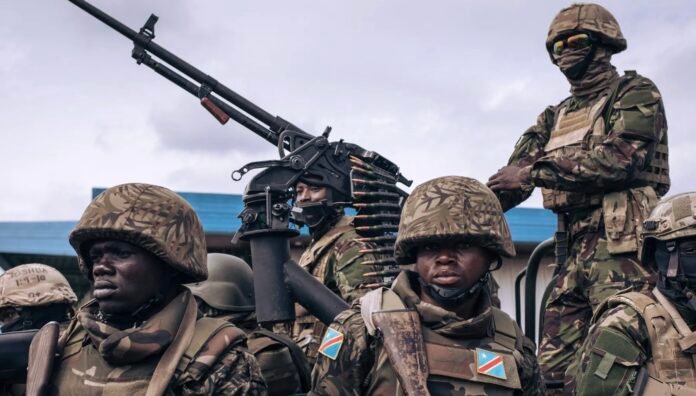
In eastern Democratic Republic of Congo (DRC), the M23 rebel group is deepening its control over territories it seized earlier this year, even as U.S.-brokered peace initiatives and international mediation continue to unfold. The group is creating a parallel administration with the characteristics of a fledgling state, raising concerns about the future of national unity and stability in Congo.
Training the Civilian Frontline
In September, near Rutshuru in North Kivu province, hundreds of civilians participated in a two-week training program led by M23 commander Sultani Makenga. Video footage and participant accounts show Makenga addressing the trainees: “Do you understand that only force can free the country from misrule by Kinshasa?” The assembled participants responded in unison, “Yes, Commander.”
Unlike combatants, these new recruits—referred to as “civilian executives”—will not serve in frontline combat roles. Instead, they are being groomed to implement governance and administrative functions across rebel-held territories. Training included basic military exercises, but the primary focus was on Congo’s historical challenges and the establishment of a federal governance system rooted in M23’s stated values: commitment, discipline, sacrifice, and determination.
The course drew on a 32-page M23 charter, which had not previously been publicly reported. According to the document, the group envisions a decentralized state with free movement of goods and people, once peace and stability are restored.
Peace Talks and Continued Fighting
Earlier this month, U.S. President Donald Trump hosted a signing ceremony in Washington, where Congo and Rwanda reaffirmed their commitment to peace. While M23 is not a party to that agreement, it is participating in separate peace negotiations in Doha, Qatar. Observers note that the rebels are using these talks to consolidate power rather than surrender territory.
Reuters reporting confirms that M23’s military force has roughly tripled over the past year, with thousands of new fighters deployed to secure the areas under its control. The group has also installed hundreds of loyal officials, including provincial governors and city administrators in major towns such as Goma and Bukavu. Infrastructure projects, taxation of coltan-rich mines, and the issuance of travel visas reflect a deliberate effort to create a self-sustaining administration independent of Kinshasa.
Implications for Congo’s Stability
Analysts warn that Congo risks a lasting fracture, with M23 governing swathes of the east and implementing strict rules for residents. “There’s no way they’re going to implement any of the peace deals,” said Jason Stearns, a Congo specialist and former U.N. panel expert. Fred Bauma of the Congolese research group Ebuteli added that the group is managing diplomatic pressures while buying time to reorganize and strengthen its forces.
Both M23 and the Congolese government have been slow in negotiations. The government has made few concessions despite losing territory, and clashes continue. M23 justifies its presence by citing the collapse of state institutions and the need to provide security and services. The group, which forms the core of the broader Alliance Fleuve Congo coalition, denies being a Rwandan proxy, although diplomats and U.N. experts have documented Rwandan involvement in training camps.
Historical Context and Regional Dynamics
Congo has faced decades of conflict, much of it linked to the 1994 Rwandan genocide and the ensuing influx of Hutu militias. Rwanda, dominated by ethnic Tutsis like M23, has historically intervened in the region under the guise of security. U.S. officials have urged the full restoration of Congo’s authority over its territory, requiring Congo to neutralize the Hutu Democratic Forces for the Liberation of Rwanda (FDLR) while Rwanda withdraws any troops present.
M23’s origins trace back to a 2009 peace deal that was never fully implemented. Since then, the group has repeatedly attempted to seize territory, including the temporary capture of Goma in 2012. This time, M23 has vowed not to repeat past mistakes and is systematically building both military and civilian capacities to maintain control.
Looking Ahead
M23’s state-building project has already reshaped eastern Congo. The rebels have recruited over 9,000 fighters, restructured local governance, and replaced more than 20 traditional community leaders with compliant officials. While residents acknowledge that M23 has brought some order, the group’s entrenchment raises the prospect of prolonged instability and a fragmented state.
Observers and policymakers worldwide are now closely monitoring the region, recognizing that the outcome of M23’s consolidation efforts and the Doha peace process could define the future political structure of Congo.
Source:Africa Publicity