

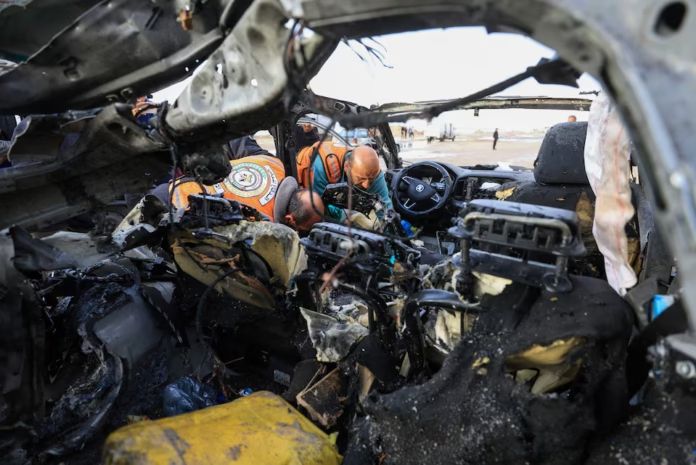
Israel said on Saturday that its forces killed Raed Saed, a senior Hamas military commander and key figure behind the October 7, 2023 attacks on Israel, in an airstrike targeting a vehicle in Gaza City. If confirmed, the operation would mark the most prominent killing of a Hamas leader since a ceasefire agreement came into force last October, raising fresh questions about the durability of the truce.
According to the Israeli military, Saed was struck while travelling in a car in Gaza City. Gaza health authorities said the attack killed five people and wounded at least 25 others, though they did not identify the individuals killed. Hamas has not confirmed Saed’s death, and medical officials in Gaza have also not independently verified Israel’s claim.
Israeli Justification and Official Response
In a joint statement, Prime Minister Benjamin Netanyahu and Defence Minister Israel Katz said the strike was carried out in direct response to a Hamas attack earlier on Saturday, in which an explosive device wounded two Israeli soldiers. The Israeli leadership said the operation was aimed at preventing further attacks and degrading Hamas’s military capabilities.
An Israeli military official described Saed as a high-ranking commander who played a central role in establishing and expanding Hamas’s weapons production infrastructure. According to the official, Saed had recently been involved in efforts to rebuild Hamas’s operational capacity and arms manufacturing networks, activities Israel said constituted a “blatant violation” of the ceasefire terms.
Israeli officials argue that the truce does not protect individuals they consider to be actively planning or directing attacks, even during periods of reduced hostilities.
Hamas Reaction and Ceasefire Concerns
Hamas condemned the strike, calling it a violation of the ceasefire agreement, but stopped short of explicitly confirming Saed’s fate or announcing retaliation. The group’s statement reflected a cautious tone, suggesting an effort to avoid immediate escalation while signalling that Israel’s actions could undermine the fragile calm.
Sources within Hamas have previously described Saed as the deputy commander of the group’s armed wing, second only to Izz el-Deen al-Haddad. He is also reported to have led Hamas’s Gaza City battalion, one of its largest and most heavily equipped units prior to Israel’s military campaign.
The lack of confirmation from Hamas has left uncertainty around the full impact of the strike, but the incident has already drawn attention because of its timing and the seniority of the alleged target.
A Ceasefire Under Strain
The ceasefire, which took effect on October 10, has brought a significant reduction in large-scale fighting after nearly a year of devastating conflict. Under the agreement, Israeli forces withdrew from several positions in Gaza City, allowing hundreds of thousands of displaced Palestinians to return to neighbourhoods reduced to rubble. Humanitarian aid deliveries have also increased, easing shortages of food, medicine and fuel.
However, the truce has been repeatedly tested. Palestinian health authorities say that since the ceasefire began, at least 386 people have been killed in Israeli strikes across Gaza. Israel, for its part, says three of its soldiers have died during the same period and that it has carried out operations against dozens of fighters it accuses of violating the agreement.
Israeli officials have consistently maintained that the ceasefire does not amount to a full end to hostilities and that they reserve the right to act against perceived threats.
Background to the Conflict
The war in Gaza erupted after Hamas-led militants launched an unprecedented cross-border attack into southern Israel on October 7, 2023, killing about 1,200 people, most of them civilians, and abducting 251 hostages. The attack shocked Israel and prompted a massive military response aimed at dismantling Hamas.
Since then, Gaza health authorities say more than 70,700 Palestinians have been killed in Israel’s offensive, with civilians accounting for the majority of casualties. Large areas of Gaza have been destroyed, and much of the population has been displaced multiple times.
International efforts to secure a lasting ceasefire have repeatedly stalled, with disagreements over hostages, security guarantees and post-war governance of Gaza.
Regional and International Implications
The reported killing of Saed is likely to draw scrutiny from international mediators who helped broker the ceasefire, as well as from regional actors concerned about a renewed escalation. Analysts say targeted killings during a truce risk triggering retaliatory attacks, even if both sides claim to be acting defensively.
At the same time, Israel faces domestic pressure to demonstrate that Hamas’s leadership and military infrastructure remain under sustained pressure, particularly from families of victims of the October 7 attack.
Whether this incident becomes a turning point or remains a contained flare-up will depend largely on Hamas’s response and on behind-the-scenes diplomatic efforts to keep the ceasefire intact.
For now, the strike underscores how fragile the current calm remains—and how quickly the Gaza conflict could slide back into wider violence despite months of painstaking negotiations.
Source:Africa Publicity