

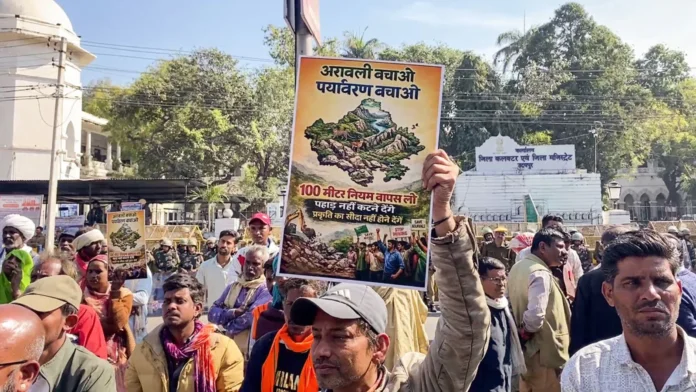
The Aravalli range has become a major flashpoint in Rajasthan as protests intensify across the state following a new uniform definition of the hills. Critics warn that the new criteria could leave more than 90 per cent of the 692-km-long range vulnerable to destructive mining and construction activities.
The outrage follows the Supreme Court’s November 20 decision to accept a definition recommended by a Centre-led panel, which classifies “Aravalli Hills” only as landforms at an elevation of 100 metres or more above the local relief.
Protests and Police Clashes
On Monday, demonstrations broke out in major cities including Jodhpur, Udaipur, and Sikar, leading to violent clashes with law enforcement.
- Jodhpur: Police resorted to a baton charge and detained several agitators.
- Sikar: Protesters scaled Harsh Mountain (945m) to voice their opposition.
- Political Reaction: Chief Minister Bhajan Lal Sharma assured the public he would not allow tampering with the range, while simultaneously dismissing former CM Ashok Gehlot’s ‘Save Aravali’ social media campaign as “theatrics.”
‘The Death of the Aravalli’
Environmentalists and human rights groups are calling on the state government to file a review petition. Kavita Srivastava, president of the People’s Union for Civil Liberties, described the judgment as unacceptable, noting that the range has already been devastated for the development of Delhi and Gurgaon.
Rajendra Singh, a Magsaysay awardee and renowned “Waterman of India,” warned in his book Aravali Par Naya Sankat that the 100m limit is a strategic threat. According to data cited by Singh:
- Total Protection Area: Only 8.7 per cent of the Aravalli landscape sits above 100 metres.
- Vulnerable Zone: The remaining 91.3 per cent—where many tribal and local communities have their homes, farms, and cultural sites—would lose its status as protected “hill” territory.
Heritage Under Threat
Singh noted that while legal battles in the early 1990s had once made the Aravallis virtually mining-free, the mining lobbies have regained significant power over the last decade. He argues that the new definition, framed under the guise of “sustainable development,” is an “eye-opener” that creates a new threat to an ancient heritage.
As the Congress party and other opposition leaders mobilize public support through rallies in Jaipur, the environmental and social ramifications of this ruling continue to dominate the political landscape in Rajasthan.
Source: The Indian Express
Related Posts:
Indian Visa Application Centre Suspends Operations in Chittagong Following Security Incidents
Extended US Vetting Rules Trigger Long Delays for Indian H-1B, H-4 Visa Applicants
India-US Trade Report: Exports Surge 22% in November Despite US Tariffs